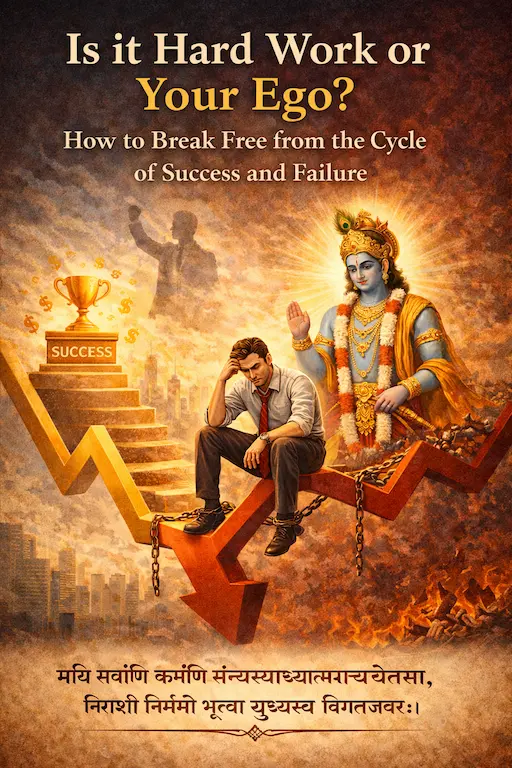
We all work hard in life. But if you pause for a moment and look closely, you’ll notice something—along with every action, we carry a hidden weight. It’s not just the work. It’s the constant thought: What if I fail? What if I succeed… and can’t handle it? What will people think? What will I get out of this?
And slowly, this “thinking” becomes heavier than the work itself.
Have you ever felt this?
That the tiredness is not from what you’re doing, but from everything going on in your head while doing it?
That’s where the real confusion begins.
In the Bhagavad Gita, Krishna addresses this very point:
मयि सर्वाणि कर्माणि संन्यस्याध्यात्मचेतसा ।
निराशीर्निर्ममो भूत्वा युध्यस्व विगतज्वरः ॥
(Chapter 3, Verse 30)
At first glance, it might sound philosophical. But if you slow down and really look at it, it’s very practical.
It doesn’t tell you to stop working.
It tells you to stop carrying unnecessary weight while working.
The problem is not the work.
The problem is the “I” we attach to it.
The moment we say, “I am doing this,” something else quietly enters—expectation. And with expectation comes pressure. With pressure comes fear. And with fear, the mind becomes restless.
So it’s not just the action we are dealing with.
We are dealing with everything we have attached to that action.
Now think about this—
if the work is no longer “mine,” what exactly are you afraid of?
The fear of failure starts to loosen.
Even the pressure of success feels lighter.
This is what the verse is pointing toward.
But let’s be clear—this doesn’t mean you should stop caring. It doesn’t mean you should become careless or stop having goals. That’s not the message.
It’s about shifting your relationship with what you do.
You still give your best.
You still work with full honesty.
But you don’t tie your peace to the outcome.
There’s another important word here—“nirmamo”, which means reducing the feeling of “mine.”
Just pause and ask yourself—
are you really doing the work, or are you constantly trying to prove something through it?
Because many times, we are not just working.
We are trying to protect our image, our identity, our ego.
And that’s where the burden begins.
Now imagine doing the same work, but with a different mindset.
Not as something that defines you, but as something you are responsible for.
Not as “my success” or “my failure,”
but as something you are simply giving your best to.
Wouldn’t that feel lighter?
And yes, it actually makes a difference.
When you work with this sense of letting go, something changes inside. You are still focused, but not tense. You are still committed, but not afraid. There is effort, but no inner struggle.
This is what “vigata-jvara” means—working without that inner fever, that constant anxiety.
Let’s bring this into real life.
Imagine you’re running a business. Every decision feels heavy because you’re constantly thinking, “What if this goes wrong?” That fear slows you down.
Now shift the mindset—“I will do my best, and I will learn from whatever happens.”
The same work, but now there’s clarity instead of fear.
Or think about content creation. You put in effort, but results don’t always show up immediately. If your mind keeps asking, “Why am I not getting recognition?”, you’ll burn out.
But if you focus on showing up, creating value, and doing your part, you stay consistent. And over time, that consistency changes everything.
So ask yourself one honest question—
am I just working, or am I carrying my ego along with my work?
If it’s the second one, that might be the real source of your stress.
Slowly, when you begin to see yourself as just a part of the process—not the owner of every outcome—something settles inside. The work remains the same. The effort remains the same. But the pressure fades.
And maybe that’s the real message of this teaching—
keep doing what you need to do, but don’t carry yourself as the center of everything.
Offer the work. Do it fully.
And then let it go.
Because the moment the “I” becomes lighter,
peace quietly begins to grow within.
And honestly, that’s what real strength feels like.
Related Reading:
➔ Is Attachment Really the Problem? Understanding Gita 3.19
“What’s the Real Reason Behind the Fear of Success and Failure?”
📅 Published: 9 अप्रैल 2026