Be honest — when was the last time you sat in complete silence for even five minutes without reaching for your phone? No scrolling, no music, no podcast. Just you and your own mind. And if you tried, how long did it last before the thoughts came rushing in — work, worries, memories, plans? That experience is not a personal failure. It is what happens when the mind has spent years running outward and has never been shown how to come home.
Most of us know we should meditate. We have heard it enough times. But when we actually sit down to try, the mind refuses to cooperate. It jumps from thought to thought, scene to scene, worry to worry. After a few minutes of frustration, we give up — "meditation is not for me." And we go back to the scroll.
The problem is not that we cannot meditate. The problem is that nobody told us where to begin. In the twenty-seventh verse of the fifth chapter, Krishna gives us exactly that — not philosophy, not theory, but a precise, step-by-step method for how the inner journey actually starts. Five thousand years old. Still completely relevant today.
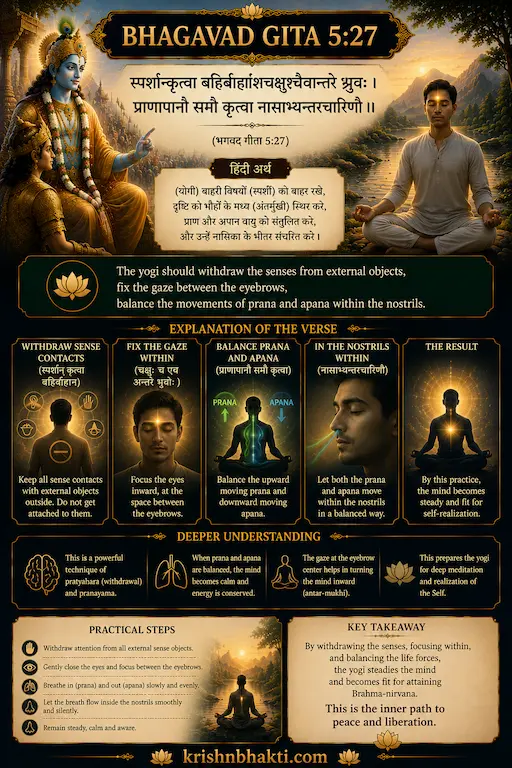
स्पर्शान्कृत्वा बहिर्बाह्यांश्चक्षुश्चैवान्तरे भ्रुवोः ।
प्राणापानौ समौ कृत्वा नासाभ्यन्तरचारिणौ ॥ ५.२७ ॥
What Is Krishna Actually Saying?
Krishna gives three instructions — keep external sense objects outside the mind, fix the inner gaze between the two eyebrows, and equalize the incoming and outgoing breath moving within the nostrils.
Three steps. Withdraw the senses. Anchor the attention. Balance the breath. This is the preparation for deep meditation — the foundation that everything else rests on. This verse connects directly to verse 5.28, which reveals what this practice leads to. Here, Krishna is showing us the door. The next verse shows us what is on the other side.
Sadhak Sanjivani — Swami Ramsukhdas Ji
In Sadhak Sanjivani, Swami Ramsukhdas Ji explains that sparshan kritva bahih does not mean closing your ears or blocking out sound. It means not letting those external inputs enter the mind and pull it outward. A sound may happen — but the mind does not chase it. Someone may walk past — but the mind does not follow. This is pratyahara — withdrawal — and it is entirely an inner act, not an outer one.
On fixing the gaze between the eyebrows, Swami Ji says — wherever the eyes go, the mind follows. When the gaze turns inward, the mind naturally moves inward too. This is why directing awareness to the ajna point — with eyes closed — is one of the most direct ways to pull the mind back from the external world and anchor it inside.
On pranапanau samau, he points to a truth that modern science has confirmed — breath and mind are directly linked. An agitated mind produces fast, shallow breath. A slow, even breath produces a calm mind. This is why breath is the first tool — it is the one thing we can consciously regulate that immediately affects our inner state.
Prabhupada — Bhagavad Gita As It Is
Srila Prabhupada in Bhagavad Gita As It Is places this verse within the context of ashtanga yoga — specifically pratyahara and dharana, the fifth and sixth limbs. He says Krishna is here describing the inner preparation that must come before real meditation is possible. Without first withdrawing the senses and fixing the mind, meditation remains a struggle.
He says the senses naturally run outward — the way water flows downhill. Turning them upward, toward the soul, is the entire work of yoga. And this cannot be done by force alone. The mind needs something more compelling than the world to turn toward. That something, Prabhupada says, is Krishna.
He makes a beautiful point — in Krishna consciousness, this process happens naturally. When the mind is genuinely absorbed in Krishna, external things lose their pull without any struggle. The devotee does not fight against the senses — they are simply drawn inward by something greater. This is why bhakti, for Prabhupada, is the most complete and natural form of pratyahara.
Swami Mukundananda Ji's Perspective
Swami Mukundananda Ji speaks directly to where most of us actually live. He says — our senses today face a level of outward pull that has probably never existed before in human history. Every minute, something is competing for our attention — a notification, a reel, a headline, a conversation. In this environment, sparshan kritva bahih — keeping the world outside the mind — is both more necessary and more difficult than it has ever been.
On the practice of fixing awareness between the eyebrows, Swami Ji explains that this corresponds to the ajna chakra — and interestingly, modern neuroscience identifies the prefrontal cortex, located in this region, as the center of focused attention and emotional regulation. When awareness is brought here, concentration deepens naturally and quickly.
For the breath, he offers the simplest possible starting point — sit for ten minutes each morning before touching your phone. Close your eyes. Do not try to control the breath. Simply watch it — in and out. That one act of witnessing, done daily, is the beginning of everything this verse describes. Start there. Everything else builds from that.
What Does This Look Like in Real Life?
Try this tomorrow morning — before you reach for your phone, sit for five minutes. Eyes closed. Bring your awareness gently to the space between your eyebrows. Feel your breath moving in and out. Nothing else. No mantra, no technique, no pressure. Just five minutes. Do it for one week and notice what changes — not dramatically, but quietly, in the texture of your mornings.
During the day — before a big meeting, after a difficult conversation, in a moment where everything feels like too much — close your eyes for two minutes and take three slow, deep breaths. That is this same practice in miniature. The technique scales down to fit any moment. And even two minutes of this brings the mind measurably back to center.
At night before sleep — put the phone down, turn off the light, and spend five minutes simply feeling the breath. This one habit, more than almost anything else, changes the quality of sleep and the quality of the morning that follows. The practice Krishna describes as the doorway to liberation begins exactly here — in these small, ordinary, daily moments.
Questions That Probably Live in Your Heart
Is fixing the gaze between the eyebrows physically safe — does it strain the eyes?
Not at all. The eyes remain closed and relaxed. You are simply directing your inner awareness — your attention — toward that area. There is no physical effort, no strain. Think of it as pointing your focus inward, not moving your eyes anywhere.
How do I actually equalize prana and apana in practice?
Start with equal-ratio breathing — four counts in, four counts out. Gradually the breath becomes longer and more natural. Over time, this equalization happens on its own during practice. The counting is just the training wheels. Once the pattern is established, you will not need it.
My mind wanders every single time — am I doing something wrong?
Swami Mukundananda Ji is clear on this — a wandering mind is not failure. Every time you notice the mind has gone somewhere else and you bring it back, that is one successful repetition of the practice. The returning is the practice. More returns, more progress. There is no session that goes perfectly, and that is completely fine.
Can these principles be applied outside of formal sitting meditation?
Absolutely. Keeping the senses from running outward, balancing the breath, directing attention consciously — these are not only for a meditation cushion. They can be practiced walking, working, waiting, eating. The formal sitting builds the capacity. But the application is meant to spread through the whole day.
This verse feels like it ends mid-thought — what comes next?
Verse 5.27 and 5.28 are one continuous teaching. This verse describes the practice — how to prepare the mind and breath. The next verse reveals the destination — freedom from fear, freedom from craving, and the attainment of Brahma-nirvana. This verse is the door. The next verse is what you find when you walk through it.
📖 Also Read: Bhagavad Gita 5.26 — Freedom From Desire and Anger: The Door to Eternal Peace
🙏 Hare Krishna — Jai Shri Krishna 🙏