In the previous verse, Krishna gave us the method — withdraw the senses, fix the gaze between the eyebrows, balance the breath. Now in this verse, He tells us what that practice leads to. And what it leads to is so complete, so total, that reading it for the first time something quietly stirs inside — could this really be possible?
All of us are living with some kind of fear. Fear of the future, fear of losing someone, fear of failure, fear of being alone. And desires — they never stop. One is fulfilled and another takes its place immediately. This chain never ends. But Krishna is saying here — this chain can end. And when it does, what remains is freedom. Not the freedom of having everything you want — the freedom of needing nothing to be complete.
This verse is the direct continuation of 5.27. That verse was the practice. This verse is the fruit. Together they form one complete teaching — here is how you walk the path, and here is where the path leads.
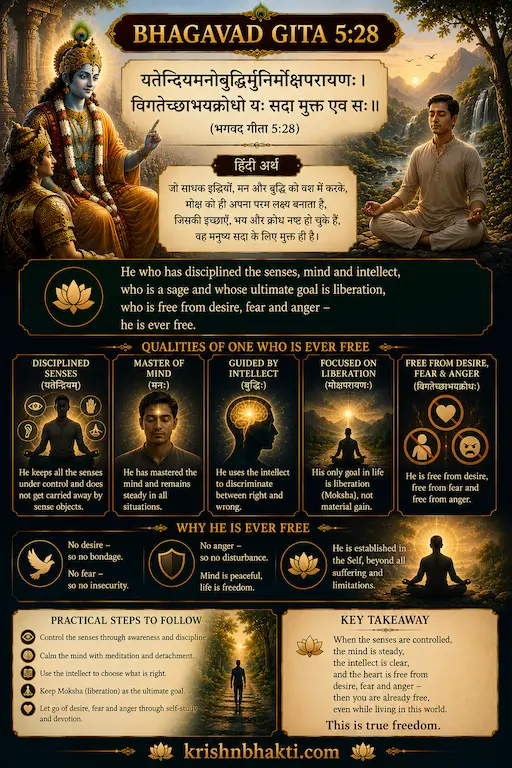
यतेन्द्रियमनोबुद्धिर्मुनिर्मोक्षपरायणः ।
विगतेच्छाभयक्रोधो यः सदा मुक्त एव सः ॥ ५.२८ ॥
What Is Krishna Actually Saying?
Krishna says — the sage who has controlled the senses, mind and intellect, who is focused on liberation as the highest goal, and who is free from desire, fear and anger — that person is always liberated.
The phrase that stands out is sada mukta eva sah — that person is always free. Not will be free after death. Not will attain freedom someday. Always free — right now, in this body, in this life. This is jivanmukti — liberation while still living.
Sadhak Sanjivani — Swami Ramsukhdas Ji
In Sadhak Sanjivani, Swami Ramsukhdas Ji explains that this verse mentions three things to be mastered — indriyas (senses), mana (mind), and buddhi (intellect). These are three distinct layers. The senses connect us to the outer world. The mind generates desires and emotions. The intellect makes decisions. When all three are brought under control — the entire inner system becomes still.
On vigata-iccha — the disappearance of desires — Swami Ji makes a profound point. He says desires cannot be suppressed — suppressed desires come back stronger. Desires leave only when understanding deepens — when a person genuinely realizes that what they are searching for outside does not exist outside. The peace, the completeness — it is inside. When this understanding becomes firm, desires naturally begin to quiet down on their own.
On vigata-bhaya — the disappearance of fear — he says all fears share one root: "I might lose something." As long as the sense of "mine" exists, fear exists. When Self-knowledge comes and the understanding settles that I am the soul — which is neither born nor dies — where is there anything left to lose?
Prabhupada — Bhagavad Gita As It Is
Srila Prabhupada, in Bhagavad Gita As It Is, says that moksha-parayanah — being dedicated to liberation as the supreme goal — is what gives the entire spiritual practice a clear direction. When the destination is clear, the mind does not wander. Every choice, every action, every moment becomes oriented toward that one goal.
On sada mukta eva sah, Prabhupada is emphatic — this liberation is not posthumous. It is available now, in this life, in this very body. One who is established in Krishna consciousness is already living in that freedom. Heaven and moksha are not distant destinations for such a person — they are the present moment itself.
He also explains vigata-krodha — the disappearance of anger — in a way that goes beyond mere self-control. He says anger truly leaves when a person understands that everything is happening by God's will. When that understanding is firm — what is there to be angry at? Who is there to blame?
Swami Mukundananda Ji's Perspective
Swami Mukundananda Ji connects this verse directly to the experience of modern life. He says — today every person is struggling with the same three things: desires that never satisfy, fears that never leave, and anger that keeps damaging relationships. And this verse says — freedom from all three is possible. That is not a distant spiritual ideal. It is a practical destination.
On yata-indriya-mano-buddhi, he explains that mastering these three happens in sequence. First bring discipline to the senses — what you watch, what you eat, what you listen to. When the senses are steadied, the mind naturally becomes calmer. When the mind is calm, the intellect becomes clear. And when the intellect is clear — right decisions follow naturally, and life begins to align.
Swami Ji offers a beautiful image for sada mukta — he says it does not mean the person's life has no difficulties. Difficulties come — but they do not shake the person. Like a lamp inside a room during a storm — the wind outside may be fierce, but the flame inside does not flicker. The always-free person is the one whose inner flame never goes out.
What Does This Look Like in Real Life?
Think of someone who loses their job. From the outside there is real hardship — financial worry, family responsibility, uncertainty about the future. But inside they are not shattered. The next morning they sit quietly before God, and then they begin again — no excessive anger, no paralyzing fear. Just a calm resolve. That quiet steadiness in the middle of real difficulty — that is what sada mukta actually looks like.
Or think about this — someone says something cruel to you. Before, you would have carried that for hours — replaying it, composing angry responses in your mind, stewing in resentment. But now? There is a moment of pain — and then the mind returns to stillness on its own. That small shift — that is the beginning of the freedom Krishna is describing.
And desires? This is the hardest part. But when daily meditation and bhajan become a habit, something quiet begins to change. That hunger that you kept trying to fill from the outside — it begins to be fed from the inside. A subtle fullness starts to grow. That is vigata-iccha beginning — not the absence of all preference, but the end of desperate craving.
Questions That Probably Live in Your Heart
Can desires really completely disappear?
Swami Ramsukhdas Ji says — desires are not suppressed, they are outgrown through understanding. When it becomes genuinely clear that real fulfillment is inside, the pull of external things naturally weakens. This does not happen in a day — but it does happen.
Does sada mukta mean no suffering ever?
No. Swami Mukundananda Ji is clear — pain and difficulty will come. But they will not break you. Like a lotus in water — it lives in the water but is never soaked by it. The always-free person lives in the world but is not owned by it.
The verse says muni — is this only for ascetics and renunciants?
Muni does not only mean someone who has left the world. Muni means one who reflects — who thinks deeply, who goes inward. Anyone who sincerely walks this inner path, regardless of their outer situation, is a muni in this sense.
How does fear actually leave — practically speaking?
Prabhupada says — trust in God is the foundation. When the understanding genuinely settles that "whatever happens is by God's will and ultimately for my good" — the root of fear begins to weaken. This trust is not built overnight. It is built through bhajan, satsang, and time spent with the Gita.
What do verses 5.27 and 5.28 teach together?
5.27 is the path — the method of practice. 5.28 is the destination — the fruit of that practice. Together they form one complete message: here is what to do, and here is what you will find when you do it. This is the Gita's way — it never just gives an ideal without also giving the road that leads there.
📖 Also Read: Bhagavad Gita 5.27 — When Your Mind Won't Stop, the Gita Says Do This
🙏 Hare Krishna — Jai Shri Krishna 🙏