The fifth chapter arrives at its final verse — and it turns out to be the key to everything that came before. In the previous verses, Krishna told us how to meditate, how to discipline the senses, how to be free from desire and anger. Now, in this last verse, He reveals what all of that practice is ultimately pointing toward. And what it points toward is not a technique or a state — it is a person. It is Him.
We all want peace. But most of us look for it as if it were a destination — a place to reach where everything finally settles down. Krishna is saying something different here. He is saying peace is not a destination. Peace is a relationship. When you truly know who I am — peace comes on its own.
This is the final verse of the fifth chapter. And it is the most important — because it tells us where the entire chapter's practice is leading.
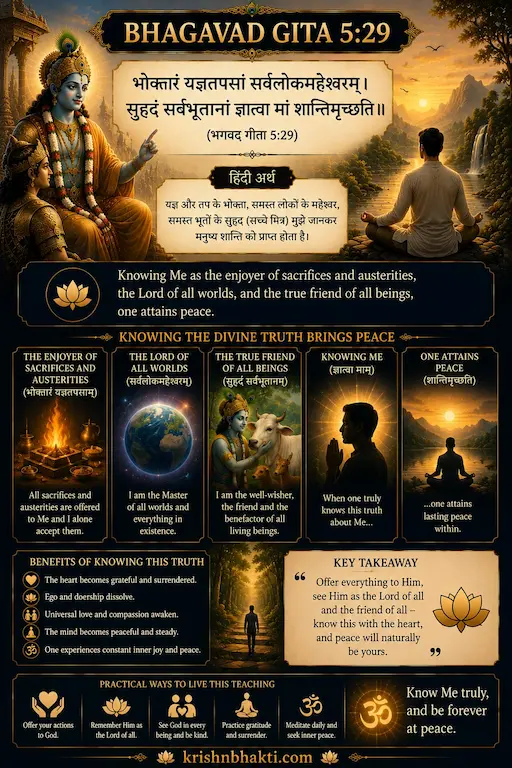
भोक्तारं यज्ञतपसां सर्वलोकमहेश्वरम् ।
सुहृदं सर्वभूतानां ज्ञात्वा मां शान्तिमृच्छति ॥ ५.२९ ॥
What Is Krishna Actually Saying?
Krishna says — knowing Me as the enjoyer of all sacrifices and austerities, as the Lord of all worlds, and as the true friend of all living beings — one attains lasting peace.
Three revelations in one verse. Krishna is the bhokta — the one who receives and enjoys all sacrifice and spiritual practice. Krishna is sarva-loka-maheshvara — the supreme Lord of every world, every realm, every corner of existence. And Krishna is suhridam sarva-bhutanam — the unconditional friend of every living being without exception. Know these three — and peace follows.
Sadhak Sanjivani — Swami Ramsukhdas Ji
In Sadhak Sanjivani, Swami Ramsukhdas Ji says the word jnatva — "having known" — is the hinge of this entire verse. This is not intellectual knowledge. This is the kind of knowing that goes all the way in — that becomes lived experience, not just information held in the mind.
On bhoktaram, he says — we often do spiritual practice and then quietly expect a return. "I gave this up, I should receive that." The moment we understand that all our practice, all our sacrifice, all our effort — it is received by God — the burden of expectation falls away. What remains is the lightness of offering without attachment to outcome.
On suhridam, Swami Ji says something that stays with you. Every relationship in this world has some element of self-interest, however subtle. Even the purest love has the desire to see the beloved flourish. But God's friendship has no self-interest whatsoever. He wants nothing from us — only our well-being. When this truly lands in the heart, the loneliness that most people carry quietly begins to dissolve.
Prabhupada — Bhagavad Gita As It Is
Srila Prabhupada, in Bhagavad Gita As It Is, calls this verse the conclusion of the entire fifth chapter — the three truths that, when genuinely understood, open the door to liberation.
On bhokta — Prabhupada says that any spiritual practice not offered to Krishna remains incomplete. The real yagna is one performed for Krishna's pleasure. And when it is, the practitioner receives the full fruit — not as a transaction, but as the natural result of being in harmony with the source of everything.
On sarva-loka-maheshvara — he says Krishna is not just the Lord of this earth. He is the Lord of every plane of existence, every universe, every dimension. When a person truly understands that the one who holds everything is also the one walking beside them — no situation in life remains overwhelmingly frightening.
On suhridam — Prabhupada says this may be the sweetest word in the entire Gita. God is our friend — unconditionally, without motive, without condition. This is the foundation of bhakti. Not fear, not transaction — friendship. And that friendship, once felt, changes everything.
Swami Mukundananda Ji's Perspective
Swami Mukundananda Ji connects this verse to what he calls the deepest wound of modern life — loneliness. He says — we live in the most connected era in human history. More friends, more followers, more conversations than ever before. And yet more people feel deeply alone than ever before. Because the one relationship that truly fills the heart — the relationship with God — has been left unattended.
On suhridam sarva-bhutanam — he emphasizes the word "sarva" — all. Not the good ones. Not the devotees. Not the people who have earned it. All beings. The sinner and the saint. The one who remembers God and the one who has forgotten. Krishna is the friend of all of them equally. When this truth is felt — not just understood — the need to earn love or prove oneself begins to fall away.
On shantimiricchati — the attainment of peace — Swami Ji says this peace is not passivity. It is not the peace of someone who has given up. It is the peace of a person who acts fully in the world but is not shaken by it. Like the depths of the ocean — storms on the surface, stillness below. That is the peace this verse promises.
What Does This Look Like in Real Life?
Think about a time you worked hard on something — really gave it your best — and no one noticed. No appreciation, no acknowledgment, nothing. There is a particular kind of loneliness in that. But when the understanding settles that every effort, every sacrifice, every sincere act — it reaches Krishna, He sees it, He receives it — that loneliness changes its character entirely.
Or think about the moments when everything feels out of control. A health scare, a financial crisis, a relationship falling apart. The fear in those moments comes from feeling alone in front of something bigger than you. But if you know that the one who holds every world, every outcome, every moment — is also the one who is your unconditional friend — that fear does not disappear, but it stops being unbearable.
And the loneliness that so many people carry — the feeling of not being truly known by anyone, of not mattering to anyone without condition — this verse speaks directly to that. There is someone who knows you completely, who holds all of existence, and who is your friend without any condition or expiration. Knowing this — really knowing it — is what Krishna calls peace.
Questions That Probably Live in Your Heart
Does simply knowing Krishna bring peace — is no other practice needed?
Swami Ramsukhdas Ji is clear — the "knowing" here is deep. It is the knowing that comes after sincere practice — meditation, discipline, devotion. This verse is the fruit of the entire chapter's teaching, not a shortcut around it.
What does bhokta mean exactly — does God consume our offerings?
Prabhupada explains — bhokta means "the one who receives and is pleased by." Like feeding someone you love — they eat and your heart is satisfied. When our practice is offered to Krishna and He receives it — the practitioner finds a completeness that no result or reward can provide.
What is the difference between suhrid and mitra — friend and companion?
Swami Mukundananda Ji explains — mitra implies a relationship between equals, with mutual benefit. Suhrid means one who wishes well from the heart, without any expectation or condition. Krishna is suhrid — infinitely greater than us, knowing everything — and yet our friend without any terms attached.
Why does the fifth chapter end here — what comes next?
The fifth chapter completes the teaching on karma yoga and the relationship between action and knowledge. This final verse is the destination — knowing Krishna and finding peace. The sixth chapter goes deeper into dhyana yoga — the direct practice of meditation and inner absorption.
If Krishna is everyone's friend — why is there so much suffering in the world?
Swami Ramsukhdas Ji answers — not because Krishna is absent, but because we have not turned toward Him. Like electricity already present in a house but the switch not turned on — the room stays dark. Krishna's friendship is always there. The practice is learning to turn toward it.
📖 Also Read: Bhagavad Gita 5.28 — No Fear, No Desire: The Gita's Secret to Being Always Free
🙏 Hare Krishna — Jai Shri Krishna 🙏