Have you ever heard someone say, “Leave everything behind, go to the forest — only then can you find God”? Or maybe, “Real spirituality means walking away from family, work, and responsibility.” Most people quietly wonder about this at some point. If we live ordinary lives — working jobs, paying bills, raising families — is spiritual life even meant for us?
This question is not new. People have carried this confusion for thousands of years. And Krishna answers it directly, right at the beginning of Chapter 6.
This verse is especially for those who think, “I have responsibilities, I live a normal life — maybe deeper spiritual teachings are not for people like me.” Krishna says — wait. Listen carefully first.
श्रीभगवानुवाच ।
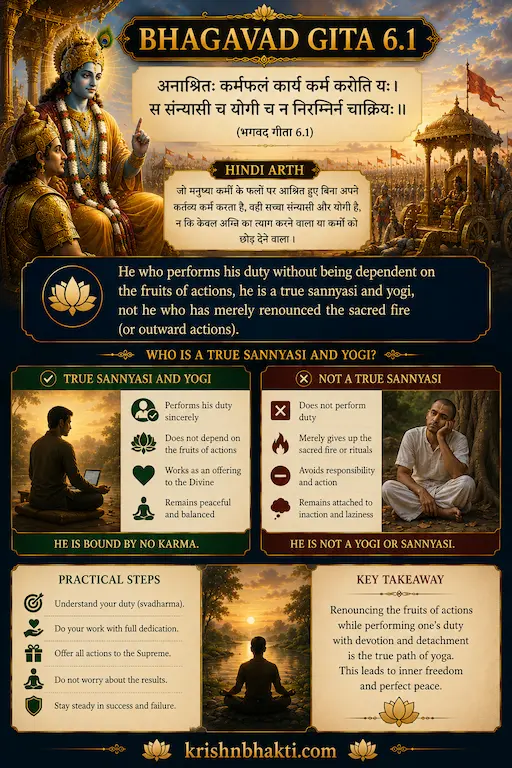
अनाश्रितः कर्मफलं कार्यं कर्म करोति यः ।
स सन्न्यासी च योगी च न निरग्निर्न चाक्रियः ॥ ६.१ ॥
What Is Krishna Actually Saying?
Krishna says — the person who performs their duty without depending emotionally on the fruits of action is the real sanyasi and the real yogi. Not the person who has merely stopped working or given things up externally.
Krishna is removing a very common misunderstanding here. Renunciation does not mean escaping responsibility. Yoga does not mean avoiding life. Real spirituality is not about leaving the world behind — it is about changing the consciousness behind the way we work and live.
Most people think peace will come after leaving everything. Krishna says peace comes when attachment leaves — not responsibility.
Sadhak Sanjivani — Swami Ramsukhdas Ji
In Sadhak Sanjivani, Swami Ramsukhdas Ji explains that the heart of this verse lies in the phrase anaashritah karma-phalam — not depending on the fruits of action for inner stability.
He says most people work with fear hidden inside: “What if this does not work out?” That fear itself is attachment. Krishna is asking us to let go of this inner dependence.
On karyam karma karoti, Swami Ji explains that duty should be performed because it is right — not because it brings praise, profit, or recognition. This is karma yoga in its purest form.
He also explains na niragnir na chakriyah very clearly. A person does not become a sanyasi simply by leaving work externally. If attachment and desire are still alive inside, real renunciation has not happened yet.
Prabhupada — Bhagavad Gita As It Is
Srila Prabhupada explains that Krishna is clearing a major misunderstanding about spiritual life. Many people think yoga and renunciation are two different paths. But Krishna says the person who works without attachment to results is already both a yogi and a sanyasi.
Prabhupada connects anaashritah karma-phalam with Krishna consciousness. When a person works for Krishna’s pleasure rather than personal gain, the pressure around success and failure slowly becomes lighter. The focus shifts from “What will I get?” to “Am I offering my best?”
He also says Krishna is not impressed by outer show. Someone may leave responsibilities externally, but if attachment still lives inside the heart, real renunciation has not happened.
Swami Mukundananda Ji's Perspective
Swami Mukundananda Ji connects this verse beautifully with modern life. He says people today are often more exhausted by result anxiety than by work itself. Before exams, interviews, business meetings, or even relationships, the mind keeps asking: “What if this fails?”
Krishna’s answer is simple — give your full effort, but do not make the outcome the foundation of your peace. Work sincerely. Prepare fully. Care deeply. But after that, let go of the pressure of controlling the result.
Swami Ji also says this verse is especially important for people living ordinary family lives. Spirituality is not only for monks. The moment you perform your duty without emotionally depending on the outcome, you are already practicing yoga.
What Does This Look Like in Real Life?
Think of a teacher who goes to class every day not because she expects praise, but because children deserve to learn. Whether results are good or bad, she continues doing her work sincerely. Quietly. Steadily. Maybe this is one of the purest forms of karma yoga in daily life.
Or think about a father working late into the night. Not because he expects appreciation in return one day, but because this is his duty right now. Even when nobody notices his sacrifices, he keeps going.
And honestly, think about yourself. How many times have you avoided doing something good because “nobody will notice anyway”? And how many times have you done something simply because it felt right? In those moments, without realizing it, you were already practicing the yoga Krishna is describing.
Some Questions That Naturally Come Up
Is wanting success wrong?
Swami Mukundananda Ji explains that wanting a good result is natural. The problem begins when your peace completely depends on it. Hoping for success is healthy. Breaking down without it is attachment.
What does “giving up fire” mean today?
Swami Ramsukhdas Ji explains that in earlier times sacred fire represented worldly duties. Today it can mean avoiding responsibilities and calling it spirituality. Krishna says that is not renunciation.
Why does Krishna call both the yogi and sanyasi the same?
Prabhupada says Krishna is intentionally removing the difference people create between these paths. The real difference is not clothes or lifestyle. The real difference is attachment.
How can someone living an ordinary life practice this teaching?
Swami Mukundananda Ji suggests a simple practice: begin each morning with the thought, “Today I will do my duty sincerely. The result I leave in God’s hands.” Slowly, this changes both work and peace of mind.
If we stop depending on results, where will motivation come from?
Swami Ramsukhdas Ji explains that when duty becomes stronger than personal gain, work actually improves. Fear becomes lighter. Pressure reduces. The mind becomes clearer.
Maybe real peace does not come from running away from responsibility. Maybe it comes from learning how to work without losing your inner balance.
Bhagavad Gita 5.29 — Know Who Krishna Really Is and Watch Everything Change
🙏 Hare Krishna — Jai Shri Krishna 🙏