Anyone who has tried to start a meditation practice knows the moment of uncertainty before sitting down. Where exactly should I sit? On what? Does it matter how high the seat is? Do I need a special cushion or mat? These questions feel small but they are not — because when the physical setup is right, settling into meditation becomes significantly easier. And when it is wrong, the body becomes a distraction before the mind even has a chance to settle.
Five thousand years ago, Krishna addressed these exact questions. In this verse, He gives precise instructions for where and how to sit for meditation. And the principles He describes — even though the specific materials He mentions belong to ancient India — are as relevant today as they were then.
This verse is the natural next step from 6.10. There Krishna described the inner and outer mental preparation for meditation — solitude, aloneness, freedom from expectation, non-possessiveness. Here He describes the physical setup — the space and the seat.
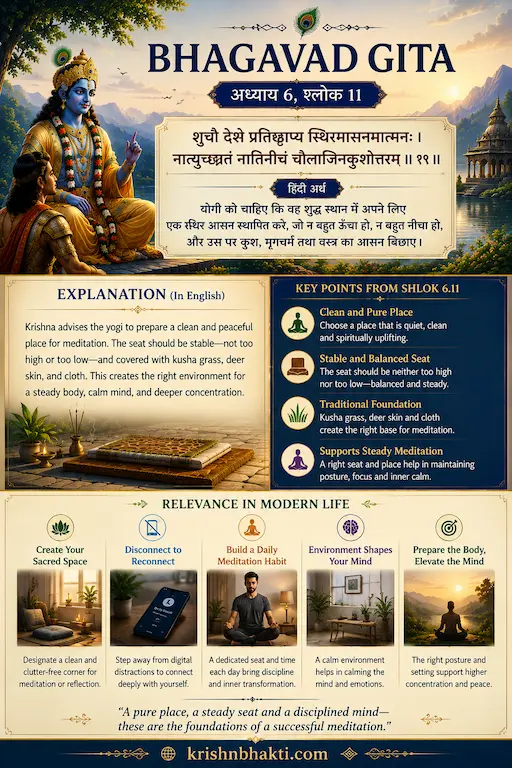
शुचौ देशे प्रतिष्ठाप्य स्थिरमासनमात्मनः ।
नात्युच्छ्रितं नातिनीचं चैलाजिनकुशोत्तरम् ॥ ६.११ ॥
What Is Krishna Actually Saying?
Krishna says — in a pure place, establish a firm seat for oneself — neither too high nor too low — covered first with kusha grass, then a deer skin, then a cloth on top.
Three elements. Shuchau deshe — a pure, clean place. Sthiram asanam — a firm, stable seat. Na ati uchchhritam na ati nicham — not too high, not too low. And the specific layering — kusha grass at the base, deer skin above it, cloth on top. Together these create the physical foundation for sustained meditation.
Sadhak Sanjivani — Swami Ramsukhdas Ji
In Sadhak Sanjivani, Swami Ramsukhdas Ji explains that shuchau deshe — a pure place — means more than physical cleanliness. Pure means a place where the mind naturally settles. Where there is not excessive noise, not negative energy, not constant distraction pulling the attention outward. Physical cleanliness is a part of this — but the deeper meaning is a space that supports inner stillness.
On sthiram asanam — a firm, stable seat — Swami Ji says the stability of the body and the stability of the mind are directly connected. When the body is still, the mind has an easier time becoming still. When the seat shifts, when the body adjusts and readjusts, the mind follows those movements and loses its thread. Once you sit — sit.
On na ati uchchhritam na ati nicham — not too high, not too low — he says this is practical wisdom with a real purpose. Too high a seat creates physical anxiety about falling, which disturbs the mind. Too low — sitting directly on the hard ground — causes energy to dissipate. A moderate height serves both comfort and alertness.
On the three layers — kusha, deer skin, cloth — Swami Ji explains each served a purpose: kusha insulated from ground moisture, deer skin preserved the practitioner's energy, and cloth provided comfort. In today's context, a good yoga mat or a woolen asana accomplishes all three purposes effectively.
Prabhupada — Bhagavad Gita As It Is
Srila Prabhupada, in Bhagavad Gita As It Is, says Krishna is giving very practical guidance here — and the practicality matters. He says even though meditation is ultimately an inner process, the outer environment significantly affects how easily that inner process unfolds. A good seed still needs good soil. Good meditation still benefits from good conditions.
On shuchau deshe, Prabhupada says a pure place is one where the presence of God is felt. A temple, a riverbank, a quiet hillside — these are naturally shuchi deshas. And within a home — a corner where God's image is kept, where regular worship is done — that corner becomes sacred over time. The sanctity builds through consistent practice.
On sthiram asanam, Prabhupada says physical stillness is the first outer condition for meditation. When the body moves, the mind follows. Whatever seat you choose, it should be one where you can remain genuinely still for an extended period. Discomfort that forces movement is a distraction — the seat should eliminate that variable.
Swami Mukundananda Ji's Perspective
Swami Mukundananda Ji translates this verse directly for the modern practitioner. He says — kusha grass and deer skin are not available to most people today, and that is completely fine. The principle of this verse is what matters, not the specific materials. The principle is: create a dedicated, consistent space for your practice and sit on something that keeps you stable and alert.
He makes a point that is both practical and profound: when you meditate in the same spot every day, that spot becomes conditioned. The moment you enter it, the mind begins to settle — because it has learned to associate that space with stillness. This is the same principle as Pavlov's conditioning, applied in a spiritual direction. A dedicated meditation corner is one of the most underrated tools for deepening practice.
On na ati uchchhritam na ati nicham in today's terms — he says try meditating on a very soft bed or a plush sofa and sleep comes quickly. Try sitting on a bare hard floor with no support and pain becomes the meditation. A firm cushion or folded blanket that slightly elevates the hips, keeps the spine naturally upright, and allows the body to remain alert without strain — that is the modern equivalent of what Krishna is describing.
What Does This Look Like in Real Life?
Choose a corner of your home — somewhere with less traffic, where it is naturally quieter. Place a small mat or folded woolen blanket there. If possible, put a small image or murti of God nearby. This becomes your shuchi desha — your meditation space. It does not need to be large or elaborate. It needs to be consistent and clean.
Use that space every day. Even for ten minutes. Over weeks and months, that corner builds its own energy — and your mind begins to recognize it. The moment you sit there, something in you starts to settle. That response is real, and it grows with every session.
For the seat — if you sit on the floor, place a folded blanket or a meditation cushion under the hips. This elevates the pelvis slightly, which allows the spine to remain upright naturally without effort. You can sit longer, more comfortably, and with more alertness. That is the practical, modern translation of na ati uchchhritam na ati nicham.
Questions That Probably Live in Your Heart
Is a dedicated meditation space really necessary — can you not meditate anywhere?
Swami Mukundananda Ji says — you can meditate anywhere, and sometimes you will need to. But a dedicated spot makes a real difference, especially in the beginning. The mind learns to associate that space with stillness. What takes twenty minutes to achieve elsewhere takes five minutes there. That conditioning is valuable.
Kusha grass and deer skin — is this not completely outdated?
Swami Ramsukhdas Ji says — look at the principle, not the material. Each layer served a function: ground insulation, energy preservation, comfort. A good yoga mat or woolen asana serves all three today. The teaching is timeless — only the available materials have changed.
Can you meditate on a bed or sofa?
Prabhupada says — you can try, but sleep tends to follow. The body associates those surfaces with rest, not alertness. A firm, upright posture on a stable surface keeps the body in a state of wakefulness that supports genuine meditation rather than drift.
Which direction should you face when sitting?
This verse does not specify direction. Traditional guidance suggests facing east or north as auspicious. But what matters most is that the body is comfortable, stable, and alert. The direction is secondary to those three.
What do 6.10 and 6.11 together teach?
6.10 gave the inner and outer mental preparation — solitude, aloneness, mind control, freedom from expectation, non-possessiveness. 6.11 gives the physical preparation — a pure place, a stable seat, the right height. Together they give a complete picture of how to set the conditions for deep meditation — addressing both what happens inside and what needs to be in place outside.
Read this also: Want to Meditate? Krishna Reveals These Five Conditions First 👇👇👇
🙏 Hare Krishna — Jai Shri Krishna 🙏