People make meditation complicated. There are apps with elaborate instructions, courses with sequential modules, techniques that require learning specific breathing patterns before you even sit down. And somewhere in all of that complexity, the simple act of sitting and bringing the mind to one place gets lost.
This verse strips all of that away. Krishna gives the most direct, minimal instruction for beginning meditation that exists anywhere in the Gita. Sit. Make the mind one-pointed. Control the mind and senses. Practice for inner purification. Four things. That is the whole instruction.
This verse follows naturally from 6.11, which described how to set up the physical space and seat. Now that the outer preparation is done, Krishna turns to what actually happens when you sit down — what you do with the mind, and why you are doing it.
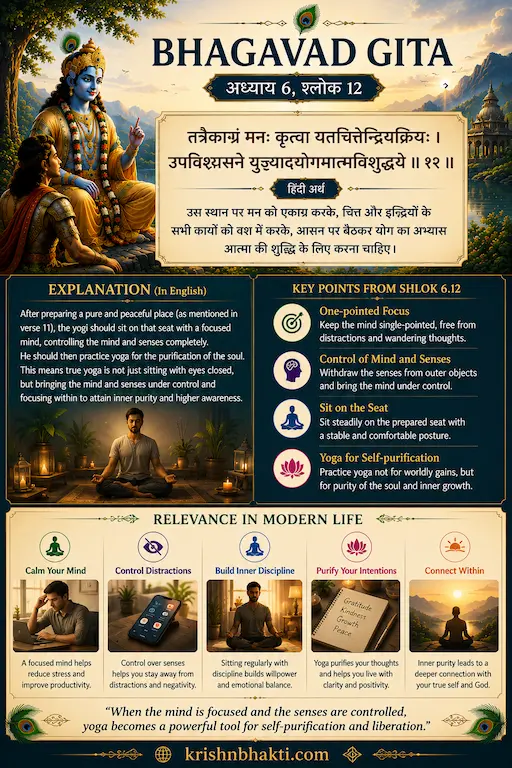
तत्रैकाग्रं मनः कृत्वा यतचित्तेन्द्रियक्रियः ।
उपविश्यासने युञ्ज्याद्योगमात्मविशुद्धये ॥ ६.१२ ॥
What Is Krishna Actually Saying?
Krishna says — having sat on that seat, making the mind one-pointed, controlling the activities of the mind and senses — one should practice yoga for the purification of the self.
Four elements. Upavisya asane — having sat on the seat. Ekagram manah kritva — making the mind one-pointed. Yata-chitta-indriya-kriyah — controlling the activities of the mind and senses. And atma-visuddhaye — for the purification of the self. Together these form the practical formula for meditation.
Sadhak Sanjivani — Swami Ramsukhdas Ji
In Sadhak Sanjivani, Swami Ramsukhdas Ji says ekagram manah — one-pointed mind — is the center of all meditation. Ekagra means one place. When the mind rests in one place — not pulled here, not pulled there — that is meditation. And where is that one place? In God. Every genuine meditation practice is an effort to bring the mind to that one resting place and keep it there.
On yata-chitta-indriya-kriyah, Swami Ji explains that chitta and indriya are two different things requiring two different kinds of control. Chitta is the deeper layer of the mind — where memories, impressions, and emotions are stored. The indriyas are the senses that reach outward. Controlling the senses is relatively accessible. Purifying the chitta is deeper work — it is what sustained practice over time accomplishes.
On atma-visuddhaye — for the purification of the self — Swami Ji makes a point that reframes the entire purpose of meditation. The goal is not a supernatural experience. The goal is not to see lights or hear sounds or enter altered states. The goal is purification — and from that purification, everything else follows naturally. First purification, then experience.
Prabhupada — Bhagavad Gita As It Is
Srila Prabhupada, in Bhagavad Gita As It Is, says Krishna is giving the most direct possible instruction for meditation here. Sit. Make the mind one-pointed. Control the senses. Three actions. The simplicity is itself the teaching — meditation is not complicated. The difficulty is not in understanding it but in doing it consistently.
On ekagram manah, Prabhupada says the mind is naturally restless — Krishna will say this explicitly in a later verse. But the practice of bringing the mind back — again and again, every time it wanders — is exactly what trains it. Each return is one repetition of the most important exercise a human being can do. The training is in the returning, not in the staying.
On atma-visuddhaye, Prabhupada connects this to bhakti — for the devotee, he says, this purification happens through Krishna's service. When the mind is engaged in Krishna, it naturally purifies. Meditation and devotion are two expressions of the same movement — both aimed at the same destination.
Swami Mukundananda Ji's Perspective
Swami Mukundananda Ji appreciates the radical simplicity of this verse. He says — people have turned meditation into something enormously complicated. Chakras, kundalini, specific mudras, elaborate breathing sequences. All of that has its place. But Krishna's core instruction is this: sit, bring the mind to one point, control the senses. If you do just this, sincerely, every day — the rest will come.
On ekagram manah kritva, he offers a practical framework. He says one-pointed attention is like a muscle — it grows stronger with use and weaker with neglect. In the beginning, the mind may not stay focused for even ten seconds. With daily practice — a minute, then five, then longer. The capacity builds. What seems impossible in week one becomes natural in month six.
On atma-visuddhaye, Swami Ji makes a point worth sitting with. He says the purpose of meditation is not relaxation — though relaxation comes. It is not stress management — though stress reduces. The actual purpose is purification of the self. And when that purification happens, it shows up in daily life — as less reactivity, less craving, more patience, more genuine care for others. That is how you know the practice is working.
What Does This Look Like in Real Life?
Sit on your asana in the morning. Close your eyes. Bring attention to the breath. The mind wanders — bring it back. It wanders again — bring it back again. This repeated act of returning is ekagram manah kritva. It is the whole practice in its simplest form. There is nothing more to do. The depth comes from the consistency and sincerity, not from complexity.
Yata-chitta-indriya-kriyah during sitting means — no checking the phone, no responding to sounds from outside, no shifting the body unnecessarily. These are the practical expressions of sense control during the session itself. Keep the body still, keep the eyes closed, keep the attention inward.
And atma-visuddhaye — you will know it is happening when life begins to change in small ways. A situation that would have made you angry last year barely bothers you now. A worry that would have kept you awake at night has lost its grip. A person you found difficult feels less heavy to be around. These ordinary changes are extraordinary signs. They mean the purification is real.
Questions That Probably Live in Your Heart
The mind wanders constantly during meditation — is that normal?
Completely normal. Swami Mukundananda Ji says — every time the mind wanders and you bring it back, that is one successful repetition of the practice. Meditation does not fail when the mind wanders. It fails only when you stop bringing it back. The wandering is not the problem — the not-returning is.
What is the difference between chitta and mana — are they not the same?
Swami Ramsukhdas Ji explains — the mana is the active layer of the mind that thinks and decides moment to moment. The chitta is the deeper layer where impressions, memories, and emotional patterns are stored. Controlling the mana is relatively accessible. Purifying the chitta requires sustained, consistent practice over a long period.
How do you know when atma-shuddhi — inner purification — is happening?
Prabhupada says — when life changes. Anger diminishes. Greed loosens. Care for others grows. Small provocations stop triggering large reactions. These are not dramatic or sudden changes — they accumulate quietly over months and years of practice. When you notice them, you are seeing purification.
How long should a beginner sit for meditation?
Swami Mukundananda Ji says — ten to fifteen minutes is a strong starting point. Quality matters more than duration. Ten minutes of genuine, sincere practice with consistent returning of the mind is worth more than an hour of drifting. Build time gradually as the capacity grows.
What do 6.11 and 6.12 together teach?
6.11 answered where and how to sit — the pure space, the stable seat, the right height. 6.12 answers what to do once seated — make the mind one-pointed, control the senses and mind, practice for inner purification. Together they give the complete setup: first get the conditions right, then begin the actual work. Physical preparation followed by the inner practice itself.
How to Set Up Your Meditation Seat: Krishna's Exact Instructions 👇👇👇
🙏 Hare Krishna — Jai Shri Krishna 🙏