The previous four verses — 6.11, 6.12, 6.13, 6.14 — gave Krishna's complete method for meditation. The right space, the right seat, how to hold the body, where to fix the mind. Now in this verse, He tells us the result of all of that practice. And the result is so significant that it is difficult to capture in words — yet Krishna manages to capture it in a single phrase: nirvana-parama, the supreme peace.
This verse closes the entire meditation section that began in 6.10. And knowing the destination matters — because without understanding what lies at the end of the path, the motivation to walk it consistently tends to fade.
This verse speaks to anyone who has asked: "why put in all this effort with meditation? What do I actually get from it?" Krishna's answer is clear — you get a peace that simply cannot be reached by any other means.
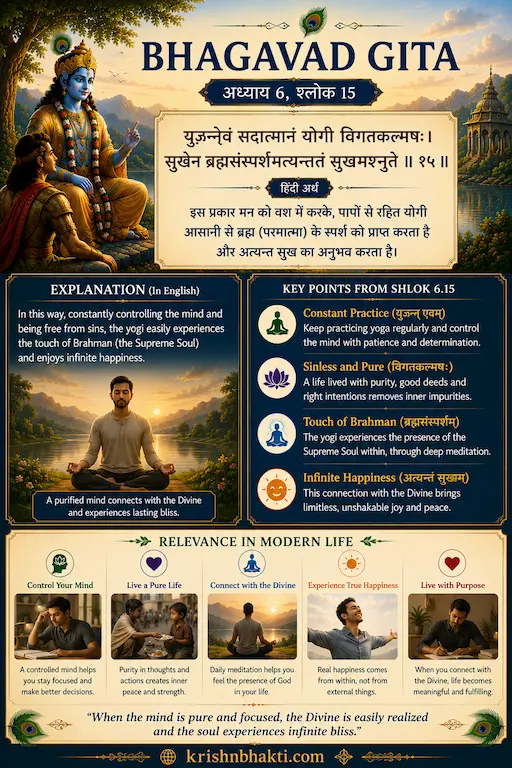
युञ्जन्नेवं सदात्मानं योगी नियतमानसः ।
शान्तिं निर्वाणपरमां मत्संस्थामधिगच्छति ॥ ६.१५ ॥
What Is Krishna Actually Saying?
Krishna says — thus constantly disciplining the mind, the yogi of regulated mind attains the supreme peace of nirvana, which is situated in Me.
Three elements. Evam sada — thus, constantly, in this manner, without break. Niyata-manasah — one whose mind is regulated and disciplined. Shantim nirvana-paramam mat-samstham — the supreme peace of nirvana, situated in Me. The verse tells us that the fruit of sustained practice is a peace established in Krishna Himself.
Sadhak Sanjivani — Swami Ramsukhdas Ji
In Sadhak Sanjivani, Swami Ramsukhdas Ji emphasizes the phrase evam sada — thus, constantly. He says the method described in the previous verses does not bear fruit through one-time effort. A single deep session followed by weeks of neglect does not produce the result Krishna is describing. Consistency itself is the practice — not an addition to it, but its very substance.
On niyata-manasah — a regulated mind — he says this means a mind that has been brought into a disciplined structure, like a river channeled by banks. An unchanneled river floods unpredictably; a channeled river flows with purpose in a single direction. The mind, similarly, needs to be regulated to flow toward its destination rather than scattering everywhere.
On nirvana-parama shanti, Swami Ji offers a profound clarification. Nirvana literally means extinguishing. But what is extinguished here? The fire of unending desire, the fire of anger, the fire of restlessness. When these fires are extinguished, what remains is not emptiness — it is the supreme peace that was always there beneath them, now finally revealed. This is fullness, not absence.
On mat-samstham — situated in Me — he says this peace is not a separate, free-floating thing. It is established in Krishna Himself. As a wave exists in the ocean, this peace exists in Krishna. This is why genuine, lasting peace is not possible apart from a relationship with the Divine — it is not a state you manufacture independently.
Prabhupada — Bhagavad Gita As It Is
Srila Prabhupada, in Bhagavad Gita As It Is, says this verse is the natural conclusion of the entire meditation section. The practical instruction that began in 6.11 reaches its fruit here — nirvana-parama shanti, the supreme peace.
He offers an important clarification on the word nirvana. In Buddhist philosophy, he says, nirvana often refers to complete voidness, the end of existence. But in the Gita's context, nirvana means the end of material existence and its restlessness, while the spiritual existence reaches its fullness. It is not emptiness — it is completeness situated in Krishna.
Prabhupada emphasizes mat-samstham — this peace is personal, not located in some abstract void, but established in Krishna. For the devotee, this peace is experienced as a living relationship with Krishna — not as dissolution into a formless emptiness, but as connection with the Supreme Person.
Swami Mukundananda Ji's Perspective
Swami Mukundananda Ji connects this verse to the modern person's endless search for peace — through therapy, retreats, vacations, shopping, achievement. He says all of these provide temporary relief, but none of them produce nirvana-parama shanti. That peace comes only through sustained, sincere spiritual practice. There is no shortcut available, no matter how much the modern world wants one.
On evam sada, he makes a very practical observation. People today want instant results — a week of meditation followed by an expectation of major transformation. But this verse says sada — constantly, over a long period. This is a marathon, not a sprint. The person who accepts this truth does not quit when results are slow, and gradually, that person finds the peace this verse describes.
On nirvana-parama shanti, Swami Ji describes it as a peace that does not depend on circumstances. It is not situational happiness that rises and falls with external conditions — it is unconditional peace. Whether the outside world is calm or stormy, this inner peace remains constant. That, he says, is the greatest promise of this practice — and it is what makes it worth the years of consistent effort.
What Does This Look Like in Real Life?
Think of someone who has meditated every morning for twenty minutes, consistently, for five years. The beginning was hard — the mind wandered, boredom set in, motivation wavered. But they did not stop. Five years later, there is a different quality to their life. Small irritations no longer have the same grip. Even significant difficulties meet a kind of inner steadiness. This is the fruit of evam sada — the fruit of unbroken consistency.
Or consider that moment within meditation itself — when sitting quietly, everything settles. No desire rises, no worry intrudes — just a deep, full stillness. This moment may be brief, may pass quickly, but it is a genuine glimpse of the nirvana-parama shanti Krishna is describing. These glimpses, repeated and deepened over years, eventually become a more constant inner ground.
In daily life, the effect shows up like this — a major crisis arrives and you find yourself inwardly calm in the middle of it. Everything around feels uncertain, and yet something inside does not break. This peace does not come from external circumstances being favorable. It comes from the years of inner practice that have built a foundation circumstances cannot easily shake.
Questions That Probably Live in Your Heart
How long does it take to actually reach this peace through practice?
Swami Mukundananda Ji says — it varies by person. Some get glimpses within months, others take years for it to deepen. But one thing is certain — sustained, sincere practice eventually brings it. The only failure mode is stopping.
Does nirvana mean the end of existence?
Prabhupada clarifies — no. The Gita's nirvana is the end of material restlessness and endless craving, not the end of the soul. It is a fullness situated in Krishna, not an emptiness or annihilation.
Does this peace stay permanently, or does it come and go?
Swami Ramsukhdas Ji says — in the beginning, it comes and goes. But as practice deepens, it becomes increasingly stable. Eventually, a point comes where this peace becomes one's natural resting state rather than an occasional visitor.
If progress takes a long time, is it acceptable to give up along the way?
Swami Mukundananda Ji is firm — never. The verse itself says evam sada — thus, constantly. Consistency is the key ingredient. Stopping erodes even the progress already made. Better to go slowly and keep walking than to stop entirely.
What do 6.14 and 6.15 together teach?
6.14 described the inner state needed for meditation — serene, fearless, established in brahmacharya, mind fixed on Krishna. 6.15 shows what happens when that state is practiced consistently over time — the supreme peace of nirvana, situated in Krishna Himself. Together, the section from 6.10 to 6.15 forms a complete journey through meditation — from the very first preparation to the ultimate fruit.
Read this also - Where Should the Mind Go in Meditation? Krishna Reveals the Secret 👇👇👇
🙏 Hare Krishna — Jai Shri Krishna 🙏