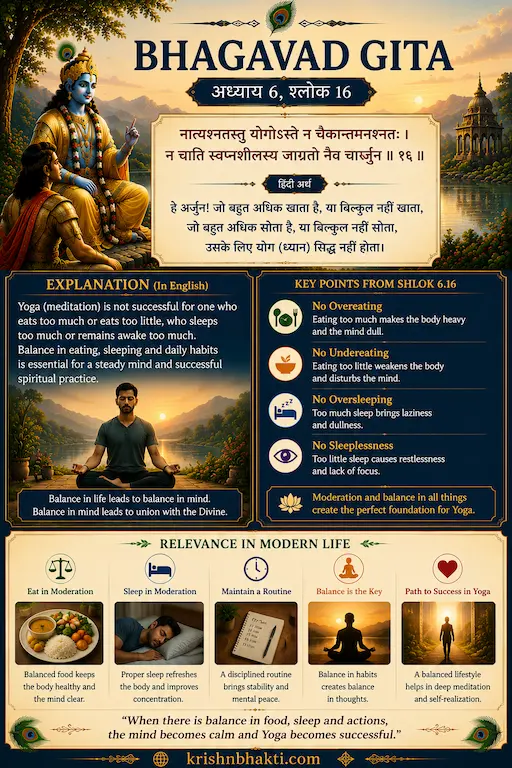
There is a common misconception in spiritual life — people believe that the more you deprive yourself, the less you eat, the less you sleep, the greater a practitioner you become. Some people drastically cut down on food, give up sleep, thinking this is tapasya, this is sacrifice for God. But Krishna says something surprising in this verse — that extreme is not yoga either.
And on the other side — those who overeat, oversleep, and live submerged in comfort and indulgence — yoga is not possible for them either. Both extremes — whether of excessive denial or excessive indulgence — block the path of yoga equally.
This verse is about balance. And this balance is not a compromise or a watered-down version of spirituality — it is the highest wisdom. Because the body is also an instrument for the spiritual journey, and an instrument should neither be overtightened nor left completely loose.
नात्यश्नतस्तु योगोऽस्ति न चैकान्तमनश्नतः ।
न च प्रस्वप्नशीलस्य जाग्रतो नैव चार्जुन ॥ ६.१६ ॥
What Is Krishna Actually Saying?
Krishna says — O Arjuna, yoga is not for one who eats too much, nor for one who does not eat at all. It is not for one who sleeps too much, nor for one who stays excessively awake.
Four extremes are named. Ati-ashana — excessive eating. Ekanta-anashana — complete abstinence from food. Prasvapna-shila — excessive sleep. Jagrata — excessive wakefulness, depriving the body of rest. All four are enemies of yoga — whether they appear in the form of austerity or indulgence.
Sadhak Sanjivani — Swami Ramsukhdas Ji
In Sadhak Sanjivani, Swami Ramsukhdas Ji says this verse corrects a very important misunderstanding. Many seekers believe that the less you eat and sleep, the greater the renunciation. But Krishna is saying — this extreme is also wrong. The body is an instrument for practice. Weakening it to the point that it can no longer support practice defeats the entire purpose.
On ati-ashana — overeating — he says when the stomach is overly full, the mind becomes dull, and sleepiness creeps into meditation. And on ekanta-anashana — complete abstinence — he says when the body is starved and weak, the mind also becomes weak and cannot sustain focus during practice. Both disturb meditation, just through opposite mechanisms.
On prasvapna-shila and jagrata — excessive sleep and excessive wakefulness — Swami Ji says sleep is a necessary repair process for both body and mind. Too much sleep increases tamas — dullness, lethargy. Too little sleep weakens the nervous system, leading to irritability and instability. Balanced sleep is what actually supports the practice.
Prabhupada — Bhagavad Gita As It Is
Srila Prabhupada, in Bhagavad Gita As It Is, says this verse reflects the Gita's deeply practical and balanced approach to spiritual life. Some believe that spiritual advancement requires bodily suffering — harsh fasting, severe sleep deprivation. The Gita directly rejects this extremism.
He says the body is an instrument for serving God. Overusing the instrument or keeping it deliberately weak both ruin the instrument. A balanced lifestyle — proper eating, proper sleep — is the actual foundation of sustainable spiritual practice, not an obstacle to it.
Prabhupada makes an important point — he says bhakti yoga has no place for extremism. A devotee living in Krishna consciousness maintains a regulated life — eating at the right time, sleeping at the right time, and dedicating the remaining time to devotional service. This is what makes spiritual life sustainable over decades rather than burning out in months.
Swami Mukundananda Ji's Perspective
Swami Mukundananda Ji connects this verse to two modern extremes — on one side, a culture of overindulgence, and on the other, trends that glorify extreme fasting and sleep deprivation as signs of discipline or productivity. He says both are equally wrong. The Gita shows us a middle path — and this middle path is not weakness, it is wisdom.
He says — today many people reduce sleep in the name of productivity, treating "I only sleep four hours and accomplish so much" as a badge of honor. But the Gita says this too works against yoga. Denying the body the rest it genuinely needs does not accelerate spiritual progress — it obstructs it.
Swami Ji makes a very practical point — proper eating and proper sleep directly affect the quality of meditation. A person who eats well and sleeps well meditates more deeply, more steadily. This is basic wellness — but it is also a genuine spiritual foundation. The two are not separate.
What Does This Look Like in Real Life?
Think of a seeker who decides — "I will fast extensively, eat very little, this will accelerate my practice." After some days, they become weak, the mind grows feeble, and focus during meditation disappears entirely. This is the cost of ekanta-anashana — extreme renunciation that does not actually work.
And think of another person who eats constantly, stays immersed in comfort food and indulgence at every opportunity. Their mind becomes dull, sleep takes over during meditation, and no real spiritual progress happens. This is the cost of ati-ashana — overindulgence.
The genuine practitioner is the one who eats at regular times, in balanced quantity — neither too much nor too little. Who sleeps a sufficient six to eight hours — neither excessive nor deprived. And within this balanced life, carves out time for bhajan, meditation, and service. That is what sustainable spiritual life actually looks like.
Questions That Probably Live in Your Heart
Is fasting wrong — many traditions emphasize its importance?
Swami Ramsukhdas Ji says — regulated, occasional fasting, like observing ekadashi, is a different matter entirely. This verse addresses extreme, prolonged abstinence that weakens the body. Regulated fasting supports practice. Extreme fasting harms it.
How much sleep is actually right?
Swami Mukundananda Ji says — generally six to eight hours suits most adults, though it varies by individual. The key principle is — not so much that lethargy sets in, and not so little that the nervous system becomes weak and unstable.
Is this verse encouraging indulgence?
Not at all. Prabhupada clarifies this is about balance, not license for indulgence. Overeating is just as wrong as starving. Both extremes are equally problematic in this teaching.
Is disciplining the body entirely wrong, then?
Swami Ramsukhdas Ji says — discipline and extremism are different things. Eating at regular times, sleeping regularly — this is discipline, and it is necessary. Breaking the body down through deprivation — that is extremism, and it is harmful.
What do 6.15 and 6.16 together teach?
6.15 said that sustained practice brings the supreme peace of nirvana. 6.16 explains that sustained practice is only possible through a balanced lifestyle. If eating and sleeping are imbalanced, consistent practice becomes impossible to maintain. This verse gives the practical foundation that makes the spiritual journey sustainable over the long run.
Read this also:- Constant Practice Brings a Peace You Cannot Find Anywhere Else 👇👇👇
🙏 Hare Krishna — Jai Shri Krishna 🙏