The previous verse told us what not to do — extremes, whether of excess or denial, do not support yoga. Now in this verse, Krishna states the same truth positively — what regulation actually looks like, and what its fruit is. And the fruit promised here is enormous — the destruction of all suffering.
This verse is not only about eating and sleeping. It addresses four major dimensions of life — ahara, what we eat, vihara, our recreation and movement, karma, our effort in work, and svapna-avabodha, our sleeping and waking. Regulation across all four — this is the path Krishna points to as the end of suffering.
This verse speaks to the modern person who tends toward extremes in everything — the workaholic or the chronically lazy, the overeater or the crash dieter, the insomniac or the oversleeper. Krishna is saying clearly — the middle path is not mediocrity. It is the healing path.
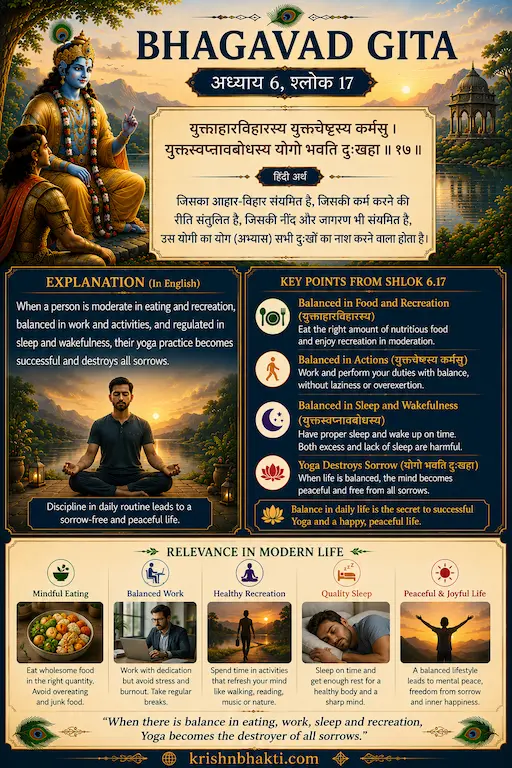
युक्ताहारविहारस्य युक्तचेष्टस्य कर्मसु ।
युक्तस्वप्नावबोधस्य योगो भवति दुःखहा ॥ ६.१७ ॥
What Is Krishna Actually Saying?
Krishna says — for one whose eating and recreation are regulated, whose effort in action is regulated, and whose sleep and waking are regulated — yoga becomes the destroyer of all suffering.
Four elements. Yukta ahara-vihara — regulated eating and recreation. Yukta cheshta karmasu — regulated effort in actions. Yukta svapna-avabodha — regulated sleep and waking. When all four are in balance — yoga becomes dukhha, the destroyer of suffering.
Sadhak Sanjivani — Swami Ramsukhdas Ji
In Sadhak Sanjivani, Swami Ramsukhdas Ji explains that yukta ahara — regulated eating — means food taken neither in excess nor deficiency, according to the body's actual need, sattvic in nature, and consumed at regular times. This is not only about quantity — quality and timing both matter equally.
On yukta vihara — regulated recreation — he says this is deeply relevant in today's context. Recreation is necessary. But when it becomes excessive, when it becomes the center of life rather than a refreshing pause within it, it scatters the mind instead of restoring it. Balanced recreation refreshes; excessive recreation distracts.
On yukta cheshta karmasu — regulated effort in action — Swami Ji says this addresses both overwork and underwork. Do not work so much that body and mind break down. Do not work so little that laziness grows. Balanced effort is what makes any practice sustainable over years rather than burning out within months.
On dukha-ha — the destroyer of suffering — Swami Ji makes a profound observation. He says most suffering in ordinary life originates from an unbalanced lifestyle itself. Overeating brings illness. Insufficient sleep brings irritability. Overwork brings burnout. Excessive entertainment brings inner emptiness. When life becomes balanced, much of this suffering naturally begins to dissolve on its own.
Prabhupada — Bhagavad Gita As It Is
Srila Prabhupada, in Bhagavad Gita As It Is, says the Gita never supports extreme asceticism. Instead, it identifies regulated, balanced living as the most effective spiritual path. This is not a watered-down compromise — it is the most sustainable road available.
On yukta ahara-vihara, he says a devotee's life is naturally regulated — taking prasadam at proper times, sleeping and waking at proper times, and dedicating the remaining hours to devotional service. This regulation does not reduce freedom — it builds the actual foundation that real freedom requires.
Prabhupada emphasizes yogo bhavati dukha-ha as a genuinely practical promise within the Gita. Yoga is not only for spiritual experience — it actively reduces the suffering of ordinary life. And this happens specifically when the lifestyle supporting the practice is itself regulated and balanced.
Swami Mukundananda Ji's Perspective
Swami Mukundananda Ji connects this verse to modern lifestyle diseases. He says — diabetes, hypertension, anxiety, depression — a significant portion of these conditions trace back to unbalanced living. Irregular eating, irregular sleep, either excessive work or excessive idleness. The Gita identified this solution thousands of years before modern medicine arrived at the same conclusion.
On yukta vihara in today's context, he explains that vihara includes both relaxation and movement. Today people either sit for hours in front of screens with no movement at all, or push themselves to extremes at the gym with excessive strain. Balanced physical activity paired with balanced relaxation — that is what yukta vihara means for the modern practitioner.
On dukha-ha, Swami Ji offers a deeply inspiring point. He says this verse promises that a regulated life does not just create the conditions for peace — yoga actively becomes a force that destroys suffering. This is not a passive benefit one stumbles into. It is active healing. This is a far bigger promise than most people realize when they first read this verse.
What Does This Look Like in Real Life?
Think of someone who stays up late on their phone every night, wakes up late, skips breakfast, overeats at lunch, and stays up late again the next night. This pattern — unregulated eating, recreation, and sleep — gradually exhausts both body and mind. No spiritual practice can go deep in the middle of this chaos, no matter how sincere the intention.
Now think of that same person gradually building a routine — fixing a sleep and wake time, fixing meal times, bringing balance between work and rest. Within a few weeks, energy levels improve, the mind becomes quieter, and whatever meditation practice exists deepens noticeably. This is not complicated. It is foundation work that people frequently skip while chasing more dramatic spiritual experiences.
It is not rocket science — but it is precisely the foundation most seekers overlook in their search for spiritual growth. Krishna's message here is direct: fix this foundation first. The rest follows naturally once the ground is stable.
Questions That Probably Live in Your Heart
Does yukta ahara mean a specific prescribed diet?
Swami Ramsukhdas Ji says — there is no single fixed diet prescribed. It means sattvic food, appropriate quantity according to need, and regularity in timing. The specifics may vary by individual, but the underlying principle remains the same for everyone.
Should entertainment be given up entirely?
Swami Mukundananda Ji says — absolutely not. Yukta vihara means balanced recreation, not its elimination. Recreation refreshes the mind. The problem arises only when it becomes the center of life rather than a healthy part of it.
How do you know if your work effort is balanced or excessive?
Prabhupada says — if tiredness after work comes paired with a sense of peace, the effort is balanced. If it brings only exhaustion and irritability, it has tipped into excess. Both body and mind give clear signals when this balance is lost.
Is this verse only for serious spiritual practitioners, or for everyone?
Swami Ramsukhdas Ji says — this principle applies to everyone. Whether or not someone practices deep meditation, a regulated lifestyle is the foundation of physical and mental health for every human being, regardless of their spiritual commitment.
What do 6.16 and 6.17 together teach?
6.16 described what not to do — excessive eating, excessive fasting, excessive sleep, excessive wakefulness. 6.17 describes what to do — regulated eating, recreation, effort, and sleep. One verse is the negative framing, the other the positive. Together they give a complete picture of the middle path that, according to Krishna, becomes the active destroyer of suffering.
read this also :- Eating Too Much or Too Little, Both Ruin Your Yoga, Krishna Says 👇👇👇
🙏 Hare Krishna — Jai Shri Krishna 🙏