What is yoga? Ask this question and you will get many answers. Body fitness, breathing exercises, stress relief, meditation. All of these describe what yoga looks like from the outside. But in this verse, Krishna gives yoga a definition from the inside — one that is precise, unexpected, and profoundly clarifying.
Krishna says — the disconnection from union with suffering is called yoga. Not adding something, not achieving something — removing something. The union with suffering that most of us carry without realizing it — breaking that union is yoga. This is a subtractive definition. And it reframes everything.
Alongside this definition, Krishna gives an instruction for how to practice it — with firm resolve and without despair. Both the destination and the manner of walking toward it, given in a single verse.
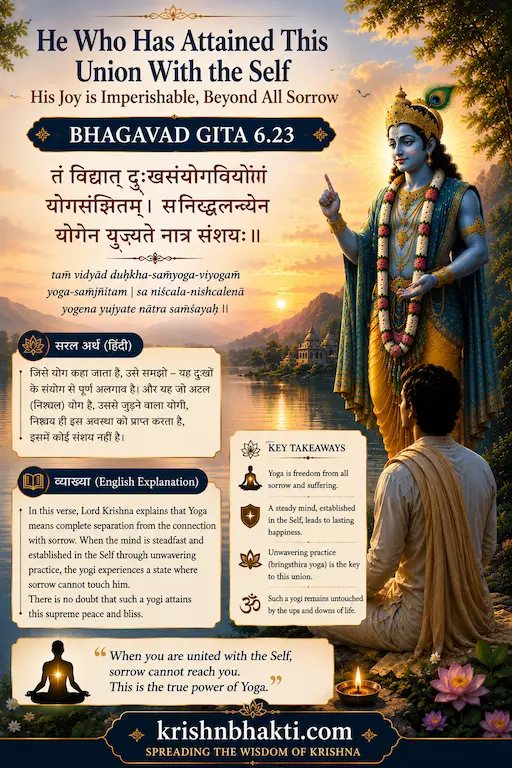
तं विद्याद्दुःखसंयोगवियोगं योगसंज्ञितम् ।
स निश्चयेन योक्तव्यो योगोऽनिर्विण्णचेतसा ॥ ६.२३ ॥
What Is Krishna Actually Saying?
Krishna says — know that the disconnection from union with suffering is called yoga. And this yoga must be practiced with firm resolve and with an undiscouraged mind.
Two instructions. Duhkha-samyoga-viyogam yoga-samjnitam — the disconnection from union with suffering is what is called yoga. And sa nishchayena yoktavyah yoga anirvinna-chetasa — this yoga must be practiced with firm resolve and without discouragement. Definition and method — given together in one verse.
Sadhak Sanjivani — Swami Ramsukhdas Ji
In Sadhak Sanjivani, Swami Ramsukhdas Ji explains that the word samyoga — union — is very carefully chosen. We have a union with suffering — we are joined to it, we identify with it, we treat it as ours. When this joining breaks — that is viyoga, disconnection. And that disconnection is yoga.
He says — this verse is not saying that difficult circumstances will stop coming. They can come. But your union with them — your identification with them, your being defined by them — that is what ends. Like the lotus in water — it is in the water but not soaked by it. Being in a circumstance of suffering and being joined to it are two different things. That distinction is yoga.
On anirvinna-chetasa — without discouragement — Swami Ji says the greatest obstacle in spiritual practice is nirveda — despair, exhaustion, the feeling that "it is not working, it will not happen for me." This feeling will come. Krishna is not pretending otherwise. He is giving the instruction for that moment in advance — when it comes, do not stop. Do not make the temporary feeling of despair into a permanent decision.
Prabhupada — Bhagavad Gita As It Is
Srila Prabhupada, in Bhagavad Gita As It Is, says Krishna here gives a completely different and highly precise definition of yoga. Yoga is not the addition of something — it is the subtraction of the bond with suffering. This is a negative definition that produces a positive result. And it cuts through all the confusion about what yoga actually is at its deepest level.
On sa nishchayena — with firm resolve — Prabhupada says this will not happen through half-hearted effort. The person who is trying yoga "just to see" will not reach this. The person who is fully committed — who has decided — will reach it. The Gita makes this demand for commitment repeatedly. This verse is one more instance of that same demand.
On anirvinna-chetasa, Prabhupada says this word is deeply practical. Practice goes through waves — periods of feeling good and periods of feeling empty, flat, purposeless. In those flat periods, despair is the greatest danger. Krishna warns about it here precisely because He knows it will come. The instruction — when it arrives, recognize it, and continue anyway.
Swami Mukundananda Ji's Perspective
Swami Mukundananda Ji connects this verse to what he calls the "quick results" epidemic of modern culture. He says — today people want instant transformation. Seven-day meditation challenges. Twenty-one-day life overhauls. And when those timelines don't deliver deep change, discouragement follows, and the practice is abandoned. This cycle — enthusiasm, disappointment, abandonment — repeats endlessly.
He says the definition duhkha-samyoga-viyogam is liberating precisely because it clarifies what yoga actually is. It is the gradual breaking of our bond with suffering. And that bond does not break in seven or twenty-one days. It breaks through sustained, consistent practice over months and years. Understanding this in advance prevents the discouragement that comes from unrealistic expectations.
On anirvinna-chetasa, Swami Ji offers an observation from every field of genuine achievement. He says — in every meaningful endeavor, there comes a point where it feels like it is not working and will not work. That feeling is not evidence that it is not working. It is almost always a sign that breakthrough is close. The person who continues through that moment reaches it. The person who stops at that moment does not. Spiritual practice is no different.
What Does This Look Like in Real Life?
You have been meditating for several months. Early on there were moments of peace that felt meaningful. Now it feels like routine. Some mornings nothing seems to happen at all. And a thought appears — "what is the point? Nothing has really changed." This is nirveda, discouragement. And this is precisely the moment Krishna's instruction applies most directly — anirvinna-chetasa. Do not stop here. Continue.
And duhkha-samyoga-viyogam in daily life shows up as — difficult news arrives, and the mind wavers for a moment — and then, more quickly than it used to, returns. The union with suffering is still there, but it is slightly looser than before. That slight loosening — barely noticeable at first — is the beginning of what this definition of yoga describes. Small shifts accumulate.
Sa nishchayena — firm resolve — shows up in daily life as sitting on the meditation cushion every morning, whether the mood is good or flat, whether yesterday's session was deep or distracted. That consistency, maintained regardless of how it feels, is what firm resolve actually looks like when it is lived.
Questions That Probably Live in Your Heart
Disconnection from suffering — does this mean not feeling pain?
Swami Ramsukhdas Ji says — no. Pain will be felt. The difference is that the pain does not define you, does not sink you, does not become you. Like walking in rain and getting wet are different things — being in a painful circumstance and being joined to it are different things. Yoga is the difference between the two.
When discouragement comes, what do you actually do in that moment?
Swami Mukundananda Ji says — in that moment, turn to something external for support. Bhajan, satsang, a verse from the Gita. These are bridges across the gap of discouragement. The feeling of discouragement is temporary. Do not allow a temporary feeling to become a permanent decision about what is possible for you.
How do you build firm resolve when the mind feels weak?
Prabhupada says — resolve is a decision, not a feeling. When the mind feels weak, hold the decision anyway. Like a farmer who goes to the field whether it rains or not — because the decision to farm does not depend on daily feelings about farming. Practice the same way.
How is this definition — disconnection from union with suffering — different from other definitions of yoga?
Swami Ramsukhdas Ji says — this definition is result-based, not technique-based. Yoga is not a technique — yoga is a state. And the identifying mark of that state is the breaking of the bond with suffering. Different techniques can lead there — the result they are all pointing toward is the same.
What do 6.22 and 6.23 together teach?
6.22 described two unmistakable effects of the state — nothing seems greater, and sorrow cannot shake you. 6.23 names what that state is called — disconnection from union with suffering — and gives the instruction for how to practice toward it — with firm resolve and without discouragement. Effects, definition, and method — all three together give the most complete picture of yoga found anywhere in this chapter.
Read this also :- After This Nothing More Is Needed, and No Sorrow Can Shake You 👇👇👇
🙏 Hare Krishna — Jai Shri Krishna 🙏