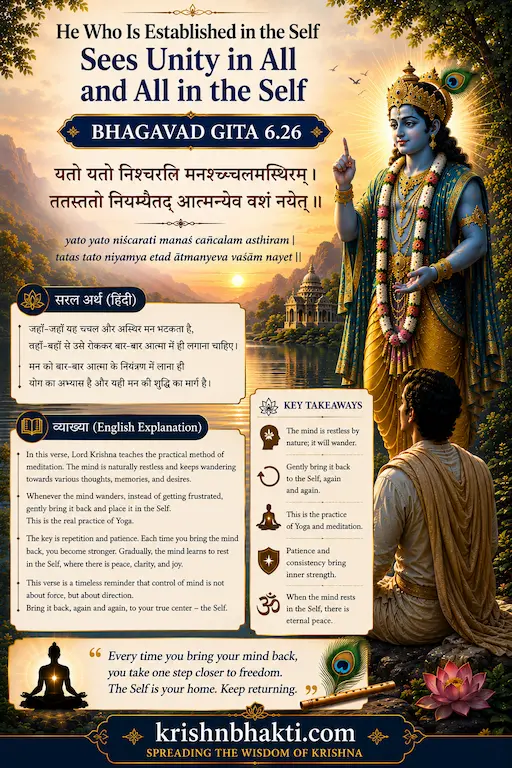
There is a very common misconception about meditation — people believe the mind should not wander at all during a session. And when it inevitably does, they become frustrated, conclude they have failed, and eventually stop practicing altogether. "Meditation is not for me" — this thought, more than almost any other, ends what could have become a genuine and transformative practice.
In this verse, Krishna says something every meditator needs to hear and remember. The mind will wander. This is guaranteed. It is not a failure. And whenever it does — simply bring it back. That returning is meditation. That returning is the practice itself.
This is one of the most practical and compassionate verses in the entire Gita. It is the moment where Krishna, like a skilled and patient teacher, says — "Yes, the mind will wander. I know. Do not be discouraged by it. Just keep bringing it back."
यतो यतो निश्चलति मनश्चञ्चलमस्थिरम् ।
ततस्ततो नियम्यैतदात्मन्येव वशं नयेत् ॥ ६.२६ ॥
What Is Krishna Actually Saying?
Krishna says — from wherever this restless, unsteady mind wanders — from there, having restrained it, bring it back under the control of the Self alone.
The verse is elegantly simple. Yato yato nishchalati — from wherever it wanders. Manah chanchalam asthiram — this restless, unsteady mind. Tatas tato niyamya — from there, having restrained it. Etad atmani eva vasham nayet — bring it back under the Self's control alone. The entire instruction describes a continuous loop — wander, return, wander, return — and establishes that returning is the practice.
Sadhak Sanjivani — Swami Ramsukhdas Ji
In Sadhak Sanjivani, Swami Ramsukhdas Ji says this verse gives the practitioner a vital permission — the mind wandering is allowed. Krishna Himself has called the mind chanchala and asthira — restless and unsteady. The mind's wandering is its nature. The practitioner has not failed when this happens.
He says — failure happens when the practitioner follows the mind wherever it goes and does not bring it back. Not returning is the failure. Wandering is simply part of the process. Yato yato nishchalati... tatas tato niyamya describes a loop that will repeat — and each returning is itself the progress.
Swami Ji emphasizes the word eva in atmani eva vasham nayet — bring it back to the Self alone. Not somewhere else — only to the Self. Bringing it back to another thought, even a good one, will not produce the same settling. Only the Self holds the mind in the way that truly quiets it.
Prabhupada — Bhagavad Gita As It Is
Srila Prabhupada, in Bhagavad Gita As It Is, says this verse acknowledges the practical reality of meditation with complete honesty. Every meditator — beginner or experienced — faces a mind that wanders repeatedly. This verse validates that reality and simultaneously gives its solution: bring it back. Every time.
On chanchalam asthiram — restless and unsteady — Prabhupada notes that Krishna will later have Arjuna himself say these very words about the mind (in verse 6.34). And here, in 6.26, Krishna gives the answer in advance. The solution is simple — bring it back. As many times as needed. The simplicity is not a limitation — it is the entire teaching.
In the context of bhakti, Prabhupada says — for the devotee, this "bringing back" means returning to Krishna. Whenever the mind goes anywhere — bring it back to Krishna's name, Krishna's form, Krishna's qualities. This is a gentle, loving practice — not forceful, but an invitation, repeated as often as needed.
Swami Mukundananda Ji's Perspective
Swami Mukundananda Ji speaks directly to frustrated meditators with this verse. He says — if the mind wanders during meditation, this does not mean you have failed. It means you are meditating. Wandering and returning — that is meditation. The wandering itself is not the problem. The not-returning would be the problem.
He offers a memorable analogy — meditation is like a gym workout for the mind. When you lift weights, the muscle builds precisely through the cycle of strain and recovery. In meditation, when the mind wanders and you bring it back — that is one mental repetition. That is the exercise that builds the capacity. More returns, more training. The wandering is not the enemy — it is the resistance that makes the training meaningful.
On yato yato nishchalati... tatas tato niyamya, Swami Ji points out that the grammatical structure itself carries the teaching. "From wherever it wanders, from there bring it back" — the parallel construction signals infinite repetition. It will happen many times. And each time, the response is the same — not with frustration, not with self-criticism, but with patient, gentle redirection. That patience is the practice.
What Does This Look Like in Real Life?
You are sitting in meditation. Attention is on the breath. Two seconds pass and the mind has gone to tomorrow's meeting. You notice — and bring it back. Five seconds later, a memory of a conversation surfaces. You bring it back. Then a worry about something unresolved. Back again. This loop may happen a hundred times in a twenty-minute sitting — and this is completely, entirely normal. This is yato yato nishchalati... tatas tato niyamya, lived in real time.
In daily life, this shows up as — being in a conversation and noticing the mind has drifted somewhere else, and choosing to return to full presence. Or working on something and catching a distraction early, returning attention to the task. These micro-moments of returning — practiced all day, every day — are part of the same training this verse describes.
And in the most difficult application — when a painful or distressing thought arrives and the mind begins to sink into it — this is the moment yato yato nishchalati tatas tato niyamya matters most. Notice where the mind has gone. And gently, without force or frustration, bring it back. This, repeated as many times as needed, is the practice.
Questions That Probably Live in Your Heart
My mind wanders constantly — is this a special problem I have?
Swami Ramsukhdas Ji says — no. Krishna Himself has called the mind restless and unsteady. This is every human mind, not yours specifically. What you experience as a personal failing is actually the normal, universal nature of the untrained mind. You are not alone — and you are not broken.
I bring the mind back every time and it still wanders — when does progress happen?
Swami Mukundananda Ji says — progress is happening. It is simply not yet visible. Just as exercise results appear slowly — weeks of effort before visible change — mental training results accumulate below the surface before becoming noticeable. Every returning is a real investment. The returns are coming.
Should the mind be brought back with force or with gentleness?
Prabhupada says — with gentleness. Bringing the mind back with frustration or self-criticism creates tension that makes meditation harder. A gentle, patient redirection — the way you would call a young child back with kindness rather than anger — is consistently more effective and more sustainable.
Must every thought be stopped — or are some thoughts acceptable?
Swami Ramsukhdas Ji says — during meditation, the goal is resting in the Self. Any thought that pulls away from that — whether troubling or pleasant, even spiritual thoughts — gently set aside. After the sitting, everything can be thought about freely. During the sitting, the goal is that one resting place.
What do 6.25 and 6.26 together teach?
6.25 said — slowly, with patience, settle the mind into the Self. 6.26 addresses what happens when it doesn't settle — when it wanders, as it inevitably will. From wherever it goes, bring it back. Every time. Together these two verses give a complete picture — move forward with patience, and when the mind wanders, bring it back without frustration. These two instructions, practiced together, are the whole of meditation.
Read this also :- Not Overnight, Slowly, With Patience and Intellect — How Real Change Happens 👇👇👇
🙏 Hare Krishna — Jai Shri Krishna 🙏