Where does the spiritual life actually begin? People give different answers — some say meditation, some say renunciation, some say prayer. But Krishna gives a precise answer in this verse, and it might surprise you. He says it begins with action. Not sitting still. Not giving things up. Action.
This verse is for everyone who has thought "I am not ready yet for real spiritual practice" or "once things settle down, I will start." Krishna is saying — start now, where you are, with what you have. And the means available to you right now is karma — sincere, dedicated action.
This verse is also a map. It shows that the path of yoga has two distinct stages. The stage of climbing — and the stage of having arrived. And what works at each stage is different.
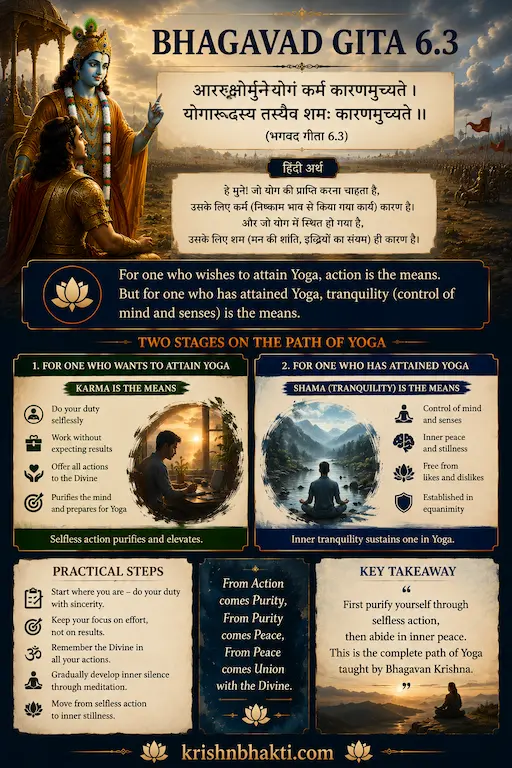
आरुरुक्षोर्मुनेर्योगं कर्म कारणमुच्यते ।
योगारूढस्य तस्यैव शमः कारणमुच्यते ॥ ६.३ ॥
What Is Krishna Actually Saying?
Krishna says — for the sage who wishes to ascend to yoga — who is at the beginning of the journey — karma is said to be the means. For the same sage who has already ascended to yoga — who is established in it — shama, inner stillness and restraint, is said to be the means.
Two stages. Aarurukshu — one who is climbing, who is still on the way. And yogarudha — one who has arrived, who is fully established. For the first, the path is active karma. For the second, the path is inner stillness — shama.
Sadhak Sanjivani — Swami Ramsukhdas Ji
In Sadhak Sanjivani, Swami Ramsukhdas Ji explains that this verse gives a clear map of spiritual progress. The first stage — aaruruksha — is the stage of effort and aspiration. Here the seeker must remain active. Worship, service, bhajan, performing one's duties with sincerity — all of this constitutes the karma that purifies the mind.
He says — when a seeker continues performing karma without attachment to results, the mind gradually becomes pure. And as the mind purifies, the second stage begins — yogarudha. Here the need for constant external activity reduces, because the mind is already stable. Now shama — inner stillness — carries the seeker forward.
Swami Ji points out a common and costly mistake — many seekers abandon karma prematurely, imagining they have reached the second stage when they have not. If the mind is still restless, still pulled by desires and reactions, the seeker is still in the first stage. Giving up karma before the mind is truly stable is not advancement — it is confusion mistaken for progress.
Prabhupada — Bhagavad Gita As It Is
Srila Prabhupada, in Bhagavad Gita As It Is, says Krishna is giving a completely practical roadmap here. He says — yoga is a journey with two distinct phases. In the first phase, the seeker must be active — karma, bhakti, service. In the second phase, when inner maturity has come, shama — inner stillness and restraint — becomes the primary vehicle.
On the aarurukshu — the beginner — Prabhupada says that attempting to sit in deep meditation before the mind has been prepared through action and devotion is largely unsuccessful. The mind has not yet been trained. It needs the structured engagement of karma first to find its direction and settle its restlessness.
He connects this to bhakti — saying that for a devotee of Krishna, this journey becomes far easier and more natural. Because in devotional service, karma and stillness are not separate stages — they happen together. The act of serving Krishna purifies the mind and brings peace simultaneously.
Swami Mukundananda Ji's Perspective
Swami Mukundananda Ji explains this verse with a beautiful image. He says — think of someone climbing a mountain. On the way up, they must keep moving — one foot in front of the other, effort, exertion, active progress. But once they reach the summit, they simply stay there. The exertion stops. The stillness of the peak holds them.
He says — the aarurukshu needs karma because the mind is still restless. It needs direction, engagement, purpose. When we act sincerely — through service, bhajan, doing our work with integrity — the mind gets a channel. That channel gradually steadies it. And as it steadies, the seeker naturally moves toward the second stage.
Swami Ji speaks directly to young seekers who feel frustrated that meditation does not work for them. He says — if you cannot sit still, do not force it. Do something instead. Serve someone. Sing bhajan. Do your work with full attention and honesty. That karma is your meditation right now. It will carry you to the stillness you are looking for.
What Does This Look Like in Real Life?
Think of someone just beginning a spiritual life. They sit to meditate and the mind goes everywhere — to work, to worries, to plans, to memories. This is completely normal. They are in the aarurukshu stage. The right response is not to give up on meditation — but to combine it with action. Service, devotion, honest work. The karma prepares the ground for the stillness.
Now think of someone who has practiced for many years — whose mind has genuinely settled, who is not easily disturbed by external events. For this person, elaborate external activity is less necessary. They can find deep peace in simplicity and quiet. This is the beginning of yogarudha. The shama — the stillness — now carries them.
In your own life — whenever the mind is restless and meditation feels impossible, take it as a signal. Not to sit harder, but to act. Do something good, serve someone, engage sincerely with your work or your prayers. That movement is not a detour from yoga — it is the path itself, exactly where you are right now.
Questions That Probably Live in Your Heart
Can I not just meditate directly — why do I need karma first?
Swami Mukundananda Ji says — meditation and karma are not in competition. Do both. But understand that in the beginning, when the mind is still unsettled, karma gives it direction. As the mind settles through sincere action, meditation naturally deepens. They work together — karma prepares the soil, meditation plants the seed.
How do I know whether I am aarurukshu or yogarudha?
Swami Ramsukhdas Ji offers a simple test — when the mind remains steady without needing external support, when no situation causes real inner disturbance — you are moving toward yogarudha. As long as you need bhajan, satsang, structured practice to stay grounded — you are in the aarurukshu stage. And that is perfectly fine. Most of us are there, and it is the right place to be.
Is it ever right to give up karma?
Prabhupada says — only when the mind has genuinely matured. Giving up karma prematurely, while telling yourself you have arrived at the higher stage, is one of the most common and subtle spiritual mistakes. Krishna is pointing to this danger in this very verse.
What exactly is shama — is it just sitting quietly?
Swami Ramsukhdas Ji explains — shama is not passive quietness. It is complete inner mastery — the state in which the mind is not pulled by any external circumstance, pleasure, or pain. It is not something you do — it is something that settles in when the earlier work has been done sincerely.
What do 6.2 and 6.3 together teach?
6.2 said — you cannot be a yogi without renouncing sankalpa, the grip of desire. 6.3 says — and the path to that renunciation is karma. Act sincerely, without attachment. The mind purifies. Sankalpas loosen. And eventually, shama arrives. These two verses are the engine and the road together.
Read This: The Cosmic Theater of Life: Bhagavad Gita on Rebirth and Identity
https://krishnbhakti.com/english-blogs/reincarnation-the-cosmic-theater-of-life
🙏 Hare Krishna — Jai Shri Krishna 🙏