Let me ask you something — have you ever met someone who looks at gold and mud with the same eyes? Someone for whom a diamond and a pebble carry no different emotional weight? The first reaction most people have is: that person must be foolish, or simply unaware of how the world works. But this verse reveals the opposite. The person who sees mud and gold as equal is not ignorant — they are the most genuinely free person in the room.
They are not unaware of gold's market value. They know perfectly well. But their happiness, their peace, their sense of completeness — none of it rests on gold or mud or anything in between. They are so full inside that nothing outside adds to them or takes away from them. That fullness is what this verse is describing.
This verse gives us the portrait of what Krishna calls yukta — one who is truly established in yoga. And in that portrait, there are qualities that speak directly to the hungers and anxieties of modern life.
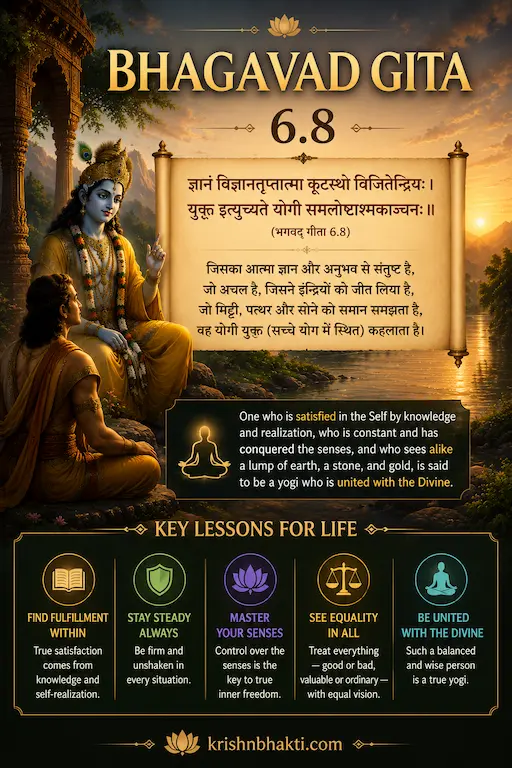
ज्ञानविज्ञानतृप्तात्मा कूटस्थो विजितेन्द्रियः ।
युक्त इत्युच्यते योगी समलोष्टाश्मकाञ्चनः ॥ ६.८ ॥
What Is Krishna Actually Saying?
Krishna says — the yogi who is satisfied with knowledge and direct experience, who is steady and unshakeable, whose senses are conquered, and for whom a clod of earth, a stone, and gold are all equal — that yogi is called yukta, truly established in yoga.
Four qualities. Jnana-vijnana-tripta — satisfied with both knowledge and lived experience. Kutastha — unshakeable, like a mountain peak. Vijitendriya — one whose senses have been brought under mastery. And sama-loshta-ashma-kanchana — for whom mud, stone, and gold are equal. Together these four describe the yukta yogi.
Sadhak Sanjivani — Swami Ramsukhdas Ji
In Sadhak Sanjivani, Swami Ramsukhdas Ji explains that jnana and vijnana are two distinct things. Jnana is understanding received from scripture, from a teacher, from satsang — knowledge taken in from outside. Vijnana is the direct inner experience of what that knowledge points to — living proof that the teaching is true. When both are present together, trupti — deep satisfaction — arrives. When only jnana is there without vijnana, a hunger remains.
On kutastha, Swami Ji says — kuta means a peak that does not move. The kutastha person is like a mountain summit — circumstances come and go, seasons change, storms pass — but the summit stays exactly where it is. This is not outer rigidity. It is inner stability that nothing external can disturb.
On sama-loshta-ashma-kanchana — equal regard for mud, stone and gold — he says this is not ignorance of worldly value. It means the emotional grip of material things has released. Gold comes — fine. Gold goes — also fine. The inner state does not shift based on what is present or absent outside. That is the equanimity this phrase points to.
Prabhupada — Bhagavad Gita As It Is
Srila Prabhupada, in Bhagavad Gita As It Is, says jnana-vijnana-tripta describes someone who is not merely theoretically informed but experientially realized. Knowing about God is jnana. Experiencing God is vijnana. When both are present — nothing more is needed, nothing more is wanted. The seeker has arrived.
On kutastha, Prabhupada says this word carries great depth. The kutastha person has risen above the influence of maya. Like the sky — clouds appear and disappear, but the sky itself never moves. Situations arrive and depart in the life of the kutastha person — but they themselves remain unmoved at their center.
On sama-loshta-ashma-kanchana, Prabhupada says this is one of the most visible signs of genuine bhakti. The devotee fully absorbed in Krishna has a practical understanding of gold's value — but no emotional investment in possessing or losing it. The inner relationship with Krishna is so complete that nothing outside competes with it.
Swami Mukundananda Ji's Perspective
Swami Mukundananda Ji connects this verse to the defining anxiety of our materialistic age. He says — the entire modern world is running after gold. Money, status, luxury, recognition — these are today's gold. And the pattern is always the same: those who don't have it are miserable, and those who have it want more. There is no finish line in this race.
He says — sama-loshta-ashma-kanchana does not mean stop earning money or stop working. It means stop tying your identity and your peace to money. When it comes, remain steady. When it goes, remain steady. That freedom — to act fully in the world without being owned by outcomes — is the most practical liberation available to a working person.
On jnana-vijnana, Swami Ji makes a point that every reader of the Gita needs to hear. He says — reading the Gita gives you jnana. But when you face a real difficulty — a loss, a betrayal, a failure — and the Gita's teaching actually holds you steady — that is vijnana. That is the moment the knowledge becomes experience. And it is only in those moments that real satisfaction, real trupti, begins to grow.
What Does This Look Like in Real Life?
Think of a businessman who loses crores in a single day — a deal collapses, an investment fails. But the next morning he wakes up, has breakfast with his family, and goes back to work — without being shattered, without weeks of depression, without his sense of self being destroyed by the loss. That is sama-loshta-ashma-kanchana — equanimity toward gold and mud — lived in an ordinary office.
Or think of a longtime spiritual seeker who has read the Gita for years. One day they face something genuinely hard — a sudden illness, an unexpected grief. And in that moment, instead of falling apart, they notice that something inside holds steady. The teaching they had only understood in theory is now being lived. That moment is vijnana — and the peace it brings is trupti.
And kutastha — in everyday life it looks like this: the office is chaos and you come home and are actually present with your family, not still mentally in the meeting. The children are difficult and you stay patient without forcing it. Good news arrives and you feel it genuinely without being swept away by it. These are small moments of kutastha stability — and they matter.
Questions That Probably Live in Your Heart
What is the difference between jnana and vijnana — are they not the same thing?
Swami Ramsukhdas Ji says — jnana is knowing about fire. Vijnana is feeling its heat. One is received knowledge, the other is lived experience. Both are necessary — one without the other is incomplete. The Gita read and understood is jnana. The Gita lived and confirmed through experience is vijnana.
Is treating gold and mud as equal actually possible in practice?
Prabhupada says — on a practical level, the difference in their market value will always be known. But on an emotional and spiritual level — when the craving for gold and the rejection of mud both dissolve — yes, this becomes possible. It is not an external performance. It is an inner state that grows with genuine practice.
Is kutastha the same as being emotionally numb or rigid?
Swami Mukundananda Ji says — absolutely not. The kutastha person is among the most alive and responsive of all. Numbness is when the mind has gone dull. Kutastha is when the mind is completely awake and aware — but not pulled off its center by any circumstance. Full presence without disturbance.
How long does it take to become a yukta yogi?
Swami Ramsukhdas Ji says — it is not about time, it is about sincerity. The person who regularly takes in genuine knowledge, applies it in life, and watches it become experience — moves toward this state naturally. There is no fixed timeline. The direction matters more than the speed.
What do 6.7 and 6.8 together teach?
6.7 described the person with a mastered mind — equal in heat and cold, joy and sorrow, honor and insult — with God always present. 6.8 deepens that portrait — satisfied with knowledge and experience, unshakeable as a mountain peak, senses mastered, gold and mud equal. Together they give us the complete picture of the yukta yogi — the person who has truly arrived in yoga.
Read this also: When the Mind Is Mastered, Heat and Cold, Praise and Insult All Feel the Same 👇👇👇
🙏 Hare Krishna — Jai Shri Krishna 🙏