There's a particular kind of exhaustion that nobody talks about enough.
It's not the exhaustion from working too hard. It's the exhaustion from carrying the work — long after it's done. The meeting ended two hours ago, but your mind is still in the room. The project was submitted yesterday, but you're still running it in your head.
You're not working anymore. But you haven't stopped.
That weight — that invisible load — has a name in the Gita. And 5,000 years ago, Krishna pointed directly at it.
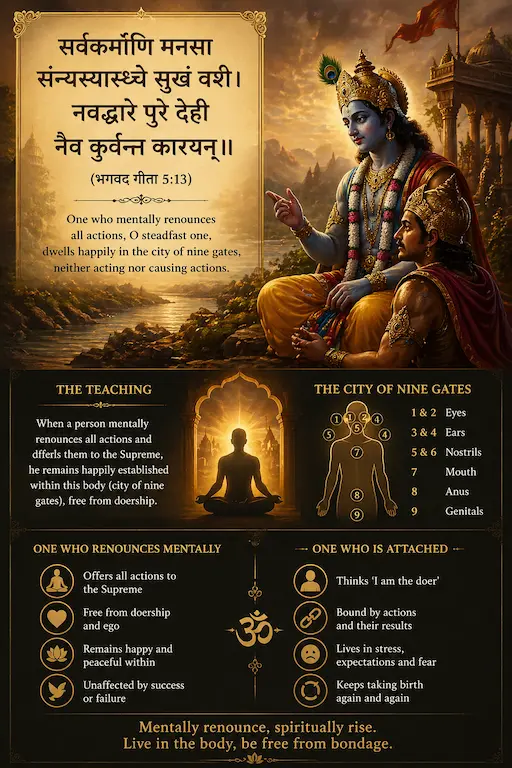
सर्वकर्माणि मनसा संन्यस्यास्ते सुखं वशी।
नवद्वारे पुरे देही नैव कुर्वन्न कारयन्॥
— Bhagavad Gita, Chapter 5, Verse 13
Breaking Down the Verse — Word by Word
"Sarva-karmāṇi manasā sannyasya" — renouncing all actions in the mind. Not physically stopping. Not running away. Mentally releasing the grip.
"Āste sukhaṁ vaśī" — the self-controlled one dwells in happiness. "Vaśī" — one who has mastered the mind. And notice: the happiness comes from that mastery, not from any external achievement.
"Navadvāre pure dehī" — the embodied soul, living in the city of nine gates. The body is a city. The soul is its resident — its king.
"Naiva kurvan na kārayan" — neither acting nor causing others to act. The soul is not the doer. It never was.
The Question That Immediately Comes Up — "If the soul doesn't act, then who does?"
This is exactly the right question.
Srila Prabhupada, in Bhagavad Gita As It Is, explains this with beautiful clarity. As long as a person identifies with the body, they claim every action as their own — "I did this, I earned this, I lost this." That identification is the source of all burden. The moment a person understands that the real "I" is the soul — not the body, not the mind — the weight shifts. Action continues, but the one who carries it changes.
Swami Mukundananda draws particular attention to the word "vaśī." He explains that true freedom has nothing to do with wealth, status, or power. A billionaire who cannot control his own mind is a slave. A monk who has mastered his mind is a king. The world chases external freedom — the Gita points to internal sovereignty.
Gita Press in its commentary expands on "navadvāre pure" — the city of nine gates. The nine gates are the two eyes, two ears, two nostrils, one mouth, and two lower gates. Through these gates, the entire external world enters — pleasure and pain, desire and fear, comparison and craving. The soul lives in this city but is not meant to be controlled by every noise at every gate.
The City of Nine Gates — Why This Metaphor Still Hits Hard
Think about what enters through your nine gates in a single day.
Your eyes scroll through a feed that shows you everyone's highlight reel — and your mind quietly measures itself against it.
Your ears pick up a comment someone made in passing — and your mind replays it for the next three hours.
Your phone buzzes — and before you've even read the notification, your nervous system has already responded.
Every gate is open. Everything comes in. And the mind — untrained, unguarded — reacts to all of it.
This is what the Gita calls being "avaśī" — without self-mastery. And it is exhausting.
The "vaśī" — the self-controlled one — doesn't close the gates. They don't become numb or disconnected. They simply decide what gets a reaction and what doesn't. They are the gatekeeper of their own inner city.
Let me ask something — Isn't "not doing" just another word for laziness?
Not even close.
"Naiva kurvan na kārayan" is not about stopping action. It's about releasing the doer-ship — the ego that insists "I am doing this."
Here's the difference in practice:
Two people are working on the same project. One thinks: "This is mine. My reputation is on this. If this fails, I fail." The other thinks: "This is my responsibility right now. I'll give it everything. What happens after is not mine to control."
Both work equally hard. But one carries the project home with them every night. The other leaves it at the door.
The second person isn't less invested. They're less identified. And that distinction — that small but enormous shift — is what this verse is pointing to.
A Story From Today's World
There's a person — maybe a designer, a writer, a developer — who is genuinely good at what they do. They put everything into their work. But the moment they hit submit, the anxiety begins.
Did the client like it? Did the team think it was good enough? Did anyone notice how much I put into this?
They check their email compulsively. They revisit the work looking for flaws. They can't sleep until they get a response.
They are working in the city of nine gates — but every gate is wide open, and the city is under siege.
The Gita isn't asking them to care less. It's asking them to locate themselves differently — not in the outcome, not in others' approval, but in something steadier. The soul that watches, that witnesses, that remains.
Three Shifts Toward Becoming "Vaśī"
1. Move from "I am doing" to "I am the instrument."
Prabhupada returns to this again and again — when you see yourself as God's instrument rather than the independent author of your actions, the ego's grip loosens. The work doesn't become less important. You become less fragile about it.
2. Guard your gates consciously.
Swami Mukundananda emphasizes that mind-mastery begins with awareness. Before you can control what enters, you have to notice what's entering. Which gate is the most unguarded? For most people in 2025, it's the eyes — the scroll, the comparison, the constant input. Start there.
3. Practice witnessing.
Gita Press describes the soul's natural state as that of a witness — a sakshi. Once a day, even for five minutes, sit and observe your own thoughts without engaging them. Not suppressing, not following — just watching. This simple practice, done consistently, begins to create the inner distance that "vaśī" requires.
The King and the City
You live in a city of nine gates.
Every day, the world knocks on every one of them — with news, noise, opinions, comparisons, notifications, and demands.
And somewhere inside — beneath the reactions, beneath the roles you play, beneath the exhaustion — there is a part of you that is none of that. Still. Watching. Unkept by any of it.
That is the soul. That is the king.
Krishna isn't asking you to abandon your city. He's asking you to remember who you are in it.
Do the work. Live fully. Engage completely.
But know the difference between the city and the king who lives in it.
That knowing — that single shift in identity — is what this verse calls happiness.
To read
Is It Really Possible to Work Without Attachment?👇👇