There's a moment most of us have experienced but rarely talk about.
You're about to do something — and somewhere deep inside, something quietly says don't. Not loudly. Not dramatically. Just a small, clear knowing.
And you do it anyway.
Then later, sitting with the consequences, you ask yourself the question that has no comfortable answer — "I knew. Why did I still do it?"
Most people call this weakness. Some call it human nature. A few blame their circumstances, their upbringing, the people around them.
But the Bhagavad Gita gives it a very specific name — ajnana. Ignorance. And what makes this definition radical is what it implies — that the knowledge was always there. It wasn't absent. It was covered.
Before we go deeper into what's covering it — there's something else this verse says first. Something that might be even harder to sit with.
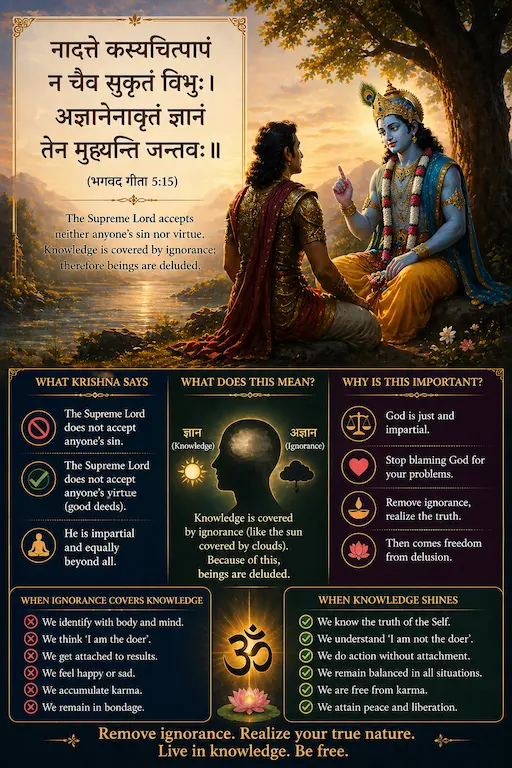
नादत्ते कस्यचित्पापं न चैव सुकृतं विभुः।
अज्ञानेनावृतं ज्ञानं तेन मुह्यन्ति जन्तवः॥
(Bhagavad Gita 5:15)
Krishna says — the all-pervading Lord takes neither the sin nor the merit of anyone. Knowledge is covered by ignorance — and because of this, all beings are deluded.
Two things are being said here. And both need to be understood separately — because one clears a misconception we've carried for years, and the other points to the actual problem we've been ignoring.
The Transaction You Never Agreed To — But Always Believed In
There's a quiet belief most of us carry — never fully examined, rarely spoken aloud.
That God is keeping score.
That if you do enough good things — pray enough, give enough, suffer enough — something will shift in your favor. That when things go wrong, it's because you did something wrong and the universe is balancing the books. That there's a cosmic ledger somewhere with your name on it.
This belief is so deeply embedded that it shapes how we relate to everything — guilt, suffering, ritual, prayer. We light a diya and somewhere in the back of our minds we're hoping it counts for something. We go through something painful and we quietly wonder what we did to deserve it.
Krishna dismantles this entirely.
God does not take your sin. God does not take your merit. The Lord is not a transactional being keeping accounts of your moral performance. According to Gita Press, the Supreme exists as a witness — impartial, untouched, uninvolved in the mechanics of karma. Like the sun that shines equally on every surface without preference or judgment — the light doesn't know what it's falling on.
This might feel cold at first. If God isn't watching the ledger, then what's the point?
But sit with it a little longer and something opens up.
It means no one is punishing you. It means your suffering isn't a verdict. It means the painful chapter you're in right now is not evidence of your unworthiness — it's the result of causes, conditions, patterns. And causes and conditions can change.
The problem was never God's indifference. The problem is something much closer to home.
The Real Culprit — And Why It's Harder To Face
If God isn't the one running your life — and 5:14 already established that your own nature is — then the natural next question is: why does the nature stay stuck? Why do people know better and still not do better?
This is exactly what the second half of this verse addresses.
Ajnanenaavritam jnanam — knowledge is covered by ignorance.
Not destroyed. Not absent. Covered.
This is one of the most quietly hopeful ideas in the entire Gita. It means you are not broken. You are not fundamentally flawed. The clarity, the wisdom, the knowing — it's already in you. Something is just sitting on top of it.
Swami Mukundananda explains that this ignorance is not intellectual — it isn't about lacking information. You can have read every self-help book, know every psychological framework, understand exactly what you should be doing — and still be completely in the grip of ajnana. Because this ignorance operates at a level deeper than the intellect. It lives in the patterns, the conditioning, the emotional grooves worn into us over years and lifetimes.
So what does this ignorance actually look like in a real life?
It has three distinct faces.
The First Face — When You Know But Can't Move
This is the most visceral and the most universal.
You know the relationship is draining you. You stay.
You know the habit is costing you. You continue.
You know the path you're on isn't yours. You keep walking it.
The knowledge is there — crisp, clear, undeniable. But something holds the door shut.
Sometimes that something is fear — of the unknown, of loss, of being alone with a decision that can't be undecided. Sometimes it's the sheer weight of years of conditioning — patterns that have been reinforced so many times they feel like identity, not just behavior. Sometimes it's the suffocating weight of what everyone else will think.
The Gita doesn't judge this. It names it.
This is ajnana in its most emotional form — where the heart knows and the accumulated weight of the past overrules it. And the path through it isn't more information or more willpower. It's awareness. The kind that doesn't flinch. The kind that looks at the pattern and asks — where did this actually come from? Is this mine — or was it handed to me?
That question, asked honestly, is already the beginning of the covering lifting.
The Second Face — When You've Lost the Thread Back to Yourself
This one is quieter. More insidious. And in the current age, nearly universal.
Open any social media app. Within thirty seconds, you're measuring. Someone's career, someone's relationship, someone's body, someone's life that looks — from a carefully curated distance — like everything yours isn't.
The familiar ache arrives. You know comparison is pointless. You know their highlight reel isn't their reality. You know this.
And yet.
The reason this loop keeps running isn't because you're shallow or weak. It's because somewhere along the way, you lost a clear sense of what you actually want. What a good life looks like to you — not to your parents, not to your peer group, not to an algorithm that has studied your insecurities with precision.
When that inner reference point is missing, you outsource it. You look outward for a definition of enough, of success, of worthy — because the one inside has gone quiet under years of noise.
Prabhupada points to this as one of the deepest expressions of ignorance — the soul forgetting its own nature and seeking outside what was never lost, only buried. The tragedy isn't that you don't have what others have. The tragedy is that you've stopped listening to the part of you that already knows what you need.
Reclaiming that voice doesn't happen through more consumption. It happens through subtraction — less noise, more stillness, more honest questions asked in quieter moments.
The Third Face — When the Label Becomes the Limit
This is the subtlest layer. And the most load-bearing.
At some point — gradually, invisibly — most people stop experiencing life and start managing an identity.
I am someone who fails under pressure.
I am not the kind of person who gets what they want.
I am defined by what happened to me.
I am what people have said about me long enough.
When an insult lands and stays with you for days, it's not because you're sensitive. It's because you've attached your sense of self to the very thing being insulted. When a failure feels like an ending rather than an event, it's because you've fused who you are with what you achieved.
The Gita says — you are larger than all of this. Vastly larger.
There is a consciousness in you that is prior to every label, every wound, every verdict anyone has ever delivered about your worth. But ignorance — layered and dense — has covered it so thoroughly that you've started to believe the covering is the thing itself.
This is what Krishna means by "tena muhyanti jantavah" — this is how all beings become deluded. Not through dramatic evil or catastrophic failure. Through the slow, quiet mistaking of the mask for the face.
So How Does the Covering Lift?
The Gita doesn't leave the diagnosis without a direction.
The first movement is honest observation. Not self-criticism — observation. When a reaction arises, when a pattern repeats, when you find yourself stuck in the same loop — pause before you judge it. Get curious about it instead. What is this protecting? What would have to be true for me to keep doing this? That pause — that fraction of space between stimulus and response — is where awareness lives. And awareness is the first thing that moves ignorance.
The second is the company you keep — including the ideas you repeatedly expose yourself to. What you consume consistently becomes your inner architecture. The Gita's emphasis on satsang isn't religious formality — it's recognition of a psychological truth. Repeated exposure to what is genuine, what is clear, what points toward depth — this slowly reshapes the conditions that ignorance needs to survive.
The third is a different kind of devotion. Not the transactional prayer that asks God to fix the ledger. But the kind of inner turning that quiets the noise long enough to hear what was always underneath it. The kind that doesn't add more layers — but gently, consistently, removes them.
This Verse Is Not a Warning. It's an Invitation.
Read quickly, 5:15 can feel like a closed door — God isn't taking your sins, you're deluded by ignorance, good luck.
But read slowly, it's one of the most quietly radical things ever said.
It means the knowledge you need is not somewhere you have to travel to find. It's not in a book you haven't read yet, a teacher you haven't met, an experience you haven't had.
It's in you. Right now. Under the covering.
And coverings — unlike walls — can be removed. One layer at a time. With enough honesty, enough stillness, enough willingness to stop outsourcing the answer to something outside yourself.
The next time you find yourself stuck — not just in a situation, but in the familiar frustration of knowing and still not doing — don't reach for more information.
Reach inward instead. Ask —
Which layer is this? What is it covering? And am I willing to look?
That question is not weakness.
That question is the beginning of everything.
"Before you sleep tonight, sit in silence for just 5 minutes. Look at one habit you know is 'wrong' and ask yourself—what is the fear that is holding it in place?"
To read
gita shloka 5.14 “Stop Blaming God — The Bhagavad Gita Says You’re Responsible for Your Life”
https://krishnbhakti.com/english-blogs/gita-shloka-stop-blaming-god-bhagavad-gita-responsibility