We judge. Constantly.
The moment we see someone, a quiet assessment begins — their clothes, their accent, their job title, their social media following, their caste, their country. We rank them. We file them. We decide, in seconds, where they belong relative to us.
And we call this being realistic. We call it discernment. We call it just the way things are.
The Gita calls it ignorance.
Not moral failure. Not something to be ashamed of. Just — a mistaken way of seeing. A case of looking at the surface and missing what's underneath entirely.
And in Chapter 5, Verse 18, Krishna describes what it looks like when someone finally sees correctly.
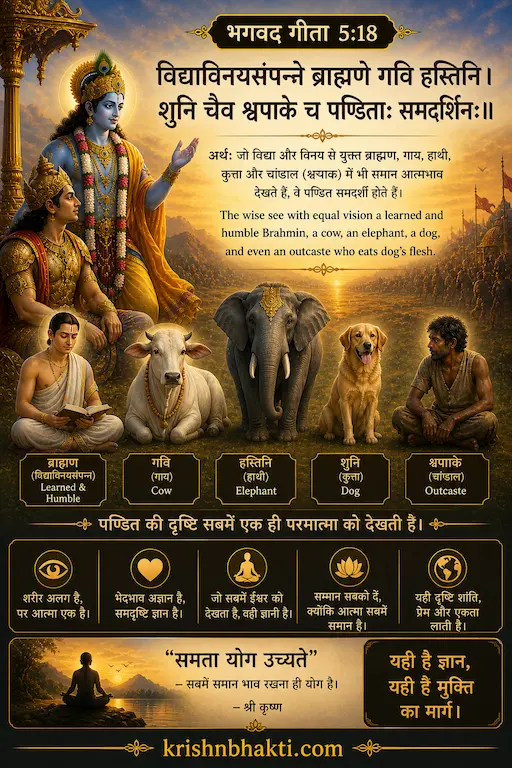
विद्याविनयसंपन्ने ब्राह्मणे गवि हस्तिनि।
शुनि चैव श्वपाके च पण्डिताः समदर्शिनः॥
— Bhagavad Gita, Chapter 5, Verse 18
Breaking Down the Verse — Word by Word
"Vidyā-vinaya-sampanne brāhmaṇe" — in a brahmin endowed with learning and humility. The most respected figure in the social order.
"Gavi" — in a cow. Sacred, gentle, revered in Indian culture.
"Hastini" — in an elephant. Powerful, majestic, imposing.
"Śuni" — in a dog. Considered low, unclean in ancient social hierarchy.
"Śvapāke" — in an outcaste, a chandala. The lowest rung of the social ladder.
"Paṇḍitāḥ sama-darśinaḥ" — the wise see equally. The same vision across all of them.
Notice what Krishna did here. He didn't choose similar examples. He chose the widest possible range — from the most learned human to a street dog, from the sacred cow to the social outcast. And he said: the wise person sees the same thing in all of them.
The Question That Immediately Comes Up — Does "Equal Vision" Mean Treating Everyone Identically?
No. And this is the most important distinction.
Srila Prabhupada, in Bhagavad Gita As It Is, is very clear on this: sama-darśinaḥ does not mean erasing all practical distinctions. A doctor and a janitor are not given the same medical responsibilities. A teacher and a student are not treated with identical protocol. Sama-darśinaḥ operates at the level of the soul — the recognition that in every body, regardless of its form or social position, there is the same spark of the Supreme. The vision is equal. The behavior adapts to context.
Swami Mukundananda frames this beautifully: when we judge someone, we are judging their costume, not them. Their body, their status, their background — these are the costume. The soul wearing it is the same across every form. The paṇḍita — the truly wise person — has learned to look past the costume.
Gita Press draws special attention to "vidyā-vinaya-sampanne" — not just knowledge, but knowledge combined with humility. This pairing is not accidental. Real knowledge always produces humility, because the more you understand, the more you realize how much you don't know. And an arrogant person cannot be sama-darśī — because arrogance is itself a form of unequal vision, placing oneself above others.
Let Me Ask Something Honest — Can We Actually Stop Judging?
Yes. But not by suppressing it — by replacing the lens.
The human brain is wired to categorize. It's not a moral failure; it's evolutionary machinery. Safe or unsafe. Familiar or unfamiliar. Like me or not like me.
The Gita isn't asking you to delete that machinery.
It's asking you to install a different operating belief underneath it — one that runs quietly in the background of every interaction:
"The same soul that is in me is in this person. In this animal. In this form I would normally dismiss."
When that belief becomes real — not philosophical, but genuinely felt — judgment doesn't disappear, but it loses its edge. Because when you see yourself in someone else, diminishing them becomes difficult.
A Story From the 21st Century
There's a senior executive — successful, respected, used to a certain kind of company. At a conference, the most useful conversation she has all day is with the janitor cleaning the corridor outside the venue. He grew up near the area where she's about to expand her business. He knows things no consultant has told her.
But she almost didn't stop to talk. She almost walked past.
Her instinct was to file him under "not relevant."
That instinct — that filing system — is what this verse addresses.
The paṇḍita would have stopped. Not because they calculated the ROI of the conversation. But because they have no category called "not worth seeing." Every form holds the same soul. Every encounter is worth presence.
What Sama-Darśinaḥ Looks Like in 2025
The "chandala" and the "dog" of this verse have modern equivalents.
It's the delivery person whose name you never learn.
It's the colleague from a background you don't understand.
It's the person whose opinion you dismissed before they finished speaking.
It's the animal suffering somewhere you chose not to look.
Sama-darśinaḥ doesn't mean performing equality. It means genuinely seeing it — in the moment, in the person in front of you, in the form you would ordinarily overlook.
And here's what changes when you develop this vision:
You stop needing to feel superior. Because when you see the same soul in everyone, the whole game of "above" and "below" loses its appeal. There's nothing to win. There's no one to beat. There's just — this person, this soul, this moment.
That is freedom. That is what the paṇḍita carries with them everywhere.
Three Ways to Develop the Equal Eye
1. Practice the recognition — make it a daily habit.
Prabhupada emphasizes that sama-darśinaḥ is not a sudden enlightenment — it's a cultivated vision. Start small: once a day, when you meet someone you would normally overlook, pause internally and recognize — "This person carries the same soul I do." It feels mechanical at first. Over time, it becomes sight.
2. Ask one question before you judge.
Swami Mukundananda suggests this practice: when the mind begins to assess and rank someone, stop and ask — "Am I seeing their body or their soul?" That single question doesn't eliminate judgment, but it creates a gap. And in that gap, the equal eye begins to open.
3. Let knowledge produce humility.
Gita Press reminds us that vidyā and vinaya travel together. The more genuinely you learn — about life, about people, about the nature of consciousness — the harder it becomes to feel superior. Real knowledge reveals how little any of us know, and how much any of us share. Arrogance thrives on partial understanding. Humility is what full understanding produces.
The Eye That Changes Everything
You don't need to go anywhere to practice this.
The person in the elevator. The colleague you find difficult. The stranger on the street. The animal you passed without looking.
They are all wearing different costumes. Different bodies, different stories, different social coordinates.
But underneath every costume — the same soul. The same spark. The same source.
The paṇḍita is not someone who knows more facts.
The paṇḍita is someone who sees more clearly.
And when you begin to see clearly — really clearly — the world doesn't just look different. It feels different. Because you stop moving through it as someone separate from everything, and start moving through it as someone connected to everything.
That is the equal eye. That is what this verse is pointing to.
To read...
Gita Shloka 5.17 , "Can't Stop Overthinking? The Gita Has a Way Out — 5:17 Explained"
https://krishnbhakti.com/english-blogs/gita-shloka-5-17-cant-stop-overthinking