When was the last time you felt genuinely satisfied?
Not the satisfaction of getting something you wanted — that kind fades within hours. Not the relief of finishing something difficult — that disappears by the next morning. Not the high of being praised or recognized — that lasts a day, maybe two.
When was the last time you felt a joy that simply stayed?
Most people, if they are honest, cannot remember. Because most people have spent their entire lives looking for that joy in places it has never actually been — in the next purchase, the next achievement, the next experience, the next relationship.
The search continues. The satisfaction never quite arrives.
The Gita says the search is real. The direction is wrong.
In Chapter 5, Verse 21, Krishna points to a joy that doesn't depend on anything outside you — and explains, with remarkable precision, how it is found.
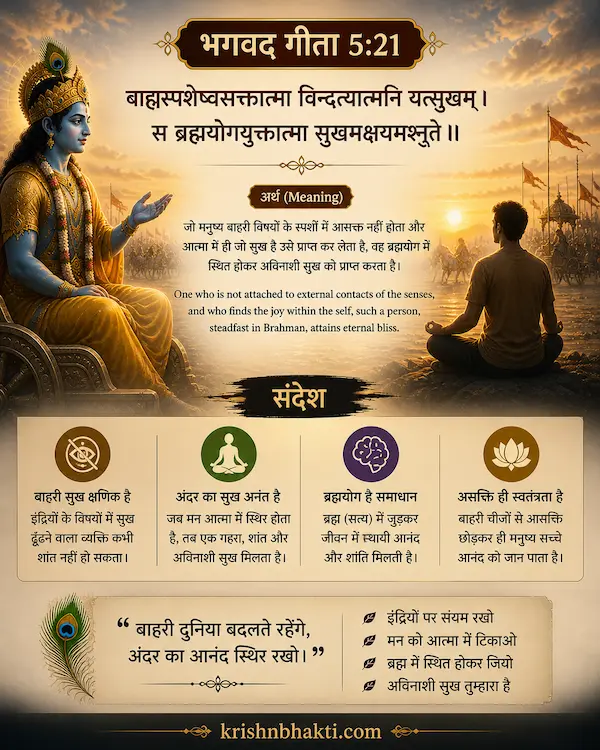
बाह्यस्पर्शेष्वसक्तात्मा विन्दत्यात्मनि यत्सुखम्।
स ब्रह्मयोगयुक्तात्मा सुखमक्षयमश्नुते॥
— Bhagavad Gita, Chapter 5, Verse 21
Breaking Down the Verse — Word by Word
"Bāhya-sparśeṣu asakta-ātmā" — the one whose self is unattached to external contacts. "Bāhya-sparśa" means the touch of external sense objects — sights, sounds, tastes, sensations, smells. "Asakta" means not clinging, not dependent.
"Vindaty ātmani yat sukham" — finds the joy that exists within the self. Not creates it. Not earns it. Finds it — as something already present, waiting to be discovered.
"Sa brahma-yoga-yukta-ātmā" — that soul united with Brahma-yoga. Connected to the Supreme through the yoga of inner union.
"Sukham akṣayam aśnute" — experiences inexhaustible joy. "Akṣaya" — that which does not decay, diminish, or disappear. Ever.
The Question That Immediately Comes Up — Does This Mean Giving Up All Pleasure?
No. And this is where so many people misread the Gita entirely.
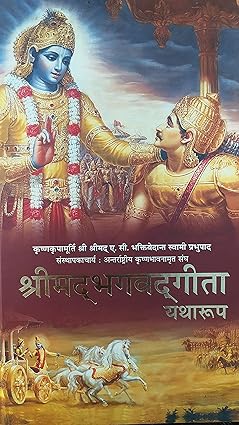
Srila Prabhupada, in Bhagavad Gita As It Is, is precise on this: "asakta" does not mean forced renunciation. It means non-clinging. The difference is enormous. You can eat a beautiful meal without being enslaved to the need for one. You can enjoy good music without being unable to function without it. You can appreciate beauty without pursuing it compulsively. The senses still function — but the mind is no longer their servant.
Swami Mukundananda frames the contrast clearly: external joy always requires an external condition. If the condition is absent, the joy is absent. You need the good news, the beautiful experience, the satisfying meal. Remove any of those and the joy vanishes. Inner joy — the joy the Gita describes — requires no external condition. It is already present within. The practice of Brahma-yoga is simply the process of uncovering what was always there.
Gita Press draws special attention to "akṣayam" — inexhaustible, imperishable. Every external pleasure is by nature temporary. It arrives, peaks, fades, and disappears. Sometimes it is taken away. Sometimes it simply wears out. But the joy of the soul — rooted in Brahman, independent of circumstance — does not follow this pattern. It does not fade because it does not depend on conditions that change.
Have You Ever Touched This Inner Joy Without Knowing It?
Yes. Almost certainly.
There are moments — brief, unexpected, easily overlooked — when this inner joy surfaces naturally.
The moment you did something genuinely kind for someone with no expectation of return — and felt, quietly, something that had nothing to do with being seen or thanked.
The morning you sat in complete silence before the world started — no screen, no input — and noticed something peaceful that was already there.
The afternoon you were so absorbed in work you loved that hours passed without your awareness — and in that absorption, there was a fullness that had nothing to do with results.
These are glimpses. Flashes of what the Gita is describing.
The joy was always there. The external noise was simply too loud for it to be heard.
What Is Brahma-Yoga? — Simply Explained
"Brahma-yoga" sounds like a complex esoteric practice.
It is actually very simple.
Brahman — the Supreme, the eternal consciousness that underlies all existence.
Yoga — union, connection.
Brahma-yoga — remaining connected to the Supreme.
This connection happens naturally when the mind stops running outward. When the senses are not constantly chasing stimulation. When a space is created inside — however small — where stillness can exist.
Prabhupada explains that this is not an overnight transformation. It is a gradual process. As external attachment loosens — slowly, through practice — the inner joy begins to surface. And as the inner joy surfaces, the compulsive chase for external pleasure begins to relax. Not because pleasure becomes bad, but because the deeper thirst has finally found water.
What "Bāhya-Sparśa" Looks Like in 2025
Krishna used "bāhya-sparśa" — external sense contacts.
In today's world, these contacts have multiplied beyond anything any previous generation faced.
The infinite scroll — each swipe delivering a new hit of stimulation, each hit requiring the next one.
Compulsive shopping — the purchase brings a brief lift, the excitement fades within days, the emptiness returns, the next purchase beckons.
The validation hunger — unable to feel settled without checking how the post performed, how people responded, whether someone approved.
The discomfort with silence — the inability to sit alone without filling the space immediately, because the quiet reveals something we have been running from.
All of this is "bāhya-sparśa." All of this is the direction away from the joy the Gita describes.
Swami Mukundananda puts it plainly: the further you go outward, the further you move from the inner source. The further you go inward, the closer you get to the inexhaustible joy.
Three Practical Pathways Toward the Joy Within
1. Give the senses small pauses.
Prabhupada points to "asakta-ātmā" as something built through practice. Start small: when an impulse arises, pause before following it. Not suppress it — pause. The impulse to scroll, to check, to snack, to fill silence — pause for one moment. That pause is not denial. It is the beginning of freedom from compulsion. And in that freedom, a small opening toward the inner appears.
2. Make friends with silence.
Gita Press reminds us that inner joy is not found in noise. Set aside a few minutes daily — genuinely device-free, genuinely quiet. It will feel uncomfortable at first, because the nervous system has been trained to expect constant input. But consistency matters more than duration. Five minutes of real stillness, practiced daily, begins to open access to something that was always there but never heard.
3. Practice Brahma-yoga through devotion.
Swami Mukundananda emphasizes that the most accessible form of Brahma-yoga is bhakti — devotional connection. Prayer, kirtan, scripture reading, time spent in genuine gratitude — these are not rituals for their own sake. They are practices of inner turning. Each one is a small movement from the external toward the source. And as that movement becomes habitual, the joy the verse promises begins to become a lived experience rather than a philosophy.
The Joy That Does Not Fade
We spend our lives accumulating conditions for happiness.
The right job, the right relationship, the right amount of money, the right recognition, the right experiences.
And sometimes those conditions arrive. And the happiness comes — briefly, genuinely, really.
And then it fades. And we begin assembling the next set of conditions.
The Gita is not saying this is wrong. It is saying this is incomplete.
Because the joy you are actually looking for — the one that doesn't fade when the conditions change, the one that is there in the morning before anything has happened, the one that stays through difficulty as well as ease — that joy has a different address.
It is inside. It has always been inside.
The practice of Brahma-yoga is simply the practice of turning around — from the outward chase toward the inward source.
And what you find there — akṣayam, inexhaustible, imperishable — is what you were looking for in every external thing you ever sought.
To read
The Art of Non-Reaction: Why Being Unshakable is the Ultimate Power. 👇👇
https://krishnbhakti.com/english-blogs/gita-shloka-5-20-art-of-non-reaction-unshakable-mind