Think about the last thing you really wanted.
Before you got it — the anticipation, the restlessness, the constant thinking about it.
The moment you got it — the rush, the satisfaction, the sense of completion.
A few days later — the familiar emptiness returning, quieter than before, but there.
And then — the next thing beginning to take shape in your mind.
If you are honest, this pattern is not new. It has been running your entire life.
Something is wanted. Something is obtained. Something fades. Something new is wanted.
Most people assume this is just how happiness works — temporary by nature, always requiring replenishment.
The Gita says this is not happiness. This is the architecture of suffering disguised as pleasure.
And in Chapter 5, Verse 22, Krishna explains exactly why — with a clarity that cuts through every rationalization we use to keep chasing.
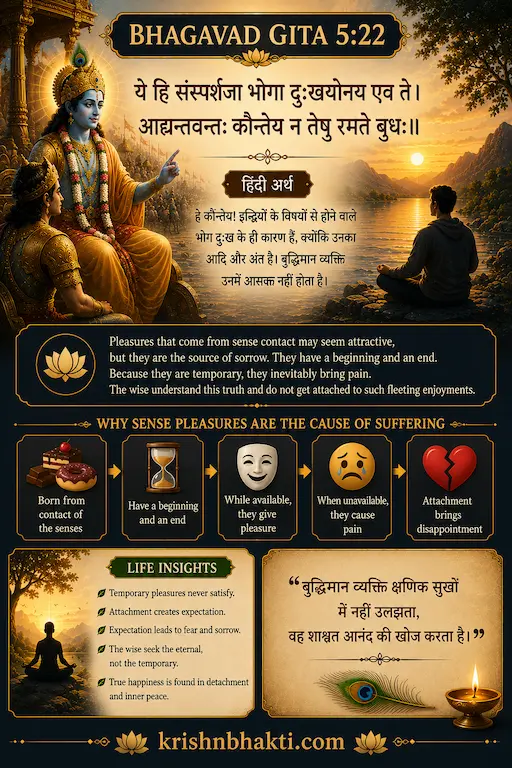
ये हि संस्पर्शजा भोगा दुःखयोनय एव ते।
आद्यन्तवन्तः कौन्तेय न तेषु रमते बुधः॥
— Bhagavad Gita, Chapter 5, Verse 22
Breaking Down the Verse — Word by Word
"Ye hi saṁsparśa-jā bhogāḥ" — the pleasures that are born of contact with the senses. Seeing, hearing, tasting, touching, smelling — every pleasure that arrives through the five sense organs.
"Duḥkha-yonaya eva te" — they are indeed the source of suffering. "Eva" — certainly, without doubt. Krishna leaves no room for exceptions.
"Ādy-antavantaḥ" — they have a beginning and an end. What begins, ends. Without exception.
"Kaunteya" — O son of Kunti. An intimate address — Krishna speaking directly, personally.
"Na teṣu ramate budhaḥ" — the wise person does not find delight in them. Not because they are forbidden. But because the wise person has seen through them.
The Question That Needs Answering — Is the Gita Against Pleasure?
No. And this distinction matters more than almost anything else in reading this verse correctly.
Srila Prabhupada, in Bhagavad Gita As It Is, explains that Krishna is not condemning sensory experience. He is describing its nature accurately. Sensory pleasures are "duḥkha-yonaya" — sources of suffering — for three specific reasons. First, the craving before obtaining creates restlessness and agitation. Second, even after obtaining, full satisfaction rarely arrives — the pleasure is less than anticipated and fades faster than expected. Third, loss of what was enjoyed brings pain proportional to the attachment. The wise person is not one who never enjoys — they are one who has seen this mechanism clearly enough not to be enslaved by it.
Swami Mukundananda focuses on "ādy-antavantaḥ" as the key phrase. What has a beginning has an end — this is not philosophy, it is physics. Every sensory pleasure is finite by definition. And when we build our happiness on finite things, we are mathematically guaranteeing future suffering. Not as a possibility. As a certainty. The wise person has done this calculation and chosen differently.
Gita Press draws attention to the word "eva" — certainly, indeed. This is not a suggestion or a possibility. Krishna is stating the nature of sensory pleasure as fact. The source of suffering. Always. The only variable is how quickly it manifests — before, during, or after the pleasure. But it always does.
Three Ways Sensory Pleasure Becomes Suffering
This is the mechanism worth understanding deeply.
Before obtaining — the suffering of craving.
The desire for something activates restlessness. The mind cannot rest until the object is acquired. Sleep is disturbed. Attention scatters. The object is not yet in your life, but its shadow — the craving — already is. And craving is suffering.
After obtaining — the suffering of fading.
The new car feels extraordinary for two weeks. Then ordinary. Then just a car. The exciting relationship becomes familiar. The dream job becomes routine. The body adjusts, the novelty dissolves, and the pleasure — which felt like it might last — is already leaving. And as it fades, the hunger for the next thing begins.
After losing — the suffering of grief.
Whatever was loved and lost takes something with it. The greater the attachment, the deeper the wound. And since everything sensory is by nature temporary — everything sensory will eventually be lost.
This three-part mechanism is what Krishna calls "duḥkha-yonaya." Not a judgment. A description of how it actually works.
What This Looks Like in 2025
The objects change. The mechanism is identical.
The dopamine loop — every notification, every like, every scroll delivers a micro-hit of pleasure. And because each hit is so small and so brief, the next one is needed almost immediately. The phone is never fully satisfying. It is also never fully put down. "Ādy-antavantaḥ" — beginning, ending, beginning again, endlessly.
The consumption cycle — the purchase brings genuine excitement. Within days, the object is background. The excitement has left, but the credit card bill remains. The next purchase is already forming in the imagination.
Comparison and FOMO — seeing someone else's sensory pleasure and generating suffering from it in your own mind. Not even obtaining the pleasure yourself — just observing it in others creates the craving, and craving, as established, is already suffering.
Swami Mukundananda observes — the mechanism has never changed across human history. Only the delivery systems evolve. The suffering that follows sensory attachment in ancient India is the same suffering that follows sensory attachment in the age of smartphones. The Gita's diagnosis is timeless because human nature is timeless.
Who Is the "Budhaḥ" — And What Do They Know?
Krishna says the wise person — budhaḥ — does not find delight in these pleasures.
But who is this wise person?
Not necessarily the most educated. Not the most accomplished. Not the most spiritually advanced in any conventional sense.
The budhaḥ is simply someone who has seen clearly.
They have watched the mechanism enough times — in their own experience — to recognize the pattern. They have chased enough things, obtained enough things, lost enough things, to understand that the promise embedded in sensory pleasure is structurally false. Not maliciously false. Just — unable to deliver what it seems to offer.
And seeing this clearly, they stop running. Not from fear. Not from discipline alone. But from understanding.
Like someone who has seen through a magic trick — it can still be watched and even enjoyed, but it no longer has the power to deceive. The wise person can taste good food without being governed by the need for it. They can enjoy beauty without being enslaved to it. They can receive praise without building their identity on it.
This is not detachment as suppression. This is detachment as clarity.
Three Practical Shifts From Gita 5:22
1. See the mechanism before you enter it.
Prabhupada points to awareness as the first step. Before following any strong sensory impulse, pause for one breath and ask: "What is the full arc of this? The craving before, the fading after, the loss eventually — am I choosing this consciously?" This is not designed to eliminate pleasure. It is designed to restore agency over it.
2. Practice "ādy-antavantaḥ" as a daily reminder.
Gita Press suggests holding the truth of impermanence actively rather than theoretically. When something is giving you great pleasure, acknowledge: this has a beginning, it has an end. When something is causing you great pain, acknowledge the same. This is not pessimism. It is the steady application of accuracy — and accuracy is the foundation of the wise person's peace.
3. Invest in what does not end.
Swami Mukundananda consistently returns to this: the solution to the trap of sensory pleasure is not suppression but substitution. When the inner joy described in the previous verse — the akṣayam, the inexhaustible — begins to be tasted, the pull of the sensory diminishes naturally. You don't renounce the lesser joy through willpower. You simply discover a greater one, and the lesser gradually loses its grip.
The Invitation You Keep Sending
Every time you chase a sensory pleasure compulsively — without seeing its nature — you are sending an invitation.
An invitation to restlessness, before it arrives.
An invitation to disappointment, when it fades faster than expected.
An invitation to grief, when it is eventually lost.
The Gita is not asking you to stop living.
It is asking you to stop sending invitations you haven't read carefully.
The wise person reads the invitation. They see what it actually promises and what it actually delivers. And having seen clearly, they make different choices — not out of fear or austerity, but out of genuine understanding.
Because once you have seen through the trap, you are no longer trapped by it.
That seeing — clear, honest, undeluded — is what the Gita calls wisdom.
To read
Beyond Sensory Pleasures: Finding Joy Within.👇👇
https://krishnbhakti.com/english-blogs/gita-shloka-5-21-beyond-sensory-pleasures-finding-joy-within