When was the last time you were completely alone — no screen, no music, no distraction — and felt genuinely at peace?
For most people, that question is uncomfortable.
Because most people, when the external stimulation stops, discover not peace but restlessness. An itch to fill the silence. An impulse to reach for the phone, to turn on something, to talk to someone — anything to avoid the feeling of simply being with themselves.
Why is being alone so difficult?
Because we have spent our entire lives training ourselves to look outward. Joy is supposed to come from something — an achievement, a relationship, an experience, a purchase. Peace is supposed to arrive when the right conditions fall into place.
The Gita says this entire orientation is backwards.
And in Chapter 5, Verse 24, Krishna describes the person who has turned around — who has found what was inside all along — and calls them the only one who truly arrives.
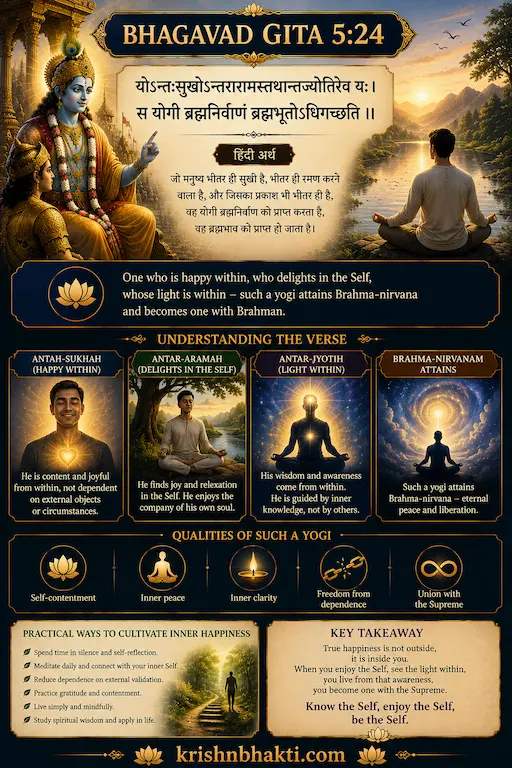
योऽन्तःसुखोऽन्तरारामस्तथान्तर्ज्योतिरेव यः।
स योगी ब्रह्मनिर्वाणं ब्रह्मभूतोऽधिगच्छति॥
— Bhagavad Gita, Chapter 5, Verse 24
Breaking Down the Verse — Word by Word
"Yaḥ antaḥ-sukhaḥ" — one who is happy within. Whose happiness does not depend on external conditions.
"Antar-ārāmaḥ" — one who delights within. Who finds play, rest, and enjoyment in the inner world. "Ārama" means rest, but also delight — the kind of ease that comes from being truly at home somewhere.
"Tathā antar-jyotiḥ" — and one who is illumined within. Whose light — whose knowledge, wisdom, clarity — comes from inside, not outside.
"Eva yaḥ" — certainly, this person.
"Sa yogī" — that person is a yogī. The real yogī — not merely one who practices postures, but one whose entire being is oriented inward.
"Brahma-bhūtaḥ" — having become Brahman, having taken on the nature of the Supreme.
"Brahma-nirvāṇam adhigacchati" — attains Brahma-nirvana. The supreme liberation. The ultimate peace.
Three "Antar" — Three Inner Powers
Notice what Krishna did in this verse.
He used the word "antar" — within, inner — three times. Antaḥ-sukha. Antar-ārama. Antar-jyoti.
This is not poetic repetition. This is a map.
Srila Prabhupada, in Bhagavad Gita As It Is, explains that these three qualities together describe a person who has become completely self-sufficient in the deepest possible sense. Not self-sufficient in the cold, isolated way that word sometimes implies — but self-sufficient like the sun. The sun does not need an external source of light. It is the source. The person described in this verse has discovered their inner sun.
First — Antaḥ-sukha — inner happiness.
The happiness that requires no external condition. Not happiness despite circumstances — happiness independent of circumstances entirely. This is not the happiness of getting what you want. It is the happiness of no longer needing things to be a certain way in order to be okay. It is the deepest, most stable foundation a human being can have.
Second — Antar-ārama — inner delight.
The word "ārama" carries the sense of play, rest, and enjoyment. The person of antar-ārama finds genuine delight in their own inner world. Solitude is not a punishment for them — it is a pleasure. They are not dependent on external entertainment, external company, or external stimulation to feel alive and engaged. They carry their own companionship.
Third — Antar-jyoti — inner light.
Swami Mukundananda focuses particularly on this quality. The inner light is the light of wisdom that does not depend on external sources — no book, no teacher, no validation needed to sustain it. This doesn't mean rejecting teachers or books — it means the understanding has moved from the head to the bones. It has become one's own. The person illumined from within does not need to borrow their confidence from others' opinions.
The Question That Matters — Is This Available to Anyone?
Yes. And the story of Ramana Maharshi is perhaps the most powerful illustration of what this verse actually looks like in a human life.
At sixteen years old, Ramana was a completely ordinary boy. No spiritual training, no special background.
One afternoon, an intense and sudden fear of death arrived.
He lay down on the floor and submitted to it — asked himself, fully and honestly: "What happens when I die?"
He noticed that the body would go. The mind would go. But something — some witnessing presence — seemed to remain. He looked for that presence directly, tracing back every "I" to its source.
What he found in that moment changed everything.
He realized that the "I" he had always assumed he was — the body, the personality, the history — was not the real "I." The real "I" was something prior to all of that. Something that was not born and would not die. Something that was, in the Gita's language, "antaḥ-sukha" — happiness itself, not a person who sometimes felt happy.
He spent the rest of his life at the foot of a mountain in South India. No wealth, no conventional comforts, no public life for many years.
And by every account of everyone who encountered him, he was among the most radiantly peaceful human beings who ever lived.
Not despite the absence of external pleasures — independent of them entirely.
This is "antaḥ-sukha." This is "antar-jyoti." This is what Gita 5:24 is describing.
Why Are We Running Outward?
We live in the most externally connected era in human history.
Infinite content. Constant stimulation. Every desire that arises can be addressed within minutes — a delivery, a stream, a search.
And yet depression, anxiety, and reported loneliness have never been higher.
Swami Mukundananda points to the mechanism: the further we go outward, the further we move from the inner source. External pleasures do not nourish the inner — they distract from it. And what goes unatttended atrophies. The inner world, perpetually ignored in favor of external stimulation, becomes unfamiliar. And unfamiliar becomes frightening. And frightening becomes something we run from.
The person who cannot sit quietly with themselves for ten minutes is not merely restless. They have lost access to the most important territory they possess.
The Gita's invitation in this verse is not to abandon the world. It is to reclaim what was always inside it.
Three Practical Ways to Turn Inward
1. Sit in silence every morning — genuinely device-free.
Prabhupada points to stillness as the doorway. Ten minutes before reaching for any device. No music, no podcast, no scroll. Simply sit. The first days will produce restlessness — that restlessness itself is data. It shows how thoroughly you have been trained to look outward. Persist. Within a few weeks, something begins to shift. A quietness appears that was always there, simply never listened for.
2. Ask the question "Who am I?" — not philosophically, but as an inner investigation.
Swami Mukundananda returns to Ramana Maharshi's central practice: self-inquiry. Not as an intellectual exercise but as a turning of attention. When you notice yourself reacting to something, pause and ask: who is noticing this? Who is the "I" that is upset, or pleased, or afraid? Trace the question inward rather than answering it outward. What you find — or what finds you — is what the verse is pointing to.
3. Use devotion as a vehicle for inward turning.
Gita Press describes bhakti as the most accessible path to "brahma-bhūta" — becoming established in the nature of Brahman. When you pray, chant, or read scripture with genuine attention — not as ritual but as relationship — something in the inner world opens. The connection is not to something outside. It is to the source that is inside. Each practice of genuine devotion is a small movement from the periphery toward the center.
The Journey That Requires No Passport
We spend our lives traveling outward.
New cities. New experiences. New relationships. New achievements.
Each one promising something. Each one delivering something. Each one, eventually, leaving the fundamental question unanswered.
The Gita says the journey that actually answers the question goes in a different direction.
No ticket required. No visa. No packing. No departure gate.
Just this — turn around. Look at what is looking. Find the one who has been searching.
The happiness you find there — antaḥ-sukha — is not conditional. It does not fade. It does not require replenishment. It was never earned and cannot be taken away.
That is the Gita's timeless mantra for finding yourself.
Look inward. What you are looking for has been looking back at you all along.
To read
Beyond Reactions: How to Master Your Inner Impulses Before It's Too Late.👇👇
https://krishnbhakti.com/english-blogs/gita-shloka-5-23-beyond-reactions-master-inner-impulses