Are You Afraid of Losing What You Have?
In the previous verse, we witnessed Arjuna standing in the middle of the battlefield, paralyzed by grief. He looked at his relatives, his gurus, and his friends, and his heart sank. He dropped his bow and declared, "I will not fight." This scene is not just an ancient story; it is the exact mental state of millions of young people today. We are caught in the tug-of-war between our responsibilities and our emotional attachments.
We often tie our identity to the roles we play. We define ourselves by our designations, our relationships, our social media followers, and our bank accounts. Because we believe we ARE these things, we live in constant terror of losing them. We stay in toxic relationships because we fear being alone; we stick to jobs we hate because we fear the uncertainty of the future. The fear of 'losing' is the biggest prison we build for ourselves.
Krishna's response to Arjuna is the ultimate liberation from this prison. He doesn't tell Arjuna to stop feeling; He tells him to change his perspective. He reveals a truth that shatters the foundation of all our worldly fears: the truth that the real 'You'—the soul—was never born and can never die. This verse is not just about a war; it is about the fundamental reality of existence.
For the youth of today, this message is a lifeline. In a world of infinite comparisons, where we feel insecure about our looks, our career progress, and our status, Krishna reminds us that these are just temporary roles in a grand play. You are the actor, not the costume. Once you understand this, the pressure to 'perform' for the world begins to vanish.
Imagine you are watching a movie. One character dies, another gets rich, and a third loses everything. Do you panic? No, because you know they are just playing their parts. Krishna is teaching Arjuna (and us) to witness our own lives with the same detachment. It doesn't mean you stop living; it means you stop being consumed by the temporary ups and downs of existence.
This verse is the antidote to modern anxiety. If you feel like your life is falling apart because of a breakup, a failure, or a loss, remember that your essential being remains untouched. You have existed before this life, and you will continue to exist after this phase passes. This is the ultimate grounding mechanism for anyone feeling lost in the modern world.
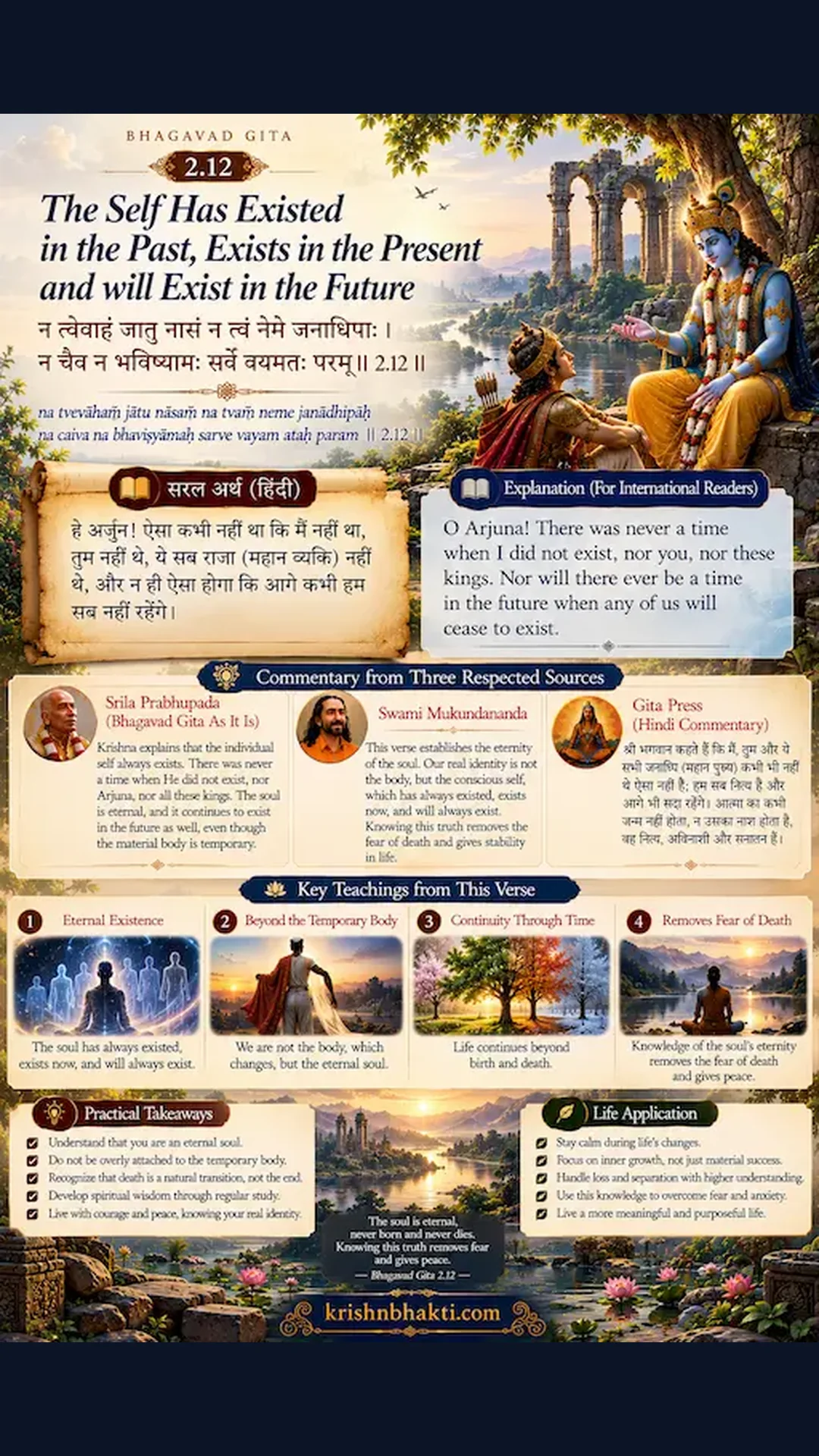
न त्वेवाहं जातु नासं न त्वं नेमे जनाधिपाः ।
न चैव न भविष्यामः सर्वे वयमतः परम् ॥ २.१२ ॥
Simple Meaning:
Na tu eva aham jaatu na aasam (There was never a time when I did not exist) na tvam (nor you) na ime janaadhipaah (nor these kings).
Na cha eva na bhavishyaamah sarve vayam atah param (nor will there be a time in the future when we will cease to exist).
Krishna explains that the soul is eternal. We are all individual, conscious beings, and this individuality continues through past, present, and future.
This shloka teaches us that while bodies are temporary, the consciousness dwelling within is eternal. We change clothes; we don't change ourselves. Similarly, the soul changes bodies, but it remains unchanged.
Perspective of Swami Ramsukhdas Ji
Swami Ramsukhdas Ji emphasized that Krishna is stating an absolute fact here. He explains that the "I" (the soul) is not dependent on the body. He often used the analogy of sleep: when you are in deep sleep, your body is there, but your mind is elsewhere. Who is that 'witness' observing the silence? That is your true self.
Swami Ji points out that Arjuna's grief is rooted in 'Ajnaana' (ignorance). He mistakes the body for the soul. The Swami teaches that until we identify with the soul, we will always be subject to the fear of death and loss. He encourages us to practice 'Self-remembrance' throughout the day to slowly detach from the anxiety of the changing body.
Bhaktivedanta Swami Prabhupada's Devotional Lens
Prabhupada emphasizes the individuality of the soul and God. He points out that Krishna says "I, you, and these kings"—implying that even the Lord and the living entities are distinct, eternal beings. This verse is a direct refutation of those who claim that death brings an end to the soul or that we all merge into one 'nothingness'.
For Prabhupada, this is the beginning of the devotional relationship. By understanding our eternal nature, we realize that we belong to Krishna. The fear of death is replaced by the joy of eternal service. He frames this not as a cold philosophy but as a warm, loving relationship that lasts forever.
Modern Wisdom by Swami Mukundananda Ji
Swami Mukundananda Ji bridges the gap between ancient philosophy and modern psychology. He explains that 90% of our stress is 'future-tripping'. We worry about scenarios that might never happen. He uses the analogy of a software program: your body is the hardware, and the soul is the software. When the hardware crashes, the software doesn't get destroyed; it just moves to another system.
He encourages us to cultivate 'Detached Involvement'. Do your work with full intensity, but don't lose your peace of mind over the outcome. Since you are eternal, no professional setback or personal loss can actually define or destroy you.
Practical Application in Daily Life
Imagine you are stressed about an upcoming job interview. You feel like your life depends on it. Instead of panicking, take a deep breath and remind yourself: "This interview is just a role I am playing. My true existence is independent of this success or failure." This simple shift in thinking removes the paralyzing fear and allows you to perform better.
Or consider the loss of a loved one. The pain is natural, but the suffering can be eased by understanding that the soul is never truly gone. We are all on a journey, and our paths will cross again. This wisdom helps us move through grief with grace rather than despair.
Q&A: Addressing Your Doubts
Does this mean I should stop working hard if everything is temporary?
Swami Ramsukhdas Ji clarifies that since you have a body, you must perform your 'Dharma' (duties). The knowledge of eternity makes you a better worker, not a lazy one, because you work without the fear of loss.
How do I stay in this state of mind when life gets chaotic?
Swami Mukundananda Ji suggests daily practice: meditate for 10 minutes, consciously separating your thoughts from your 'Self'. As you practice this daily, it becomes your default reaction to stress.
🙏 Hare Krishna — Jai Shri Krishna 🙏
📖 Also Read: What Krishna Says When Everything Falls Apart in Life 🌸