When Life Shakes Your Happiness and Sorrow, This Gita Verse Holds You — Gita 2.15 🌿
📅 2026-07-01 | Bhagavad Gita Wisdom Series
In the previous verse, Lord Krishna taught Arjuna how to endure the dualities of cold and heat, pleasure and pain, explaining that these arise purely from the contact of the senses with their objects and are temporary, coming and going like seasons. Naturally, a profound question arises in Arjuna's mind: if these experiences are fleeting and bring either happiness or sorrow, how is a human being supposed to endure them all? What is that inner psychological state where these external circumstances stop breaking us from within? Every single one of us is grappling with this exact question in our daily lives today. Whether it is the sudden failure of a crucial meeting at the office, the lingering fear of sudden job loss, a sharp and hurtful remark from a loved one at home, or the gnawing feeling of inadequacy when seeing someone else's success on social media — what are all these? These are the modern equivalents of the very same pleasures and pains that constantly fluctuate the temperature of our minds.
One of our greatest flaws as human beings is that we take every little circumstance far too seriously. When everything is going smoothly in life, our bank balances are growing, relationships are harmonious, we tend to fly high in the sky. We become so convinced that this happiness is going to last forever, completely ignoring the uncertainties of the future. But the moment the wheel of life turns and we hit a bump — whether it is a painful breakup, a career downslide, or a sudden health scare — we completely shatter. It feels as if the end of the world has arrived. We lie awake at night wondering why this happened only to us, and whether God is angry with us.
Here, a massive mental misconception comes into play. People often think that being spiritual means you will stop feeling sorrow altogether. People assume that someone who worships God, reads the Gita, or meditates will never cry, never feel depressed, and never experience anxiety. This is a profound misunderstanding. Lord Krishna is never saying that you will not feel pleasure or pain. Krishna is saying that the arrival of happiness and sorrow at the physical level is natural, but how your consciousness reacts to them is entirely in your hands.
When a tragic event occurs, feeling sad in the body and mind is a biological reaction. Tears welling up in your eyes are not a sign of weakness; rather, they are the mind's natural ventilation system releasing built-up pressure. The problem begins when we attach our identity to that sorrow and start believing 'I am miserable'. Krishna wants to shatter this illusion. He wants to teach Arjuna, and every lost youth of today, that you are not what is happening outside; rather, you are the observer watching all of it.
Imagine sitting in your room while outside, a torrential downpour is raging along with fierce winds, rain droplets striking the windowpanes rapidly. Is that rain entering your room? If your room is tightly sealed and your roof is secure, no matter how fiercely the storm rages outside, it cannot get you wet. In the same way, this material world is like a changing season. Sometimes the sunshine of success will bloom, sometimes the storm of failure will blow, sometimes the cold wind of criticism will chill. But if the room of your consciousness is grounded and strong, these external weather patterns will only graze past you on the outside, leaving your inner peace untouched.
The greatest crisis facing today's generation is that we take everything personally. If someone doesn't like our post on Instagram, we start feeling an inner void. If a boss scolds us in front of everyone at the office, we lose sleep for two nights. It feels as though our entire self-worth is tethered to the validation of others. We hand over the remote control of our happiness to everyone else. If someone praises us, we feel like royalty; if someone criticizes us, we crash to the floor. Krishna offers an infallible formula to pull us out of this instability.
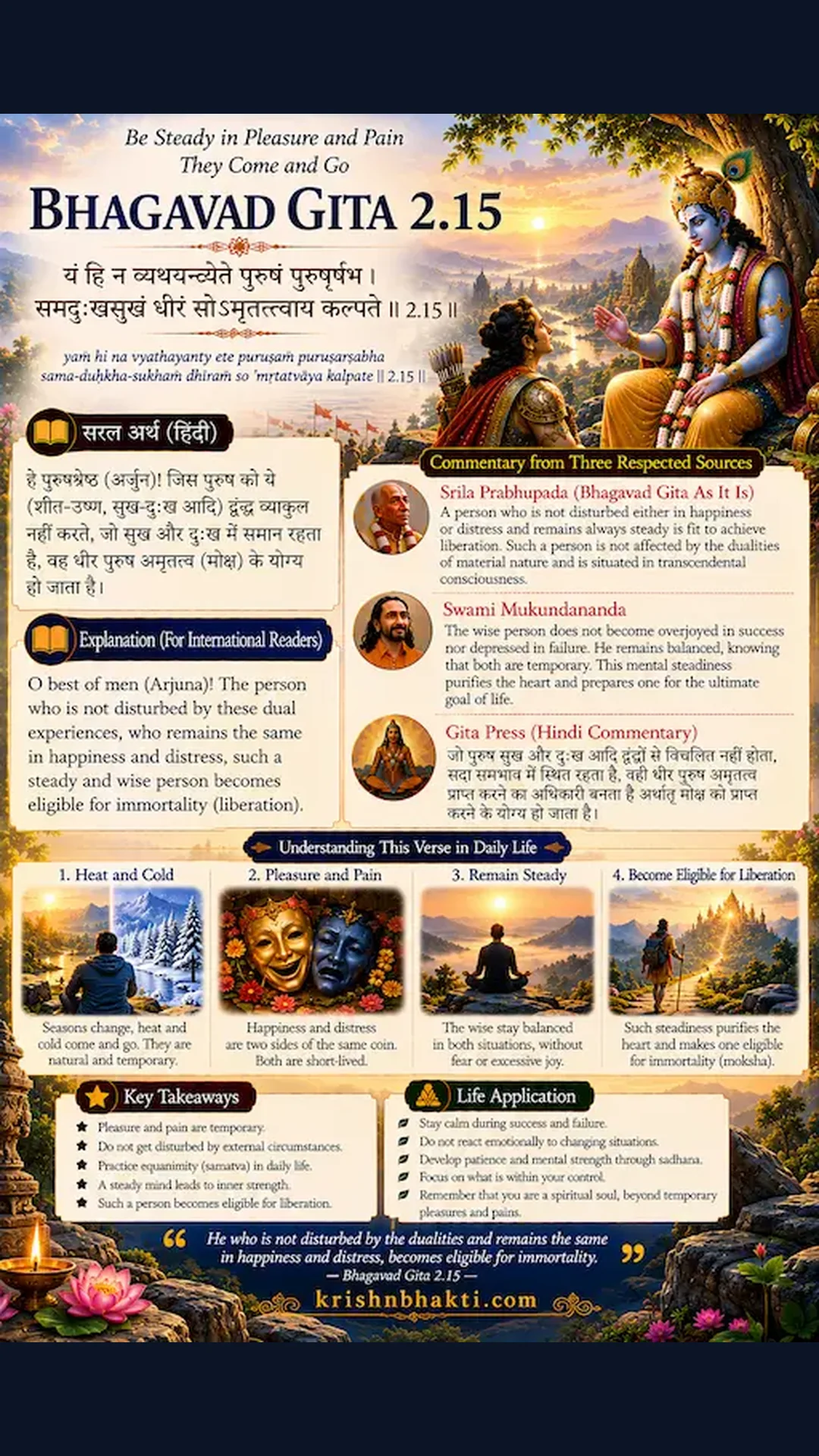
Lord Krishna tells Arjuna that the person who remains undisturbed by these fluctuations of pleasure and pain at every turn of life, who looks at both with an equal eye, is the one who truly becomes eligible for immortality. This is not some dry, abstract philosophy; it is a vital life-skill that is as essential as oxygen for every corporate worker, student, and householder of the modern era. Let us examine what exact words Krishna spoke in this timeless verse and what they mean for our lives.
यं हि न व्यथयन्त्येते पुरुषं पुरुषर्षभ।
समदुःखसुखं धीरं सोऽमृतत्वाय कल्पते॥ २.१५ ॥
Simple Meaning and Word-by-Word Breakdown
To understand this verse deeply, we must break down its individual words. Lord Krishna addresses Arjuna as 'Purusharshabha' — the best among men. This implies that the person who transcends these mental dualities is the one who possesses the true capacity to become an exceptional human being. Let us understand the core terms:
Yam hi na vyathayantyete — Yam (whom) hi (indeed) na (not) vyathayanti (disturb, afflict) ete (these pleasures and pains born from sensory contact). Meaning, the person whom these external circumstances do not disturb or afflict from within. Here, the word 'vyathayanti' is crucial. It means circumstances may arise, but they fail to break you from the inside.
Purusham purusharshabha — O Arjuna, the best among men! The human being who is such. Here Krishna reminds Arjuna of his true potential, telling him that he is not some ordinary creature easily blown away by a slight wind, but a spark of that infinite power which is impossible to destabilize.
Samaduhkhasukham dhiram — Sama (equal, viewing with equanimity) duhkham (in sorrow) sukham (and in happiness) dhiram (the steadfast, intelligent, and balanced person). The person who does not get puffed up with ego when happiness arrives, nor sinks into the abyss of despair when sorrow strikes, maintaining inner equilibrium in both states, is termed 'dhira' (steadfast).
So'mritatvaya kalpate — Sah (he) amritatvaya (for immortality, liberation) kalpate (becomes fit). Such a steadfast soul alone becomes qualified to transcend this repetitive cycle of birth, death, and mental turmoil, attaining that supreme peace or immortality.
Four key takeaways emerge from this verse for us: First, the arrival of pleasure and pain is the law of this world, which no one can alter. Second, the person who remains unshaken within both states is the true wise and steadfast soul. Third, this stability is not an innate genetic trait, but a mental discipline that can be cultivated through practice. Fourth, within this very equilibrium, a human being experiences their true nature — immortality.
Profound Insights from Great Commentators
This magnificent verse of the Bhagavad Gita has been elucidated by various great saints from their unique perspectives. When we weave together the insights of Swami Ramsukhdas Ji, Srila Prabhupada, and Swami Mukundananda Ji, the depth of this verse becomes fully radiant. Let us explore the perspectives of these three great masters in detail.
1. Swami Ramsukhdas Ji's Perspective: 'Equanimity is the Soul of Sadhana'
Swami Ramsukhdas Ji, in his wonderful commentary 'Sadhak Sanjivani', sheds profound and practical light on this verse. He states that human beings' greatest weakness is that they are content during happiness, but the moment sorrow arrives, they begin blaming God or become completely destabilized. Swami Ji emphasizes that 'Samaduhkhasukham' does not mean turning into a stone heart devoid of any feelings whatsoever. Its true meaning is that your intellect should become mature enough to recognize that pleasure and pain are both guests — guests arrive and depart, while the master of the house remains firmly in place.
Swami Ji explains that when we cling to happiness with intense attachment, sorrow is inevitably born. If a person feels overly elated upon acquiring wealth, you can rest assured that when that same wealth is lost, they will suffer even more intensely. Therefore, Swami Ramsukhdas Ji advises that both pleasure and pain should be accepted as 'received circumstances' (prapta paristhiti). In his discourses, he often shares a beautiful truth — the situation standing before us right now is the fruit of our past karma and an opportunity to refine our present. If we react with raga (attachment) or dvesha (repulsion), we bind ourselves to new karmic bonds. The 'dhira' is one who does not swell with pride in favorable conditions nor weep in unfavorable ones. This true equanimity frees a person from within.
2. A. C. Bhaktivedanta Swami Prabhupada's Perspective: 'Rising Above Dualities through Krishna Consciousness'
Founder-acharya of ISKCON, Srila Prabhupada, views this verse entirely through the lens of bhakti-yoga and Krishna consciousness in his commentary 'Bhagavad Gita As It Is'. Prabhupada clearly asserts that as long as an ordinary person tries to overcome pleasure and pain relying solely on their own mental strength, they will fail because the mind is naturally fickle and weak. Prabhupada explains that the true 'dhira' (steadfast and wise person) can only be one who has surrendered their consciousness to the lotus feet of Lord Krishna.
Prabhupada writes that for a person situated in Krishna consciousness, both worldly happiness and sorrow become opportunities for rendering service to the Lord. When something good happens, they think it is Krishna's mercy and that this opulence should be utilized in Krishna's service. When a difficulty arises, they consider it the reaction of their past sinful activities being heavily mitigated by the Lord out of mercy for their devotion, accepting it gracefully as the Lord's prasadam. Thus, according to Prabhupada, there is no artificial or dry method to rise above pleasure and pain; it is possible only by deepening one's loving relationship with the Supreme Lord. When love for Krishna fills the heart, external storms cannot shake the soul.
3. Swami Mukundananda Ji's Perspective: 'Mental Recycling and the Fusion of Modern Psychology'
Swami Mukundananda Ji, a renowned IIT-IIM graduate and spiritual mentor, explains this verse by blending modern science, psychology, and spirituality seamlessly. He states that for today's youth generation, this verse serves as a masterclass. Swami Ji often shares a relatable analogy — just when we lift heavy weights in the gym, our muscles ache, but that very stress builds physical strength. Similarly, the challenges and adversities in life act as a 'mental gym' that builds our mental stamina.
Swami Mukundananda Ji explains that whenever a problem arises in our lives, our brain immediately enters a 'fight or flight' mode, which triggers stress and anxiety. This Gita verse teaches us cognitive reframing — changing our perspective toward circumstances. Swami Ji notes that the steadfast person understands that the contact of senses with objects is a natural mechanical process, but giving a mental reaction to it is our choice. We can halt our reaction. Through a little daily meditation, self-reflection, and the practice of wisdom, we can train ourselves to remain calm and centered under all circumstances.
The essence of these three commentaries is that while pleasure and pain are inevitable parts of life, remaining undisturbed by them is the ultimate mark of our spiritual and psychological evolution.
Reflections and Real-Life Scenarios: When Life Tests Us
Let us now bring this principle down into our everyday lives. Suppose you are a 25-year-old youth working as a software developer in a multinational company. You have spent months burning the midnight oil to build a massive project. You are fully confident that this time your promotion is guaranteed and your salary bump will be substantial. You start dreaming about what you will buy with that money and where you will take your family on vacation.
However, on appraisal day, something happens that you never imagined. Your name is missing from the promotion list. Instead, a junior colleague is promoted, and HR brushes you off with vague excuses about budget constraints. What happens inside you at that very moment? For a split second, it feels as though the ground has slipped beneath your feet. A heavy weight settles in your chest, and a wave of anger and despair surges up. You feel your hard work is unappreciated and the world is entirely unfair. You return home from the office, unwilling to speak to anyone, lock your room door, and lie down on the bed. This is a vivid illustration of getting hopelessly entangled in the cycle of pleasure and pain.
Now consider this second scenario. Suppose you are that exact same youth, but you have started absorbing the wisdom of Bhagavad Gita's 2.15 verse into your inner being. When the disappointing news hits, the initial shock still strikes you — because you are not a robot, you are human, and feeling hurt is natural. But within moments, the wisdom of Krishna's teaching awakens inside you — 'Samaduhkhasukham dhiram'. You remind yourself that this situation is like an external weather pattern that came and will pass. This does not define your entire identity.
You take a deep breath, step out of the office, and realize that not getting promoted today does not mean your capability is destroyed. Perhaps this is a cue for a better door to open, or an opportunity to hone your skills further. You reach home, sit down peacefully with your parents, drink a cup of tea, and engage in normal conversation. Your face lacks the panic and nervous wreck state typical of a defeated soul. People around you marvel at how someone can remain so composed after facing such a massive blow. This is the true hallmark of that 'steadfast' person praised by Lord Krishna.
A second example relates to the world of relationships. In modern times, broken relationships, breakups, and loneliness have become major causes of depression among youth. When a relationship abruptly ends, it feels as though the very foundation of life has collapsed. People spend months unable to recover from that shock, repeatedly checking their ex's social media profile, crying over old pictures, and self-blaming.
Yet, if you adopt this perspective from the Gita, you understand that relationships, too, are like the seasons of this world. They form by circumstance and dissolve in due time. Someone's departure does not end your existence. Your wholeness is not dependent on the presence of another human being, but anchored in the Divine residing within your own heart. When you deeply realize this, you neither go ecstatic when someone arrives nor let your life collapse when someone walks away. You navigate every turn of life like a traveler — smiling, learning, and moving forward.
Self Q&A: Your Doubts and Their Solutions
Q1: Is it really possible for a human being to remain completely unaffected by both happiness and sorrow? Won't we turn into unfeeling robots?
Answer: This is the most common doubt that arises in every reader's mind. Swami Ramsukhdas Ji explains very clearly that the Gita never asks you to become stone-hearted or a robot. Robots lack sentience, whereas a 'dhira' (steadfast person) possesses deep sensitivity, but their intellect is not enslaved by those emotions. When a loved one passes away, shedding tears is a natural human response. Lord Krishna Himself wept and felt distressed during various moments of the Mahabharata war. The difference is that an ordinary person drowns in that sorrow, gets swept away, and remains depressed for months; whereas a wise or 'dhira' person acknowledges the pain when it arrives, yet never lets their sense of duty and inner peace break down. They know that these dark clouds will clear and the sun will shine again. Thus, this is not an invitation to become a robot, but an inner journey to strengthen your consciousness so external storms cannot shake you from within.
Q2: When a major financial crisis hits or I lose my job, how do I keep my mind calm in that moment? How is this practical?
Answer: Swami Mukundananda Ji offers a wonderful practical solution to this question. He states that panicking when a crisis hits is biological, but dragging out that panic is our own mental habit. When a job is lost or a massive loss occurs, first focus entirely on your breathing so that the brain's 'fight or flight' response calms down. Next, view your situation from a third-person perspective — imagine this problem is not yours, but a close friend's, and they have come to you for advice. What would you tell them? You would immediately give logical, calm advice. This technique is known as cognitive distancing. Simultaneously, adopt Srila Prabhupada's perspective — bring the thought into your mind, 'O Krishna! If this difficult time has arrived, some profound mercy of Yours must be hidden within it. Give me the strength to pass this test.' When you surrender your problem at the lotus feet of the Lord, half the burden is lifted instantly.
Q3: Does this verse mean we should never wish for good pleasures in life and must always live a gloomy, detached life?
Answer: Absolutely not! This is a major misconception people hold about spirituality. Swami Ramsukhdas Ji clarifies that Lord Krishna is never asking anyone to renounce happiness. He is explaining that pleasure and pain naturally come and go in the world — 'Aagamapayinonityastamstitikshasva bharata'. What matters is your level of attachment to them. If happiness arrives and you become blinded by ego, starting to look down on the less fortunate, that happiness leads to your downfall. But if happiness arrives and you feel deeply grateful, treat it as a blessing from God, and use it in the service of others, that very happiness enriches your life further. God's objection is not to happiness itself, but to infatuation with happiness and the madness that ensues when it is taken away.
Q4: Why does this verse appear right at the beginning of the second chapter of the Bhagavad Gita? How is it connected to the previous verse (2.14)?
Answer: In the previous verse (2.14), Krishna told Arjuna that cold and heat, pleasure and pain are mere sensory contacts that come and go (anitya), therefore, O Bharata, endure them. A natural question arose in Arjuna's mind: 'What will I gain by enduring them? Why should I bear them?' To answer this exact query, Lord Krishna declares in the very next verse (2.15) that the person who remains undisturbed by these pleasures and pains, viewing both with equanimity, becomes qualified for 'amritatva' — immortality and liberation. Endurance is not a punishment; it is the ladder that lifts you from mortality to that infinite divinity where no sorrow can ever touch you. It is both the consequence and the goal of the teaching given in the previous verse.
Q5: How can the modern youth generation, surrounded by social media likes, career pressures, and relationship uncertainties, apply this verse in their daily routine?
Answer: Swami Mukundananda Ji provides deeply practical guidance for today's youth on this issue. He notes that modern youth have handed over the remote control of their happiness to others — their self-esteem is pegged to how many likes they get on Instagram. To rectify this, practice regular digital detox and mindfulness. Whenever bad news arrives during the day or someone criticizes you, take a 10-second pause instead of reacting immediately. Tell yourself, 'This is an external opinion; it does not define my true worth.' Spend 10 minutes every morning meditating on a verse of the Bhagavad Gita. When your roots are strong from within, social media storms or office pressures will fail to shake you. You will become the true captain of your ship, not a helpless passenger.
🙏 Hare Krishna — Jai Shri Krishna 🙏
📖 Also Read: When Your Mind Says 'I Give Up', Remember This Verse from the Gita 🧘♂️