Think about the last time you were so consumed by wanting something — a promotion, a relationship, an outcome — that you could not think straight. Or the last time someone said or did something that made you lose yourself completely in anger. That heat, that desperation, that feeling of being dragged — that is what Krishna is talking about in this verse. And He is telling us there is a way out.
We all know anger is destructive. We all know that chasing desires endlessly leads nowhere. But knowing and actually living free from them — that is an entirely different thing. We resolve each night to be calmer tomorrow. And by mid-morning something happens and we are right back in the fire. That is not weakness. That is the absence of the inner training the Gita points toward.
In the twenty-sixth verse of the fifth chapter, Krishna describes the ones who have crossed this fire — and what they find on the other side. It is not a distant reward after death. It is available here, now, in this very life.
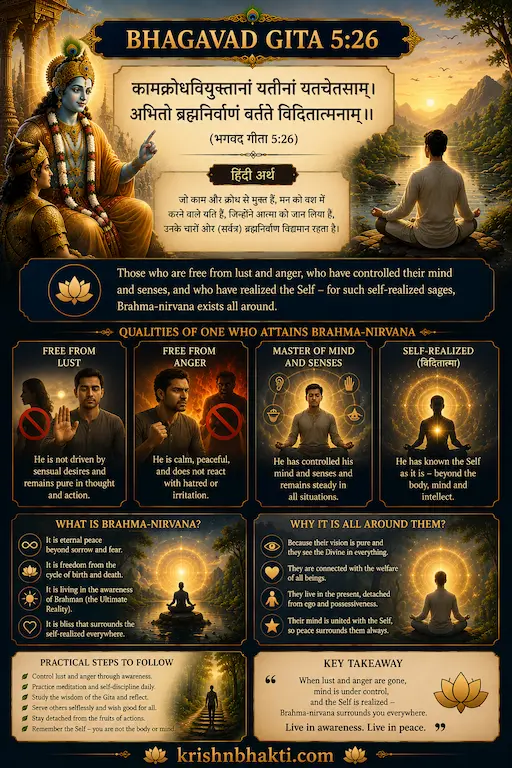
कामक्रोधवियुक्तानां यतीनां यतचेतसाम् ।
अभितो ब्रह्मनिर्वाणं वर्तते विदितात्मनाम् ॥ ५.२६ ॥
What Is Krishna Actually Saying?
Krishna says — for those disciplined seekers who are free from desire and anger, whose minds are fully controlled, and who have realized the Self — Brahma-nirvana, supreme peace, surrounds them from all sides.
The word that stands out here is abhitah — meaning "from all around" or "on every side." This peace does not come and go. It is not a good day followed by a bad one. It is a constant, unshakeable stillness that remains whether life brings joy or difficulty, company or solitude. That is what awaits the one who walks this path sincerely.
Sadhak Sanjivani — Swami Ramsukhdas Ji
In Sadhak Sanjivani, Swami Ramsukhdas Ji explains that desire and anger are not two separate enemies — they come from the same root. When a desire is not fulfilled, anger is born. And where does desire come from? From the belief that something outside of us holds the key to our happiness. The moment we place our sense of wholeness in an external object, person, or outcome — desire takes root. And when that root is disturbed — anger erupts.
On the word yatinam — disciplined seekers — Swami Ji is clear: this does not only mean monks who have renounced the world. A yati is anyone who has made the sincere commitment to master the mind and senses. A householder, a working professional, a student — anyone who takes up this inner discipline qualifies. The ashram is not a requirement. The intention is.
He places special emphasis on viditатmanam — those who have known the Self. He says that without this knowledge — without the clear understanding that "I am not this body, I am the soul" — lasting freedom from desire and anger is not truly possible. Because as long as we identify with the body, desires are natural. And where desires are, anger will follow. Self-knowledge is the very foundation of this freedom.
Prabhupada — Bhagavad Gita As It Is
Srila Prabhupada, in Bhagavad Gita As It Is, makes a point that is both practical and profound. He says desire and anger are not the soul's nature — they are coverings of maya. Just as dust covers a mirror without becoming the mirror, desire and anger cover the soul without changing its true nature. The soul beneath is always pure, always peaceful, always full.
Prabhupada teaches that in the path of bhakti, desire and anger are not suppressed — they are transformed. Direct your desire toward Krishna's service and it becomes devotion. Direct your anger toward injustice and it becomes courage. The energy itself does not need to be destroyed — it needs a better destination. This is the genius of bhakti-yoga.
On the word abhitah, Prabhupada says that for one established in Krishna consciousness, Brahma-nirvana is not a future promise. It is a present reality. Not after death, not after more years of practice — but right now, in this body, in this life. The peace is already here for the one who has cleared the obstruction.
Swami Mukundananda Ji's Perspective
Swami Mukundananda Ji brings this verse down to the ground level of everyday experience. He says — desire itself is not evil. To live and act in the world, some desire is necessary. The problem arises when desire becomes so deep that we feel incomplete without its fulfillment. When "I want this" becomes "I cannot be okay without this" — that is when desire turns into bondage.
On anger, he offers a beautiful insight: anger always follows a broken expectation. Every time we are angry at someone, somewhere we expected something from them and they did not deliver. So if we want to reduce anger, we need to examine our expectations — and trace them back to the belief that our peace depends on what others do. That belief is the real problem, not the other person.
On yata-cetasam — those with controlled minds — Swami Ji says the goal is not to kill the mind but to redirect it. A river blocked becomes destructive. The same river channeled properly waters entire fields. The mind controlled and turned toward God becomes the greatest instrument of peace. That is the practice — not suppression, but redirection.
What Does This Look Like in Real Life?
You have probably noticed this pattern in your own life — you want something badly, it does not happen the way you hoped, and suddenly there is this heat inside. Frustration, resentment, maybe words said that you regret. That is the direct chain from desire to anger. It happens in offices, in marriages, in families, in friendships. It is everywhere.
Now think of someone who works just as hard for that same promotion — but holds it lightly. They give everything, but they are not shattered if the result does not come. They feel the disappointment, but it does not become a storm. That steadiness — that is what freedom from desire and anger begins to look like in practice. Not indifference. Not giving up. Just holding outcomes a little more loosely.
In family life, this is tested every single day. A child who does not listen. A spouse who says something hurtful. A parent whose worry comes out as criticism. Every one of these moments is an opportunity — not a failure. The person who slowly, day by day, passes these small tests is quietly walking toward the peace Krishna describes as abhitah brahma-nirvana.
Questions That Probably Live in Your Heart
Can desire and anger really be overcome — are they not just human nature?
They are a part of conditioned human nature — but not the soul's true nature. Prabhupada says the path is not suppression but transformation. When desire is turned toward God and anger is turned toward adharma, they become instruments of liberation rather than bondage.
I am a householder with responsibilities — is this verse meant for me?
Absolutely. Swami Ramsukhdas Ji is explicit — a yati is anyone who has taken up inner discipline, regardless of their external situation. A householder who consciously works on mastering the mind is walking this path. Family life is not an obstacle — it is the training ground.
When anger comes in the moment, what do I actually do?
Swami Mukundananda Ji gives very practical guidance — in that moment, pause. Just one breath. One repetition of the Lord's name. You do not need to extinguish the fire in that second — you just need to not pour oil on it. Step back for one moment and the intensity naturally begins to drop.
Is abhitah — peace from all sides — really possible in this world?
It is not poetry. The lives of saints and devoted practitioners across centuries are evidence. They lived in the world, faced difficulty, felt pain — but there was an inner stillness that did not shake. That stillness is available to anyone who walks sincerely toward it.
Without Self-knowledge, can one really be free from desire and anger?
Swami Ramsukhdas Ji says Self-knowledge is the foundation — but the building begins before the foundation is complete. Bhajan, satsang, reading the Gita — all of these gradually build toward that knowledge. Begin walking and the destination draws closer on its own.
📖 Also Read: https://krishnbhakti.com/english-blogs/bhagavad-gita-5-25-who-truly-finds-inner-peace" style="color:#d35400;">Bhagavad Gita 5.25 — Who Truly Finds Inner Peace? The Secret of Brahma-Nirvana
🙏 Hare Krishna — Jai Shri Krishna 🙏