Have you ever felt that everything on the outside looks fine — a job, a home, people who love you — and yet somewhere deep inside there is a hollow? A restlessness that follows you to bed and wakes up before you do? Like something is missing, though you cannot name it?
📖 Also Read: https://krishnbhakti.com/english-blogs/gita-shloka-5-24-look-inward-gitas-timeless-mantra-finding-yourself" style="color:#d35400; text-decoration:none;">Look Inward: The Gita's Timeless Mantra for Finding Yourself
🙏 Hare Krishna — Jai Shri Krishna 🙏
We spend our whole lives chasing that peace. A new city, a better salary, a new relationship, the next vacation. And for a moment it feels like we have found it — and then it slips away again, like sand through fingers. The longing returns. That is not a personal failing. It simply means we have been looking in the wrong places.
In the fifth chapter of the Bhagavad Gita, Krishna says something that cuts through all of this. He names the people who actually reach what He calls Brahma-nirvana — the highest peace, the peace that does not leave. And they are not kings or celebrities. They are people who have mastered something on the inside.
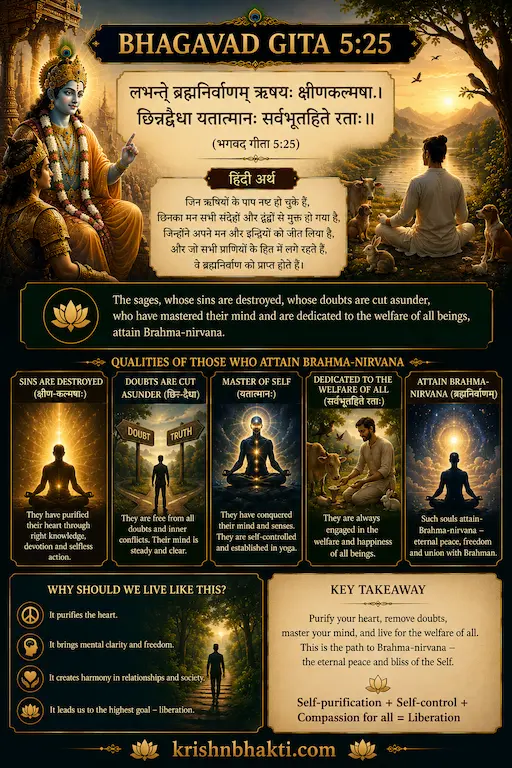
लभन्ते ब्रह्मनिर्वाणमृषयः क्षीणकल्मषाः ।
छिन्नद्वैधा यतात्मानः सर्वभूतहिते रताः ॥ ५.२५ ॥
What Is Krishna Actually Saying Here?
Krishna says — those sages who have destroyed all their sins and impurities, who have cut away all inner conflict and doubt, whose minds are fully controlled, and who are dedicated to the welfare of every living being — they attain Brahma-nirvana.
Brahma-nirvana is not a place. It is a state — the state where restlessness ends, where fear has no grip, where nothing feels incomplete. It is liberation while still living. And Krishna gives us four clear markers of the person who reaches it: purified from sin, free of inner conflict, a disciplined mind, and a heart that genuinely wishes well for all.
Sadhak Sanjivani — Swami Ramsukhdas Ji
In his monumental commentary Sadhak Sanjivani, Swami Ramsukhdas Ji goes deeper than the surface meaning. He explains that kshina-kalmasha — being rid of impurities — is not just about stopping wrong actions. It means the roots of sin in the mind itself have been pulled out. The habit of jealousy. The reflex of anger. The quiet arrogance. These are the kalmasha that matter most.
On chinna-dvaidha — severance of doubt — Swami Ji explains that the most paralyzing doubt is the existential one: "Is the soul real? Is God real? Is there truly something beyond this body?" As long as this doubt lives in the mind, no amount of outer success brings peace. The purpose of true spiritual practice, he says, is to cut this doubt at its root — not through blind faith, but through direct inner experience cultivated over time.
And yatatmana, he says, is not just outward restraint. Eating less, speaking less — these are preliminary. The truly disciplined person is as pure in private as in public. There is no gap between who they are alone and who they are in front of others. That integrity is real self-mastery.
Prabhupada — Bhagavad Gita As It Is
Srila Prabhupada, in Bhagavad Gita As It Is, brings a distinctly devotional lens to this verse. He notes that the word rishi is precise — a rishi is not just one who knows the truth, but one who lives it entirely. Knowledge without transformation is not the rishi's way.
Prabhupada emphasizes that Brahma-nirvana is not mere emptiness or cessation. For the devotee, it is the experience of oneness with the Supreme — a fullness, not a void. And he makes a beautiful point: for one who is established in Krishna consciousness, Brahma-nirvana is not a distant goal requiring separate effort. It arises naturally, the way fragrance arises from a flower without force.
His interpretation of sarva-bhuta-hite ratah is also striking. He says real welfare for all beings means connecting them to God — not just feeding the body while leaving the soul starving. Distributing prasad, chanting the holy name together, sharing the Bhagavat — this, for Prabhupada, is the highest service to all living beings.
Swami Mukundananda Ji's Perspective
Swami Mukundananda Ji speaks to the modern seeker directly. He says — the exhaustion most people feel today is not physical. It is the exhaustion of dvandva — constant inner conflict. Should I do this or that? Should I stay or go? Should I say yes or no? The mind is a battlefield of competing voices, and this war drains more energy than any work ever could.
He explains that chinna-dvaidha — the end of this conflict — comes when a person finds a clear direction in life. And that direction is God. When you know where you are going, the small decisions stop being overwhelming. The river does not agonize over the stones in its path — it simply flows toward the sea.
Swami Ji also reminds us that becoming kshina-kalmasha is not an overnight event. It is a daily practice. Every time you catch yourself speaking ill of someone and stop — one impurity dissolves. Every time you resist the urge to react in anger — one layer is shed. Slowly, steadily, the mirror of the mind becomes cleaner.
What Does This Look Like in Real Life?
Think about that colleague who keeps taking credit for work that was yours. There was a time it ate at you — the resentment, the comparison. But one day you decided: my job is to do good work, not to keep score. And slowly, that bitterness began to loosen. That is a kalmasha dissolving.
Or think about lying in bed at night with twenty things spinning in your head — tomorrow's meeting, the school fees, the unread messages, the family tension. That mental noise is dvandva. Now imagine sitting quietly for ten minutes each night in front of God — not asking for anything, just being present. Over weeks, that noise begins to settle. That is yatatmana beginning.
And sarva-bhuta-hite? It does not require grand gestures. Remembering to check on a friend who has gone quiet. Not walking past someone struggling with heavy bags. Listening to someone without immediately giving advice. These small acts, done with a full heart, are the practice of universal goodwill.
Questions That Probably Live in Your Heart
Is Brahma-nirvana only for monks and renunciants?
Not at all. Krishna uses the word rishi not to indicate a robed ascetic, but a person of inner clarity. A householder who works, raises children, and fulfills duties in the world — while cultivating these four qualities — is absolutely walking toward Brahma-nirvana.
I have made too many mistakes in life. Is it too late for peace?
Swami Ramsukhdas Ji says clearly — sincere repentance and the determination to change is the greatest purifier there is. The past does not have to define the path forward. The Lord's grace does not work on a credit score system.
My mind never stops wandering. Will it ever settle?
Krishna Himself calls the mind restless. But He also says it can be trained — through practice and dispassion. Every time the mind drifts and you bring it back, that is one repetition of the most important workout there is. The stillness comes slowly, but it comes.
How can I genuinely wish well for others when the world feels so selfish?
Here is what Swami Mukundananda Ji says — this practice is for your freedom, not theirs. When you hold goodwill in your heart, your mind becomes lighter. Other people's selfishness is their karma. Your response is yours. You get to choose what you carry.
How do I know if I am moving in the right direction?
Both Prabhupada and Swami Mukundananda Ji point to the same signs — small irritations stop having power over you. Someone says something unkind and your mind stays steady. You sit alone and feel complete rather than lonely. These are quiet signals that the inner journey is real and moving.
🙏 Hare Krishna — Jai Shri Krishna 🙏