Most people who want to meditate go through the same cycle. They download an app, watch a few guided sessions, maybe buy a book. For a few days it feels promising. Then the mind refuses to cooperate, the sitting feels forced, and gradually the practice fades. And the conclusion that gets drawn — "maybe meditation is just not for me."
But the real issue is not the meditation technique. The issue is preparation — both outer and inner — that most approaches never address. And that preparation is exactly what Krishna lays out in this verse. Five specific conditions. Without them, meditation stays on the surface. With them, it goes deep.
This verse marks a turning point in the sixth chapter. From here, Krishna moves into practical instruction — how to meditate, where to meditate, in what state of mind. And the first instruction is this: before you sit, make sure these five conditions are in place.
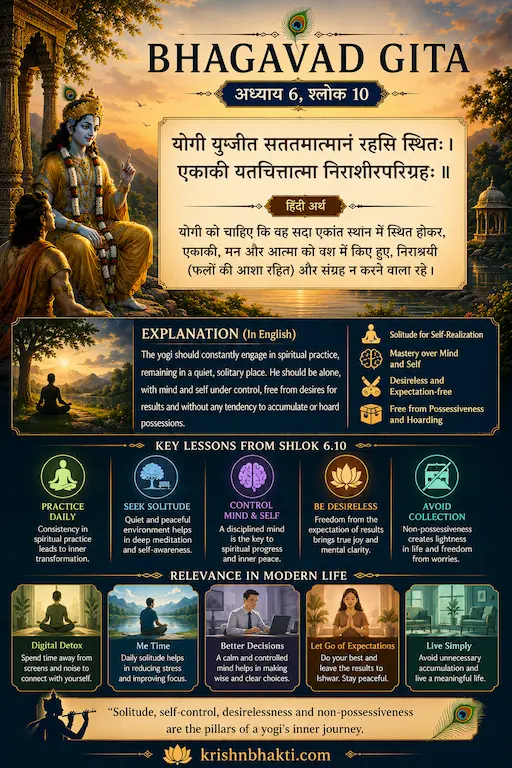
योगी युञ्जीत सततमात्मानं रहसि स्थितः ।
एकाकी यतचित्तात्मा निराशीरपरिग्रहः ॥ ६.१० ॥
What Is Krishna Actually Saying?
Krishna says — the yogi should constantly engage the mind in meditation — staying in solitude, alone, with mind and body controlled, free from hope, and without possessiveness.
Five conditions. Rahasi — in solitude. Ekaki — alone. Yata-chitta-atma — mind and body brought under control. Nirashi — free from hope and expectation. Aparigraha — without accumulation or possessiveness. These five together form the foundation that makes sustained meditation possible.
Sadhak Sanjivani — Swami Ramsukhdas Ji
In Sadhak Sanjivani, Swami Ramsukhdas Ji begins with the word satatam — constantly. He says meditation is not only the act of sitting with closed eyes for thirty minutes each morning. Satatam means a current — a continuous orientation of the mind toward God, running underneath all activity. As practice deepens, this current grows stronger and more continuous.
On rahasi — solitude — Swami Ji says solitude does not require a forest or a cave. It can be found at home — early in the morning before the household wakes, or late at night when it has gone to rest. What matters is the absence of external distraction. These are among the most naturally available windows of solitude for a householder.
On nirashi — free from hope — he says this means releasing the expectation of a particular experience during meditation. "Today I will feel peace." "Today something will happen." These hopes are among the biggest obstacles to depth in practice. Sit without wanting anything to happen. What needs to come will come on its own.
On aparigraha — non-possessiveness — Swami Ji extends this beyond material things. The mind's accumulation of unnecessary memories, grievances, and mental clutter is also a form of parigraha. When the mind is emptied of what it does not need — space opens for what is essential.
Prabhupada — Bhagavad Gita As It Is
Srila Prabhupada, in Bhagavad Gita As It Is, says Krishna is here giving both outer and inner preparation for meditation. The outer preparation is solitude and aloneness. The inner preparation is mental control, freedom from expectation, and non-possessiveness. Both must be present for meditation to go beyond surface experience.
On ekaki — alone — Prabhupada says deep meditation is a deeply personal process. In crowds, in noise, surrounded by activity — the mind has too many hooks pulling at it. Every sincere practitioner needs to carve out time each day when they are genuinely alone — phone off, outer noise reduced, inner space available.
On aparigraha, Prabhupada connects it to bhakti — he says for the devotee absorbed in Krishna, non-possessiveness comes naturally. When you have found the highest, the impulse to accumulate lesser things simply weakens. Like someone who has the sun — why would they collect candles?
Swami Mukundananda Ji's Perspective
Swami Mukundananda Ji speaks to one of the defining features of modern life — the near-total disappearance of genuine solitude. He says — whenever we have a free moment today, the phone goes up. Whenever aloneness starts to settle in, we turn on a show. We have become afraid of our own company. And that fear is one of the main things standing between us and real meditation.
He says — rahasi ekaki — in solitude, alone — these two are both needed. Outer aloneness: no people, no screens, no noise. And inner aloneness: no mental crowd either — no racing thoughts about what needs to be done, no replaying of conversations. When both come together, meditation has the ground it needs.
On nirashi, Swami Ji says — sitting down to meditate with the thought "something special will happen today" is one of the most common and most effective ways to prevent anything from happening. Meditation is a surrender — coming to God with empty hands, no agenda, no demands. Simply being present. What arrives when you come that way is real. What you manufacture through expectation is not.
What Does This Look Like in Real Life?
Five in the morning — the house is still, everyone asleep. Phone on airplane mode. A quiet corner. Sit down. Eyes closed. Breath noticed. No agenda, no list of what you hope to feel. Just fifteen or twenty minutes of this. That is rahasi ekaki — solitude and aloneness — available to any householder who chooses to claim it.
Or the office lunch break — ten minutes alone, phone face down, no content, no conversation. Just sitting with yourself. That too is a form of solitude that builds the capacity for deeper practice later.
And aparigraha in daily life — letting go of what has accumulated unnecessarily. The physical clutter in the home that weighs on the mind. The mental clutter of old grievances that take up space. The emotional clutter of expectations about how things should go. As these release — room appears. And in that room, practice naturally deepens.
Questions That Probably Live in Your Heart
How do you find solitude in a busy household — there is always noise?
Swami Mukundananda Ji says — solitude is created, not found. Wake up earlier than the household. Stay up a little after it sleeps. Even ten to fifteen minutes of genuine quiet is enough to begin. The outer solitude does not need to be perfect — what matters is the intention and the consistency.
Satatam — meditating constantly — is that actually possible?
Swami Ramsukhdas Ji says — not at the beginning. But with practice, a current forms. Like a river that keeps flowing regardless of what it passes — a current of inner orientation toward God can run quietly beneath all activity. It builds gradually, one sincere session at a time.
Nirashi — no expectation — then why meditate at all?
Prabhupada says — the reason to meditate is connection with God. Not to have a particular experience, not to achieve a specific state. The way a mother loves her child without calculating a return — simply because the love is there. Sit that way. The rest takes care of itself.
Aparigraha — does this mean giving everything up?
Swami Ramsukhdas Ji is clear — keep what you genuinely need. Release the habit of accumulating beyond need. And release the inner accumulation — the grievances, the unnecessary memories, the burdens that serve no present purpose. Both dimensions of aparigraha, outer and inner, matter for practice.
What do 6.9 and 6.10 together teach?
6.9 described the mark of the greatest yogi — equal vision toward all, friend and enemy, saint and sinner alike. 6.10 shows how that state is cultivated — through solitude, aloneness, inner and outer discipline, freedom from expectation, and non-possessiveness. One verse shows the destination, the other shows the daily practice that leads there.
Read this also: Friend or Enemy, Saint or Sinner — The Greatest Yogi Sees Them All the Same 👇👇👇
🙏 Hare Krishna — Jai Shri Krishna 🙏