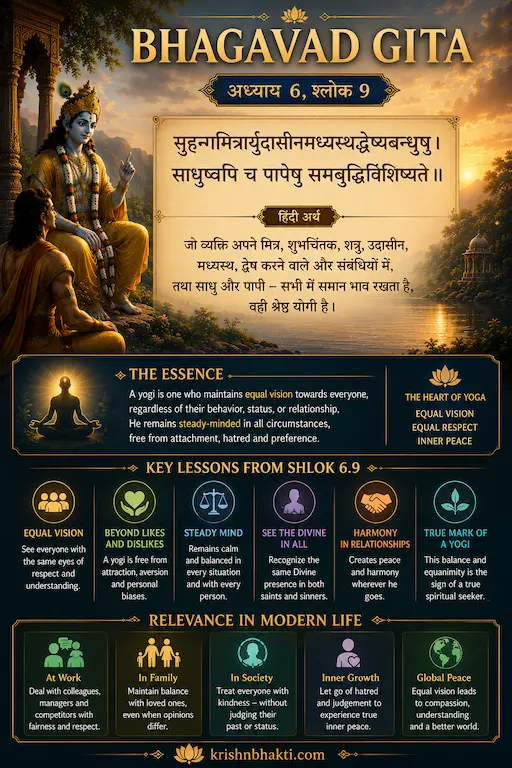
Here is a truth most of us know but find hard to accept — we do not treat everyone the same. We are warmer with people who have helped us, colder with those who have hurt us. We are patient with friends and guarded with strangers. We carry the memory of who wronged us and adjust ourselves accordingly. This is human. But is it the highest way a human being can live? And is it possible to go beyond it?
This verse describes someone who has gone beyond it. Someone who looks at a friend and an enemy with the same eyes. Who meets a relative and a stranger with the same inner warmth. Who responds to a saint and a sinner from the same place of equanimity. This is not a fantasy — it is the highest fruit of sustained spiritual practice.
And this verse speaks directly to the person who is exhausted by the weight of their own relational history — keeping score, holding grudges, adjusting behavior based on who helped and who hurt. Krishna is pointing to a state where that entire burden simply does not exist.
सुहृन्मित्रार्युदासीनमध्यस्थद्वेष्यबन्धुषु ।
साधुष्वपि च पापेषु समबुद्धिर्विशिष्यते ॥ ६.९ ॥
What Is Krishna Actually Saying?
Krishna says — one who maintains equal-minded vision toward the well-wisher, friend, enemy, the indifferent, the neutral, the envious, relatives — and toward the righteous and the sinful alike — that person is most excellent.
Seven categories of people are named. Suhrid — one who wishes you well without motive. Mitra — a friend. Ari — an enemy. Udasina — one who is indifferent. Madhyastha — one who stands in the middle. Dveshya — one who holds enmity. Bandhu — a relative. And then — saints and sinners both. Equal vision toward all of them. That is the mark of the most excellent.
Sadhak Sanjivani — Swami Ramsukhdas Ji
In Sadhak Sanjivani, Swami Ramsukhdas Ji explains that sama-buddhi — equal-minded vision — does not mean identical external behavior toward everyone. A doctor and a neighbor are treated differently in practical terms — and that is appropriate. But the inner attitude — the underlying regard, the wish for their genuine good — should be the same toward all.
On sadhushvapi cha papeshu — equal vision toward saints and sinners — Swami Ji says this is the hardest part. Equal regard toward a saint is natural. But toward someone who has done genuine harm? Toward someone whose actions you find deeply wrong? That is the real test. And it is the highest practice.
He makes an important clarification — equal vision does not mean condoning wrong action. The wrong action can and should be condemned. But the soul behind the action — in which God resides just as in your own — deserves the same fundamental regard. The act was wrong. The soul is not diminished. When this understanding is firm, equal vision becomes possible.
Prabhupada — Bhagavad Gita As It Is
Srila Prabhupada, in Bhagavad Gita As It Is, says this equal vision is not a mental exercise — it is the natural fruit of Self-knowledge. When a person truly realizes that every living being contains a fragment of the Supreme — that the same consciousness animates the friend and the enemy, the saint and the sinner — the instinct to divide them begins to dissolve. Because at the deepest level, there is no division to make.
Prabhupada emphasizes the word vishishyate — most excellent, superior. He says Krishna is being deliberate here. Equal vision toward all is not merely a nice quality — it is a major spiritual milestone. Those who have reached it have arrived at one of the highest expressions of yoga that exists.
For the devotee, he says, this equal vision comes through seeing Krishna everywhere. When you see Krishna's presence in every face — when you genuinely understand that the person in front of you, regardless of their behavior, carries the divine spark — enmity simply has no ground to stand on. That is the bhakta's natural equal vision.
Swami Mukundananda Ji's Perspective
Swami Mukundananda Ji connects this verse to the silent weight that so many people carry — the accumulated grievances of broken relationships. He says — in almost everyone's life, there is at least one person whose name or face makes the mind go heavy. Someone who betrayed, who hurt, who became an enemy for no clear reason. And we carry that heaviness for years — sometimes for entire lifetimes.
He says — this verse names that heaviness and points to its release. Sama-buddhi — equal vision — means seeing every person through the lens of their soul rather than through the lens of their behavior toward you. Their behavior may have been wrong. But the soul in them is the same soul that is in you. When that is seen — the weight begins to lift.
Swami Ji says something that many people need to hear: forgiving someone is not weakness. It is the strongest thing you can do. When you forgive an enemy — you are not doing it for them. You are doing it for yourself. The burden you have been carrying — sometimes for years — finally comes down. That lightness is the practical gift of sama-buddhi.
What Does This Look Like in Real Life?
Think of a colleague who once spoke badly about you behind your back. You know. And every time they walk into the room, something tightens in you — a small bitterness, a guardedness. That is the opposite of sama-buddhi. But the person who gradually releases that — who can greet that colleague with the same ease they greet a friend — that person is living this verse, one small moment at a time.
Or in family life — where some relationships are warm and some carry decades of tension. The person who can show up to the difficult relative with the same genuine care they show the beloved one — not performed, not forced, but actually felt — that person has touched something real in this teaching.
And the hardest case — the saint and the sinner. When you encounter someone whose actions you find genuinely wrong — and your response is not contempt but a kind of compassion, a quiet understanding that "this person is lost right now" — you are moving in the direction this verse points toward.
Questions That Probably Live in Your Heart
Is equal vision toward an enemy actually possible — or just an ideal?
Swami Mukundananda Ji says — possible, but built gradually. Start by catching yourself thinking badly about that person and stopping. Then practice wishing them well in your mind, even briefly. Each small step changes the inner ground. The direction is what matters — and it is available to everyone.
Does sama-buddhi mean treating everyone identically?
Swami Ramsukhdas Ji is clear — external behavior will and should vary based on context. A doctor treats a patient differently than a friend at dinner. But the inner attitude — the underlying care, the wish for genuine good — should remain consistent. This is inner work, not outer performance.
Equal vision toward sinners — does this mean forgiving their actions?
Prabhupada says — no. Wrong actions can be acknowledged and addressed. But the soul of the person who did wrong still carries the divine spark — the same one that is in you. Condemning the action while maintaining regard for the soul — that distinction is the heart of this verse.
Is this equal vision necessary for yoga — can you progress without it?
Swami Ramsukhdas Ji says — this is a hallmark of the highest stages of yoga. Every sincere seeker should be moving toward it — even if arrival takes time. The direction matters more than the distance covered. And every act of genuine forgiveness or impartial regard is a real step forward.
What do 6.8 and 6.9 together teach?
6.8 described the yukta yogi — satisfied with knowledge and experience, unshakeable, senses mastered, gold and mud equal. 6.9 extends that portrait into the realm of relationships — the true yogi not only sees things equally, they see people equally. Friend, enemy, saint, sinner — all met from the same inner ground. This is yoga completed — not just in stillness, but in relationship.
Also Read: When Mud, Stone and Gold All Look the Same to You — That Is the Sign of a True Yogi 👇👇👇
https://krishnbhakti.com/english-blogs/bhagavad-gita-6-8-mud-stone-gold-all-equal-signs-of-true-yogi
🙏 Hare Krishna — Jai Shri Krishna 🙏