Once you sit down to meditate, the next question is immediate — what do I do with my body? Should I let it relax? Should the spine be straight or is that too rigid? Where do the eyes go — open, closed, somewhere in between? These questions feel minor but they are not. The body's position directly affects how easily the mind settles. Get it right and meditation deepens naturally. Get it wrong and the body itself becomes the distraction.
This verse gives Krishna's precise answer. He describes exactly how the body should be held during meditation — the spine, the neck, the head, and the eyes. These instructions are thousands of years old, and every element of them has been confirmed by both traditional practice and modern understanding of how the body and mind interact.
This continues the step-by-step instruction that began in 6.10 with mental preparation, moved to 6.11 with the physical space and seat, to 6.12 with what to do with the mind once seated, and now to 6.13 with how to hold the body throughout the practice.
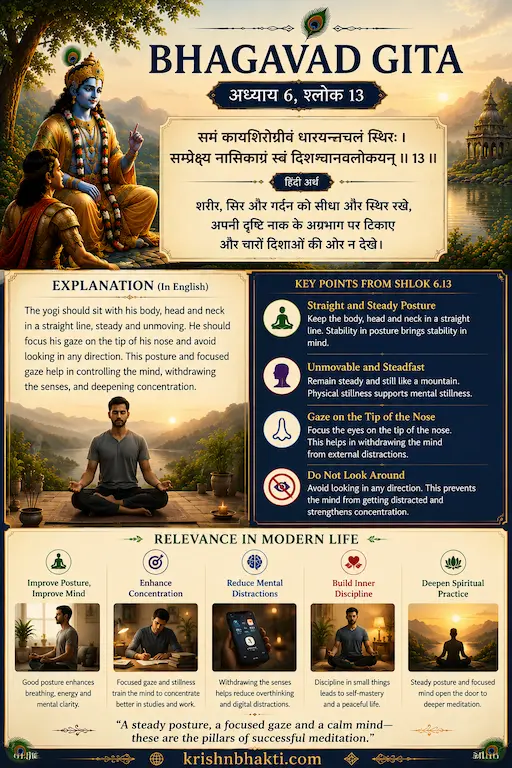
समं कायशिरोग्रीवं धारयन्नचलं स्थिरः ।
सम्प्रेक्ष्य नासिकाग्रं स्वं दिशश्चानवलोकयन् ॥ ६.१३ ॥
What Is Krishna Actually Saying?
Krishna says — holding the body, neck and head erect and still, unmoving — fixing the gaze on the tip of one's own nose — not looking around in any direction.
Three clear instructions. Samam kaya-shiro-griivam — torso, head and neck held straight and aligned. Achalam sthirah — unmoving and stable — do not shift. Samprekshya nasikagram svam — gaze fixed on the tip of the nose. And disha na avalokayan — not looking around in any direction. Together these constitute the complete physical posture for sustained meditation.
Sadhak Sanjivani — Swami Ramsukhdas Ji
In Sadhak Sanjivani, Swami Ramsukhdas Ji explains that samam kaya-shiro-griivam — keeping the torso, neck and head aligned and erect — is not merely an aesthetic instruction. When the spine is straight, the flow of energy through the body is unobstructed. When the head and neck are aligned, circulation to the brain is optimal. This serves both physical wellbeing and the depth of the meditative state.
On achalam sthirah — unmoving and stable — he says the connection between bodily stillness and mental stillness is direct and real. When the body moves, the mind follows. Every adjustment, every shift, every scratch breaks the thread of concentration and requires the mind to find its way back. Once you sit — commit to stillness for the duration of the session.
On nasikagram samprekshya — fixing the gaze at the tip of the nose — Swami Ji explains this is a specific and effective technique. When the eyes rest at the nasal tip, they are neither fully open nor fully closed — they occupy a middle position. This half-closed state creates a particular quality of attention that is neither fully outward nor fully inward — and it is in this middle ground that concentrated meditation most naturally occurs.
Prabhupada — Bhagavad Gita As It Is
Srila Prabhupada, in Bhagavad Gita As It Is, says Krishna here is giving the specific physical instructions of ashtanga yoga practice. The erect spine — what practitioners today call "spine erect" — is the foundational physical condition for deep meditation. It is not rigid or tense, but aligned and alive. This posture benefits both the body and the quality of inner absorption.
On nasikagram, Prabhupada says the position of the eyes matters because the eyes and the mind are directly connected. When the eyes move, the mind follows. When the eyes are still and directed inward — resting at the nasal tip — the mind has fewer external hooks pulling at it. The technique uses the natural connection between visual attention and mental attention to support inner focus.
He adds that these physical instructions remain completely valid regardless of which meditation tradition one practices. Whether the object of meditation is the breath, a mantra, or God directly — an erect spine, still body, and controlled gaze will always support the practice. The outer form is universal even when the inner content varies.
Swami Mukundananda Ji's Perspective
Swami Mukundananda Ji opens with an observation that is both humorous and true. He says — look at how we sit today. Slumped over laptops, hunched over phones, collapsed into sofas. We spend our entire waking lives in postures that modern research confirms reduce energy, increase negative emotion, and decrease cognitive clarity. And then we sit down to meditate in those same collapsed postures and wonder why nothing happens.
On samam kaya-shiro-griivam, he offers a simple technique to find the right position instantly. Imagine a thread attached to the crown of your head pulling gently upward. When you hold that image, the spine lengthens naturally, the neck aligns, the head lifts. No forcing, no rigidity — just a gentle upward orientation that brings the whole structure into alignment.
On nasikagram, Swami Ji says this is one of the most ancient and most tested techniques in the entire yogic tradition. The eyes rest softly at the nasal tip — slightly downward, slightly inward. Fully open eyes invite external distraction. Fully closed eyes invite sleep. The half-closed position holds a quality of alert, inward attention that is the natural home of meditation. Try it for even five minutes and notice the difference.
What Does This Look Like in Real Life?
When you sit for meditation, make the posture check the first thirty seconds of every session. Is the spine erect? Is the neck straight — not jutting forward the way it does when we look at screens? Is the head balanced — not tilted forward or back? Are the hips elevated enough to allow the lower back to have its natural curve? These checks take half a minute and significantly improve what follows.
Then the eyes. Rather than closing them completely, let them rest at half-mast — oriented gently toward the tip of the nose. If this feels strange at first, that is normal. With a few sessions of practice it becomes natural. And you will notice that the quality of attention it creates is different from closed eyes — more present, more alert, less prone to drifting into mental storytelling.
And achalam sthirah — the commitment to stillness. When discomfort arises in the legs or the back, the instinct is to immediately shift. Instead — pause for a moment. Can you stay with the discomfort for another minute or two? This practice of staying with physical discomfort without reacting is itself a form of meditation — and it trains the same quality of mind that is needed for the deeper practice.
Questions That Probably Live in Your Heart
Should the eyes be open or closed during meditation — this verse seems to say half-open?
Swami Ramsukhdas Ji says — both approaches are valid. The nasal gaze described here is a specific technique with its own benefits. Fully closed eyes is another valid approach. In the beginning, use what feels most natural — but commit to one approach rather than switching. Consistency allows the technique to deepen.
Keeping the spine erect is uncomfortable — the back starts to ache quickly?
Swami Mukundananda Ji says — this discomfort is the result of years of sitting in collapsed postures that have weakened the back muscles. It diminishes with practice. Initially, sitting against a wall for support is acceptable. The long-term goal is to sit unsupported with a naturally erect spine — and it becomes achievable with consistent effort over weeks.
The body keeps shifting during meditation — is this a problem?
Prabhupada says — it happens in the beginning. Each time the body moves, bring it back to stillness — just as you bring the mind back when it wanders. Both are the same practice: noticing the departure and returning. With time, the body learns to remain still for longer without effort.
Can this posture be maintained while sitting in a chair?
Absolutely. Swami Mukundananda Ji says — sit with feet flat on the floor, spine erect, sitting slightly away from the chair back so the back is self-supported rather than leaning. The eyes can still rest at the nasal tip. Chair meditation with correct posture is entirely valid and accessible.
What do 6.12 and 6.13 together teach?
6.12 described what to do with the mind once seated — make it one-pointed, control the senses, practice for purification. 6.13 describes what to do with the body — hold it erect and still, fix the gaze. Together they give the complete picture: what the mind does and what the body does during meditation. One without the other is incomplete. Both together create the conditions for genuine depth.
Read this also: Sit Down, Focus the Mind — This Is Exactly How Meditation Begins 👇👇👇
🙏 Hare Krishna — Jai Shri Krishna 🙏