Throughout this chapter, Krishna has been laying out the complete method for meditation — where to sit, how to sit, where to fix the mind, what kind of lifestyle supports it. Now in this verse, He gives a very clear marker — how do you actually know you have arrived at the state of being yukta, truly established in yoga? No external certificate is needed. No one else's opinion matters. Just look within.
This verse functions like a mirror. It tells you exactly what the sign of genuine yoga looks like — and that sign is entirely internal. It does not depend on how long you have practiced, what others think of your progress, or any external validation whatsoever.
This verse speaks to everyone who has wondered — "I am meditating, but how do I know if it is actually working?" Krishna's answer is direct — when your desires begin to quiet down on their own, you will know the path is working.
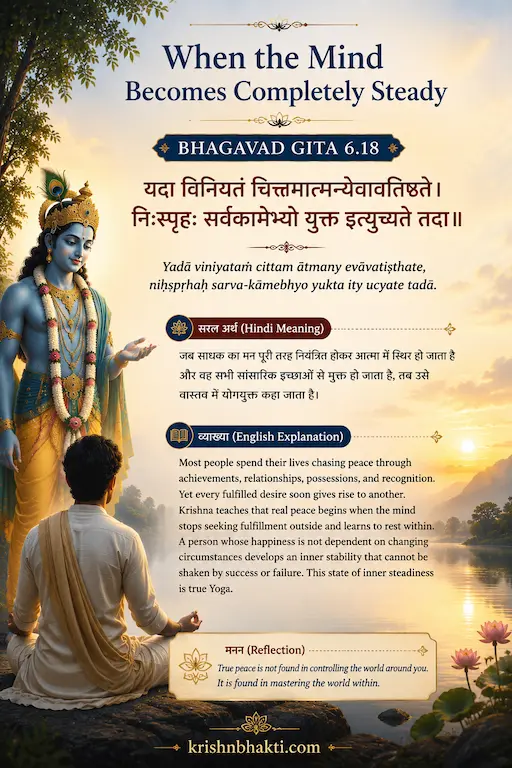
यदा विनियतं चित्तमात्मन्येवावतिष्ठते ।
निःस्पृहः सर्वकामेभ्यो युक्त इत्युच्यते तदा ॥ ६.१८ ॥
What Is Krishna Actually Saying?
Krishna says — when the fully disciplined mind rests steadily in the Self alone, and when a person becomes free from longing for all desires — at that time, they are called yukta.
Two elements stand at the center here. Viniyatam chittam atmani avatishthate — the fully controlled mind settles and rests in the Self alone. And nihsprihah sarva-kamebhyah — free from longing for all desires. When both of these are present together — that is when the genuine state of yukta arrives.
Sadhak Sanjivani — Swami Ramsukhdas Ji
In Sadhak Sanjivani, Swami Ramsukhdas Ji explains that viniyatam chittam — the fully controlled mind — is the culmination of a long process. All the practice described in the previous verses — regulated eating and recreation, the precise meditation method, sustained daily practice — all of it converges toward this single point.
On atmani eva avatishthate — resting in the Self alone — he says this describes the moment when the mind no longer feels any need to go searching outward. The mind naturally, effortlessly, remains turned inward. This is not a forced state achieved through suppression — it is the natural, settled condition that emerges after sustained, sincere practice.
On nihsprihah sarva-kamebhyah — free from longing for all desires — Swami Ji offers a crucial clarification. This does not mean ceasing to function in the world. It means the end of the inner restlessness that typically drives desire. A person continues to act, to work, to fulfill responsibilities — but the desperate grasping that previously fueled those actions is no longer present.
Prabhupada — Bhagavad Gita As It Is
Srila Prabhupada, in Bhagavad Gita As It Is, says this verse gives a precise definition for the entire meditation section that began in 6.10 — who exactly is the yukta? This is not a vague or abstract concept. It is a specific, recognizable inner state.
On viniyatam chittam, he says complete mental discipline arrives gradually, through sustained practice. It does not happen instantly. But when it arrives, all the restlessness of the mind settles. The mind rests in God the way a lamp burns steadily in a windless place — undisturbed, unwavering.
Prabhupada explains nihsprihah in the context of bhakti — for the devotee, this state arises through love for Krishna. When love for Krishna becomes deep enough that all other desires pale by comparison, freedom from craving arises naturally. It does not come from suppression. It comes from a higher love that simply outshines everything else.
Swami Mukundananda Ji's Perspective
Swami Mukundananda Ji connects this verse to the modern person who is always searching for "the next thing" — the next job, the next relationship, the next achievement. He says this endless wanting is itself the root of suffering. And this verse describes the end of that endless wanting — not its forceful suppression, but its natural quieting.
He explains viniyatam chittam atmani avatishthate with a beautiful image — a river that keeps trying to flow in many directions at once becomes weak, dissipated, losing its force. But when it flows in a single direction — toward the ocean — its power and momentum grow. The mind works the same way. When it stops scattering everywhere and settles in the Self, its true strength reveals itself.
On nihsprihah sarva-kamebhyah, Swami Ji offers a very practical observation — this state arrives on a gradient. One desire weakens first, then another, then another. It is not a sudden switch that flips overnight. And those on this journey should hold patience close, because every small loosening of desire's grip is a real and meaningful victory, even when it feels incremental.
What Does This Look Like in Real Life?
Think of someone who has practiced meditation for years and one day notices they are no longer living from a place of constant wanting. They still work, still care for their family, still fulfill their responsibilities — but there is an inner peace that does not depend on any particular "if only this happens" outcome. This is what nihsprihah sarva-kamebhyah actually feels like, lived in an ordinary life.
Or think of that moment during meditation when the mind, instead of wandering everywhere, simply settles — inward. No thought arises insisting "I need to do this" or "I need to think about that." Just a deep, quiet presence. That moment is a glimpse of viniyatam chittam — the fully controlled mind resting in the Self.
In daily life, this shows up as — an unfulfilled desire no longer disturbing you the way it once did. A craving arising and then settling on its own, without struggle or suppression. These small, repeated experiences are genuine signs that the practice is moving in the direction this verse describes.
Questions That Probably Live in Your Heart
Being free from all desire — does this mean ceasing to truly live?
Swami Mukundananda Ji says — the exact opposite is true. The person free from desperate craving is the most fully alive, because they live without the constant restlessness that desire usually brings. Having preferences is part of life. What dissolves is the desperate grip — and that release is freedom, not withdrawal.
How long does it take to reach this state — how much practice is required?
Swami Ramsukhdas Ji says — there is no fixed timeline. But one thing is certain — for the person who practices sincerely and consistently, this state does not remain permanently out of reach. Each day's practice is one step toward it.
What does the mind resting in the Self practically mean?
Prabhupada explains — it means the mind's primary reference point shifts from outside to inside. Previously the mind built its sense of identity and stability from external circumstances in every situation. Now it rests in its own inner nature, regardless of what is happening outside.
Is this state achievable only for renunciants?
Swami Mukundananda Ji says — no. This state is available to any sincere practitioner, whether householder or renunciant. It depends not on external lifestyle but on the depth and sincerity of inner practice.
What do 6.17 and 6.18 together teach?
6.17 explained that a regulated lifestyle makes yoga the destroyer of suffering. 6.18 reveals what the ultimate fruit of that regulated life actually is — the mind resting steadily in the Self, free from the grip of desire. One verse builds the foundation. The other describes the summit built upon it.
Read this also:- Balance in Eating, Rest, Work and Sleep Is What Actually Ends Suffering 👇👇👇
🙏 Hare Krishna — Jai Shri Krishna 🙏