Most of our stress does not come from situations themselves. It comes from the mind constantly wanting life to happen in a particular way.
We want people to understand us. We want our hard work to give the exact result we imagined. We want relationships to stay the same forever. And when life moves differently, something inside starts feeling heavy.
Outside, everything may still look normal. But inside, the mind keeps struggling.
Krishna is speaking exactly about this inner struggle. In the previous verse, He explained that the real yogi is the person who works without becoming completely dependent on results. Now He goes deeper. He says that until the mind slowly loosens its constant attachment and expectations, real yoga cannot truly begin.
And then Krishna says something surprising — sanyasa and yoga are not two different paths.
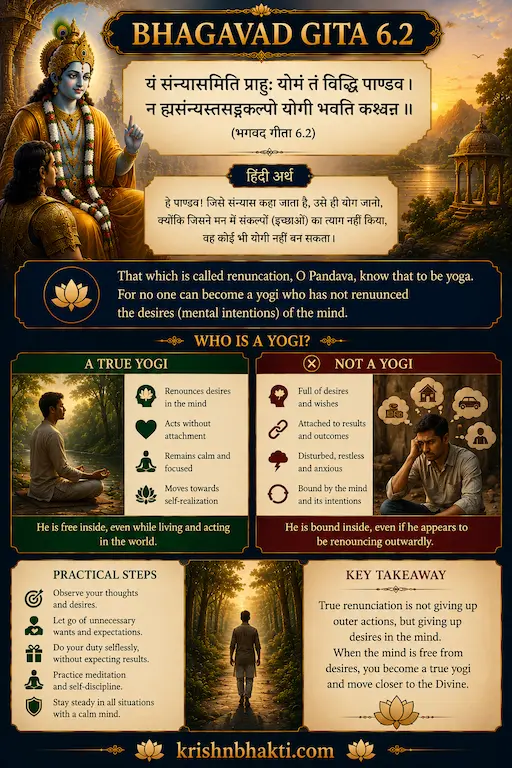
यं सन्न्यासमिति प्राहुर्योगं तं विद्धि पाण्डव ।
न ह्यसन्न्यस्तसङ्कल्पो योगी भवति कश्चन ॥ ६.२ ॥
What Is Krishna Actually Saying?
Krishna says — what people call sanyasa is the same as yoga. And no one becomes a true yogi until the mind slowly loosens its attachment toward desires and expectations.
The important word here is sankalpa. It is more than desire. It is the inner insistence that says, “Life must go my way for me to feel okay.” As long as the mind keeps living inside that pressure, peace keeps slipping away.
Swami Mukundananda Ji — Connecting This Verse to Modern Life
Swami Mukundananda Ji says that modern people are not only physically tired — they are emotionally exhausted because the mind keeps holding onto expectations all day.
“I need this promotion.” “People should appreciate me.” “This relationship must survive.” “I cannot fail.” Slowly, these expectations stop feeling like wishes and start feeling like emotional necessities.
And the moment life does not go according to those expectations, anxiety grows.
That is why many people look successful from outside and still feel restless inside. The mind keeps trying to control every outcome.
Swami Ji explains that Krishna is not asking us to stop dreaming or stop working hard. He is simply saying — do not hand over your peace to outcomes. Work sincerely. Give your best. But do not let one result decide your entire emotional state.
And honestly, this may be one of the hardest spiritual practices in life.
Prabhupada — Bhagavad Gita As It Is
Srila Prabhupada explains that people often separate yoga and renunciation into different spiritual paths. Some think yoga means meditation while sanyasa means giving up the world completely. But Krishna brings both together here.
The real purpose of both is the same — rising above restless desires and reconnecting the mind with God.
Prabhupada explains sankalpa as the inner voice constantly saying, “I need this to be happy.” As long as the mind keeps running behind those demands, steadiness becomes impossible.
He further explains that when a person begins finding joy in Krishna consciousness, many smaller cravings naturally start losing their grip. The attachment slowly weakens from inside.
Gita Press / Swami Ramsukhdas Ji — A Simple Traditional Understanding
Swami Ramsukhdas Ji explains that leaving inner attachment is much harder than changing outer lifestyle. A person may leave many external things behind and still carry strong expectations inside.
He explains that asannyasta-sankalpa means a person whose inner insistence has still not softened. This does not mean ordinary desires disappear overnight. It simply means that even when desires are not fulfilled, the mind slowly learns not to lose its balance completely.
Swami Ji beautifully explains that real renunciation is not mainly external — it is internal. If the mind keeps clinging tightly from inside, outer renunciation alone changes very little.
What Does This Look Like in Real Life?
Think about a student waiting for exam results. The results are not even out yet, but sleep is already disappearing. Why? Because somewhere deep inside, peace has become connected to one outcome.
Or think about how often people check their phones. Messages. Likes. Replies. Reactions. Slowly, approval becomes addictive. The mind forgets how to sit peacefully without constant validation.
Relationships show this even more clearly. Sometimes we become so emotionally dependent on someone that we start feeling, “If this relationship breaks, I will break too.”
Krishna is teaching us to slowly loosen this inner grip.
That does not mean stop loving people, stop dreaming, or stop working hard. It simply means — do not place your entire life on top of one outcome.
Because the moment the mind slowly accepts that life will not always move according to our plans, a different kind of peace begins to appear.
Some Questions That Naturally Come Up
Do all desires need to disappear completely?
No. Krishna is not asking us to destroy every desire. He is asking us to slowly loosen the attachment that steals our peace.
If attachment becomes weaker, will motivation also disappear?
Swami Mukundananda Ji explains that the opposite often happens. When fear and anxiety reduce, the mind becomes clearer and work becomes more focused.
Is this teaching only for monks and sanyasis?
Not at all. This verse is for ordinary people — students, office workers, parents, anyone trying to find peace while living daily life.
What do verses 6.1 and 6.2 teach together?
Verse 6.1 explained that the real yogi works without depending completely on results. Verse 6.2 explains that this becomes possible only when the mind slowly starts releasing its inner attachment.
Maybe real renunciation is not about leaving the world behind. Maybe it is about slowly quieting the voice inside that keeps saying, “Everything must go my way.”
📖Also Read: Bhagavad Gita 6.1 — The Real Yogi Is Not the One Who Quits, But the One Who Works Without Attachment 👇👇
🙏 Hare Krishna — Jai Shri Krishna 🙏