We all search for peace somewhere. Some go to nature, some listen to music, some read, some surround themselves with people they love. And for a while, peace arrives — and then the restlessness returns. Because the peace found outside never fully stays. It cannot. It was always borrowed from somewhere, and borrowed things have to be returned.
In this verse, Krishna describes the state where peace arises from inside — and stays. This is the deeper experience of meditation, where the mind finally stops its movement, where the soul actually sees itself. This is not a concept or a metaphor. It is a real experience that arrives as the natural fruit of sincere, sustained practice.
This verse marks the beginning of what scholars recognize as the description of yoga samadhi in this chapter. From here, Krishna begins to describe the deeper states that genuine meditation leads to.
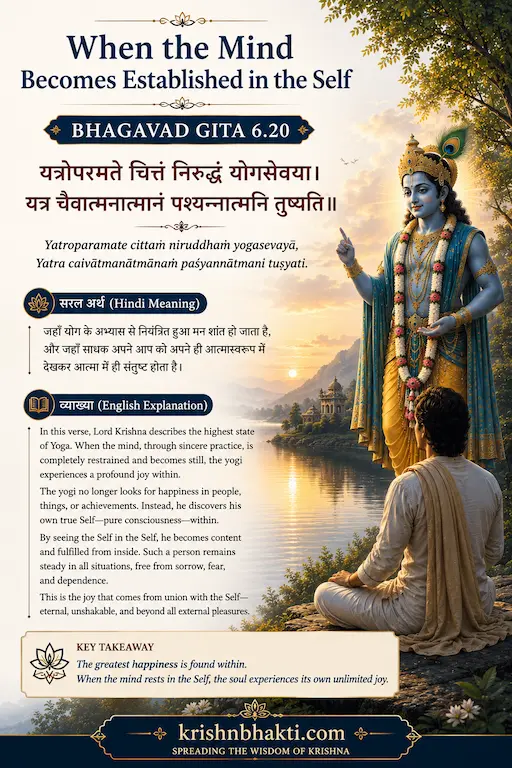
यत्रोपरमते चित्तं निरुद्धं योगसेवया ।
यत्र चैवात्मनात्मानं पश्यन्नात्मनि तुष्यति ॥ ६.२० ॥
What Is Krishna Actually Saying?
Krishna says — the state where the mind, restrained by the practice of yoga, becomes still — where one sees the Self through the Self and finds complete satisfaction in the Self alone.
Two experiences sit at the center of this verse. Yatra chittam uparamate — where the mind becomes still, comes to rest. And atmana atmanam pashyan atmani tushyati — seeing the Self through the Self, one finds satisfaction within the Self alone. These two together describe the deep meditative state Krishna is pointing toward.
Sadhak Sanjivani — Swami Ramsukhdas Ji
In Sadhak Sanjivani, Swami Ramsukhdas Ji explains that yoga-sevaya niruddham chittam uparamate — the mind restrained through yoga's practice comes to rest — is describing something very significant. The mind's coming to rest means going beyond thoughts, desires, and disturbances. This is not a blank or unconscious state — it is a state of heightened, conscious stillness.
On atmana atmanam pashyan — seeing the Self through the Self — Swami Ji says this is the Gita's deepest teaching in one phrase. Ordinarily we see outward — objects, people, situations. Here, the Self sees itself. This is a level of self-awareness where the observer and the observed become one — a complete turning of consciousness back upon itself.
On atmani tushyati — satisfaction within the Self — he says this is the satisfaction that depends on nothing outside itself. No person, no object, no circumstance is needed for this contentment to arise. It is self-sufficient, self-sustaining. And once a person has tasted this — nothing the outer world offers can match it.
Prabhupada — Bhagavad Gita As It Is
Srila Prabhupada, in Bhagavad Gita As It Is, says this verse begins the description of samadhi — the state in which meditation becomes so deep that the ordinary activity of the mind comes to a standstill.
On niruddham yoga-sevaya — restrained through yoga's service — Prabhupada says this does not happen spontaneously. It is the result of consistent, sincere practice over time. There is no shortcut to this state. There is only sustained, genuine practice — and eventually this is where it leads.
Prabhupada places atmana atmanam pashyan in the context of bhakti — for the devotee, he says, this "seeing of the Self" manifests as the experience of Krishna. When meditation reaches sufficient depth, the devotee experiences Krishna's presence directly. This is the moment the entire practice has been preparing for.
Swami Mukundananda Ji's Perspective
Swami Mukundananda Ji connects this verse to the universal human experience of searching for happiness everywhere outside — and not finding it that lasts. He says the reason is simple: we look outward for what is inward. And this verse describes what happens when a person finally arrives at the inward place where that happiness actually lives.
On chittam uparamate — the mind becoming still — he explains this in contemporary language. Normally we run a constant internal commentary — "this happened, that will happen, this needs doing, that needs thinking about." When that commentary stops — what remains is the Self. The stillness is not emptiness. It is presence without the noise that usually covers it.
On atmani tushyati, Swami Ji says something that stays with you — he says that whoever experiences this inner satisfaction even once, knows with certainty that what they have been searching for their entire life was here all along. This single experience changes everything — priorities shift, choices change, and the whole direction of life quietly reorients.
What Does This Look Like in Real Life?
During meditation, moments come — perhaps very briefly at first — when everything becomes genuinely quiet. No thought, no plan, no worry. Just a deep, full presence. And in that moment, a quiet contentment arises — with no cause, no reason, no outside trigger. This is a genuine glimpse of atmani tushyati — and it is real.
In daily life, this experience creates change. Someone who has tasted even a little of this inner satisfaction begins to notice that the pull of outer things has slightly loosened. A new phone does not feel as urgent. A new purchase does not seem as necessary. Because something inside has been touched — and that touch is more satisfying than anything the outer world had been offering.
And when a serious difficulty arrives — and one can find their way briefly to that inner space — a peace is found there that does not change the situation but gives the genuine capacity to face it. That is the practical value of this experience, and it grows with every session of sincere practice.
Questions That Probably Live in Your Heart
Is the mind becoming still the same as falling asleep?
Swami Ramsukhdas Ji says — the exact opposite. In sleep, consciousness diminishes. Here, the mind becoming still is a state of heightened awareness — with no thoughts, no disturbances, but fully awake and present. It is more awake, not less.
The Self seeing the Self — how does this actually happen in practice?
Swami Mukundananda Ji says — it cannot be forced. It happens when meditation becomes genuinely deep. In that depth, the observer, the act of observing, and what is observed all become one. It is very difficult to capture in words — but those who have experienced it recognize it immediately.
Does this experience happen every time one meditates?
Prabhupada says — not at the beginning. This is the fruit of deep, sustained practice. But once even a glimpse of it has been tasted, it makes the practice more sincere — because now the practitioner knows exactly what they are searching for, and they have confirmed it is real.
Is atmani tushyati — self-satisfaction — a form of selfishness?
Swami Ramsukhdas Ji says — no. The person who is inwardly satisfied does not need to take from others. And the person who does not need to take is far more genuinely capable of giving. Inner satisfaction does not make people stingy — it makes them genuinely generous, because they are no longer operating from a place of lack.
What do 6.19 and 6.20 together teach?
6.19 gave the analogy — still as a flame in a windless place. 6.20 describes what happens within that stillness — the mind comes to rest, the Self sees itself, and a satisfaction arises that nothing outside can provide. Image followed by inner experience — together they describe the depth of meditation with a clarity that words alone could not reach.
Read This also :- Still as a Flame in a Windless Place, This Is What a Mastered Mind Looks Like 👇👇👇
🙏 Hare Krishna — Jai Shri Krishna 🙏