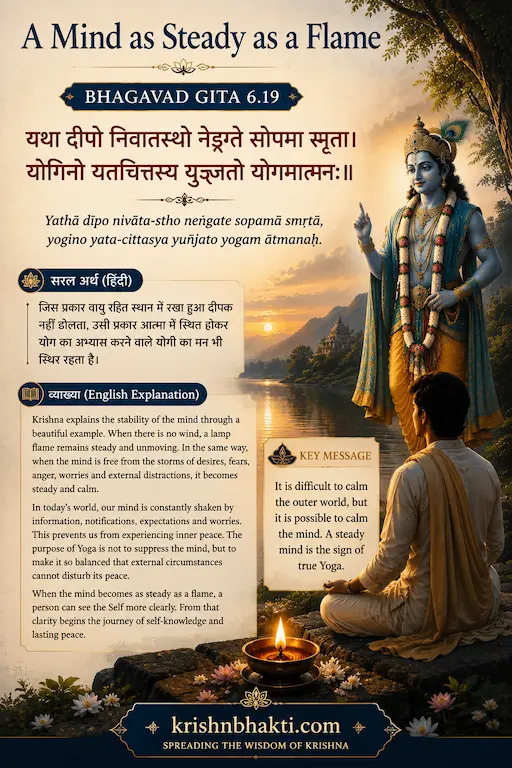
Sometimes a single image carries more truth than a thousand words could ever convey. In this verse, Krishna does exactly that. The previous verse described what a yukta person is like — mind resting in the Self, free from desire. Now, instead of more explanation, Krishna gives us a picture. And it is a picture that, once seen, is never forgotten.
A lamp. Burning in a place with no wind. Perfectly still, perfectly steady, its flame not wavering even slightly. This image is so simple that anyone can grasp it immediately — and yet its depth is endless. Mystics and philosophers across traditions have returned to this same image again and again because nothing else captures the quality of a mastered mind quite so precisely.
This verse is for anyone trying to actually visualize the state Krishna has been describing throughout this chapter. Words alone were proving difficult to fully convey it — so Krishna gives us something to see instead.
यथा दीपो निवातस्थो नेङ्गते सोपमा स्मृता ।
योगिनो यतचित्तस्य युञ्जतो योगमात्मनः ॥ ६.१९ ॥
What Is Krishna Actually Saying?
Krishna says — as a lamp in a windless place does not flicker — this analogy is remembered for the yogi of controlled mind, who practices the yoga of the Self.
The entire verse rests on this single analogy. Dipo nivatastho — a lamp in a windless place. Na ingate — it does not waver. This stillness is the very stillness of the yogi whose yata-chittasya — mind is controlled — and who is yunjato yogam atmanah — engaged in the yoga of the Self.
Sadhak Sanjivani — Swami Ramsukhdas Ji
In Sadhak Sanjivani, Swami Ramsukhdas Ji offers a beautiful explanation of this analogy. He says a lamp's flame flickers in wind because an external force is acting upon it. But when it sits in a windless place, no external force can disturb it — it simply rests in its own nature, burning steadily.
He says the mind works exactly the same way. Why does the mind waver? Because external influences — desires, fear, anger, attachment — act on it like wind acts on a flame. As sustained practice gradually reduces the force of this "wind," the mind too begins to settle into stillness, just like the flame in still air.
Swami Ji makes an important point — this stillness does not come from outside; it comes from an inner transformation. While a windless room must be physically arranged for the lamp, the practitioner must build that "windless space" within themselves — an inner condition where external disturbances no longer reach and shake the mind.
Prabhupada — Bhagavad Gita As It Is
Srila Prabhupada, in Bhagavad Gita As It Is, says this analogy is among the most beautiful and most memorable in the entire Gita. A simple lamp — and yet within it lies the complete philosophy of yoga.
He explains that a lamp's nature is to give light — but when wind blows, it flickers and cannot give its full, steady illumination. The mind's nature is similarly knowledge and peace — but when the wind of desires and disturbances blows through it, the mind cannot offer its true light. When that wind stops, the mind returns to its natural state, and only then does it give genuine illumination.
Prabhupada makes an important point about bhakti — he says this "windless space" is created through Krishna consciousness. When the mind is fully absorbed in Krishna, external objects lose their power to disturb it. Devotion itself becomes the protective, windless space the lamp needs.
Swami Mukundananda Ji's Perspective
Swami Mukundananda Ji explains this verse beautifully in contemporary language. He says — today we live in a constant wind of notifications, opinions, and expectations. From every direction, something is shaking the mind. In an environment like this, stillness can feel nearly impossible.
He says — but this verse reveals that stability does not come from stopping the external wind. It comes from building an internal, protected space. That protected space is built through meditation, bhajan, and sustained practice. Just as the walls of a room block the wind from a lamp, sustained practice builds an invisible wall around the mind.
Swami Ji offers a very practical observation — in the beginning, the flame flickers a great deal — the mind is highly unstable. But through daily practice, that "wall" gradually strengthens. A day eventually comes when, no matter how fierce the storm outside, the inner flame burns steady.
What Does This Look Like in Real Life?
Think of someone facing a genuinely difficult situation — bad news, a serious challenge. In the past, this person would have stayed consumed by it for hours, the mind racing in every direction. But after sustained practice — they see the situation, feel it fully, and yet inside, the lamp does not waver. This is a real glimpse of the stable mind this verse describes.
Or that moment during meditation when, quite suddenly, everything becomes very quiet. No thought rises, no disturbance pulls at attention — just a steady, peaceful presence, like a lamp in a windless room. This may be brief in the beginning, but it is a genuine taste of exactly what this analogy describes.
In daily life, this shows up as — when someone tries to provoke you and you do not waver. When chaos surrounds you and you remain anchored at your own center. This is the "windless space" that sustained practice gradually builds within.
Questions That Probably Live in Your Heart
Is it actually possible for the outside world to have no effect on the mind at all?
Swami Mukundananda Ji says — complete imperviousness is the final stage of this journey, and it arrives gradually. In the beginning, the effect simply lessens; over time, the person becomes increasingly steady. This is a journey, not an instant switch.
My mind wavers constantly — where do I even begin?
Swami Ramsukhdas Ji says — begin with daily practice. Each day's meditation is one brick in that "windless wall." It does not form in a single day, but it certainly forms through consistent daily effort.
Why is this lamp analogy so famous across spiritual traditions?
Prabhupada says — because it is extremely simple, yet profoundly deep. Everyone has watched a lamp burn. The image is instantly understood — and this is the genius of the Gita, expressing profound truths through simple, universal analogies.
Does this stillness of mind eliminate feeling altogether?
Swami Mukundananda Ji says — no. A lamp still gives light when it is steady — in fact, its light becomes even better. Similarly, a person with a stable mind still feels fully — but that feeling no longer sweeps them away.
What do 6.18 and 6.19 together teach?
6.18 described who is yukta and what condition the mind is in. 6.19 gives that same state a beautiful image — a lamp burning steady in a windless place. Words followed by a picture — together they make this state both vividly clear and unforgettable.
Read this also :- When the Mind Becomes Completely Still, Only Then Are You Truly Yukta 👇👇👇
🙏 Hare Krishna — Jai Shri Krishna 🙏