We all want happiness. This is the most fundamental of all human drives. But the happiness most of us know is sensory happiness — the pleasure of taste, of music, of the company of someone we love. This happiness is real. But it does not last. The food ends, the music stops, relationships change. And then the same emptiness returns, waiting to be filled again.
In this verse, Krishna speaks of a happiness that does not come from the senses — one that is grasped through pure intellect alone. And the defining quality of this happiness is that once reached, it never lets a person deviate from the deep truth of existence.
This verse continues directly from 6.20, which described the state where the mind becomes still and the Self perceives itself. Now Krishna describes the happiness of that state — what it is like, how it is accessed, and why it is categorically different from anything the senses can offer.
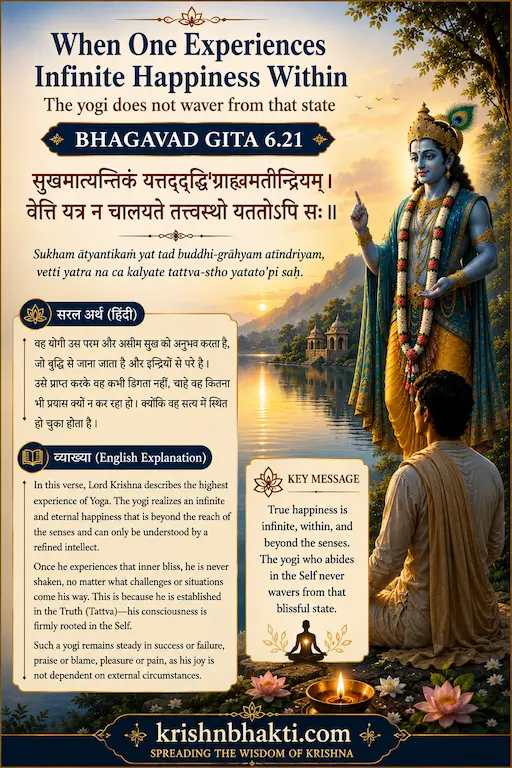
सुखमात्यन्तिकं यत्तद्बुद्धिग्राह्यमतीन्द्रियम् ।
वेत्ति यत्र न चैवायं स्थितश्चलति तत्त्वतः ॥ ६.२१ ॥
What Is Krishna Actually Saying?
Krishna says — that supreme happiness which is grasped by pure intellect and is beyond the senses — knowing that state, one established there never deviates from the truth.
Three elements stand at the center. Atyantikam sukham — the supreme, ultimate happiness that has no end. Buddhi-grahyam atindriyam — grasped by intellect alone, beyond the reach of the senses. And tattvtah na chalati — never deviates from the truth of existence. Together these three paint the complete portrait of what this happiness is and what it does to the one who reaches it.
Sadhak Sanjivani — Swami Ramsukhdas Ji
In Sadhak Sanjivani, Swami Ramsukhdas Ji explains that atyantikam sukham — supreme happiness — is happiness that has no end. Worldly happiness comes and goes. This happiness, once reached, does not leave. This is why it is called "atyantika" — ultimate, beyond which nothing more is needed or wanted.
On buddhi-grahyam — grasped by intellect — he makes a profound point. The senses grasp the outer world. But this happiness lies beyond the outer world — only a purified intellect can reach it. And a purified intellect is one that has been refined through meditation, practice, and sustained spiritual discipline.
On tattvtah na chalati — never deviating from the truth — Swami Ji says this is the most significant statement in the verse. The person who reaches this happiness never wavers from the deep truth — "I am the soul, God alone is the reality." This does not remain intellectual understanding. It becomes lived reality, unshakeable by any circumstance.
Prabhupada — Bhagavad Gita As It Is
Srila Prabhupada, in Bhagavad Gita As It Is, says Krishna is here making a crucial distinction — between sensory happiness and transcendental happiness. Sensory happiness is temporary because both the senses and their objects are impermanent. But this spiritual happiness — which lies beyond the senses — is as permanent as God Himself, because it comes from the same source.
On atindriyam — transcendental — Prabhupada says this means beyond the material dimension entirely. The senses operate within the material dimension and therefore cannot access this happiness. Only pure consciousness — refined through meditation and devotion — can experience it directly.
On tattvtah na chalati, Prabhupada says this is the devotee's greatest strength. One who has reached this happiness cannot be shaken from their understanding of truth by any external situation. They know who they are. They know who God is. And that knowing has become so firm that no storm can move it.
Swami Mukundananda Ji's Perspective
Swami Mukundananda Ji connects this verse to what he calls the fundamental design flaw in the pleasure-seeking approach to life. He says — entire economies are built on selling sensory pleasure. The food industry, entertainment industry, fashion industry — all target the senses. And we chase that happiness. But it is never enough — because it is temporary by design.
He says — atyantikam sukham is categorically different. This is happiness that does not produce boredom. It does not increase craving. It does not leave you wanting more immediately after. It is self-sufficient — and this self-sufficiency is precisely what makes it "atyantika," the ultimate happiness beyond which nothing further is needed.
On buddhi-grahyam, Swami Ji makes an important practical point — this happiness requires a purified intellect to be accessible. And intellect purifies through sattvic living, meditation, and devotion to God. Without this groundwork, this happiness remains out of reach — not because it is scarce, but because the instrument needed to perceive it has not yet been prepared.
What Does This Look Like in Real Life?
Think of a moment when you have come out of a very deep meditation session. There is a quality of contentment present — with no cause, no reason, nothing that triggered it from outside. Just a fullness. That is the buddhi-grahya sukham — happiness accessed through the intellect, not the senses. It is real, it is unmistakable, and it is completely different in character from any sensory pleasure.
And the person who knows even a little of this happiness begins to shift. The desperate running after outer things quiets slightly. Not because the outer world has been rejected — but because something inside has been found, and that finding changes the relationship with everything outside. Priorities reorder themselves, naturally and without force.
And tattvtah na chalati — in daily life this shows up when something significant is lost — a job, a relationship, a loved one — and the person grieves, feels it fully, but underneath the grief, knows: "This belongs to the body and the world. I am the soul. God is the reality." That knowing does not eliminate the pain — but it prevents the loss of one's center. That is what it means to never deviate from the truth.
Questions That Probably Live in Your Heart
Is sensory happiness wrong — must it be completely given up?
Swami Ramsukhdas Ji says — no. Sensory happiness is not wrong — it is simply insufficient. When transcendental happiness is reached, sensory pleasures remain in their place, but the desperate grip on them loosens. Both can coexist — one simply no longer owns you the way it did before.
How does happiness grasped by the intellect actually work in practice?
Swami Mukundananda Ji says — in those deep moments of meditation, the peace and contentment that arise are happening at the level of pure awareness, not through any sensory channel. The senses are quiet in those moments — but a consciousness is awake and experiencing. That is the intellect — the pure awareness that perceives this happiness directly.
Does not deviating from the truth mean emotions stop?
Prabhupada says — no. Emotions remain — but they no longer alter the fundamental truth one is resting in. Like clouds moving through a sky — the clouds come and go, but the sky itself does not change. Emotions arise and pass in this person — but their core reality remains unmoved.
Once this happiness is reached, does it stay permanently?
Swami Ramsukhdas Ji says — in the beginning, it comes and goes. But as practice deepens, it becomes an increasingly constant undercurrent. Eventually, it becomes the person's natural resting state rather than an occasional visitor.
What do 6.20 and 6.21 together teach?
6.20 described the experience — where the mind becomes still and the Self perceives itself. 6.21 describes the happiness of that experience — transcendental, beyond the senses, grasped through pure intellect — and its lasting effect — never again deviating from the truth of one's own existence. Experience and its fruit, described together, give the complete picture of what deep meditation ultimately leads to.
Read this also :- Where the Mind Stops and the Soul Sees Itself — This Is the Deepest Meditation 👇👇👇
🙏 Hare Krishna — Jai Shri Krishna 🙏