Let us try a thought experiment. Is there anything you could receive that would make you genuinely say — "I need nothing more"? Any amount of money? Any achievement? Any relationship? Most of us, if we are honest, would say no — because every time something is gained, something else immediately appears on the horizon that seems necessary. The ladder never ends.
But in this verse, Krishna speaks of a gain after which this ladder genuinely disappears. Not because motivation is lost or because the person has become passive — but because what was actually being searched for has been found. And alongside this, Krishna adds something that addresses our other deepest fear — that this state, once reached, cannot be shaken even by the heaviest sorrow life can bring.
This verse continues directly from 6.21, which described the supreme happiness that is grasped through pure intellect and is beyond the senses. Now Krishna names two of the most unmistakable practical effects of reaching that state — nothing seems greater, and sorrow loses its power to shake.
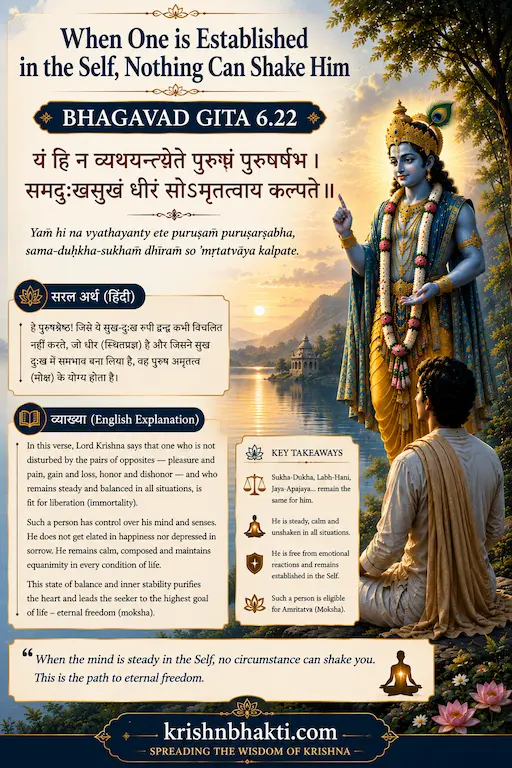
यं लब्ध्वा चापरं लाभं मन्यते नाधिकं ततः ।
यस्मिन्स्थितो न दुःखेन गुरुणापि विचाल्यते ॥ ६.२२ ॥
What Is Krishna Actually Saying?
Krishna says — having attained which, one considers no other gain greater than that — and established in which, one is not shaken even by the heaviest sorrow.
Two statements at the center. Yam labdhva aparam labham na manyate adhikam — having gained this, no other gain seems greater. And yasmin sthitah gurunapi duhkhena na vichalyate — established in this, not shaken even by the heaviest sorrow. Together they describe the two most recognizable signs of having reached the state Krishna has been describing through this entire section.
Sadhak Sanjivani — Swami Ramsukhdas Ji
In Sadhak Sanjivani, Swami Ramsukhdas Ji says yam labdhva aparam labham na manyate adhikam is the cure for the mind's most fundamental disease — the disease of always wanting more. Whatever is gained never feels like enough — something more is always needed. When this supreme gain is reached, that insatiable "more" simply stops. Not through suppression, but through genuine satiation. The hunger that drove the search has been genuinely met.
On gurunapi duhkhena na vichalyate — not shaken even by heavy sorrow — he makes a crucial clarification. This verse is not saying the person feels no pain. Pain comes — the body feels it, the emotions feel it. But the person is not "shaken" — meaning they do not lose their ground, their center, their deep place. Vichalana means being displaced from one's position. This person is not displaced from their core, regardless of what sorrow arrives.
Swami Ji adds that these two qualities — "nothing seems greater" and "unmoved by heavy sorrow" — are two sides of the same coin. The person who is genuinely satisfied inside is not particularly vulnerable from outside. Because their core identity does not depend on any external condition remaining stable.
Prabhupada — Bhagavad Gita As It Is
Srila Prabhupada, in Bhagavad Gita As It Is, says Krishna here describes the two most immediately recognizable characteristics of this state — ones that any ordinary person can understand and relate to at once. First — nothing seems greater. Second — sorrow cannot shake you. Both of these speak directly to the deepest human longings: to find something that truly satisfies, and to be free from the terror of suffering.
On yam labdhva — having gained which — Prabhupada says for the devotee, this is Krishna. When the devotee finds Krishna — genuinely, experientially, not just intellectually — they truly want nothing more. This is not poetic exaggeration. It is the actual lived experience of genuine bhakti, confirmed by every sincere practitioner across the centuries.
On gurunapi duhkhena na vichalyate, Prabhupada says this is the test of the state. When great difficulty arrives and the person remains at their center — that is when the reality of their attainment becomes visible. This is not performed equanimity or forced positivity. It is genuine, deeply-rooted stability that nothing external can move.
Swami Mukundananda Ji's Perspective
Swami Mukundananda Ji connects this verse to what he calls the fundamental trap of achievement culture. He says — today everyone is chasing the next level. Achieve this, then that. Gain this, then want that. The ladder goes on forever. And entire lifetimes pass in climbing it, without ever arriving anywhere that feels like enough.
He says — yam labdhva aparam labham na manyate adhikam is the Gita's most radical statement. There exists a gain after which the ladder climbing simply stops — not because motivation is gone, but because what was actually being sought has genuinely been found. This is completeness — and it comes only from the realization of God within.
On gurunapi duhkhena na vichalyate, Swami Ji says something that touches a universal chord. He says — we all fear suffering. So much so that we spend enormous energy trying to arrange external security and comfort to protect ourselves from it. But this verse points to something altogether different — an inner stability from which no sorrow can move you. Not outer security — inner rootedness. And this cannot be bought or arranged. It comes only through genuine practice.
What Does This Look Like in Real Life?
Think of someone who has lost a great deal — a job, relationships, health — in a relatively short time. Everything that seemed secure has shifted. But this person, who has practiced sincerely for years, does not break. There is grief, there is difficulty — but there is a thread that does not snap. That thread is gurunapi duhkhena na vichalyate — made real in an ordinary life.
Or that moment in meditation or bhajan when a quiet fullness arrives — and the mind does not ask "what's next?" It does not search for more. It simply rests. This is the glimpse this verse is pointing toward — aparam labham na manyate adhikam — experienced in a few seconds of genuine inner quiet.
In daily life, this shows up as — the loss of something desired no longer being as devastating as it once would have been. A difficult piece of news arriving and the mind wavering for a moment — and then returning. These small, repeated signs are the early evidence of a stability that, with continued practice, grows into something unshakeable.
Questions That Probably Live in Your Heart
Nothing more is needed — does this mean ambition ends?
Swami Mukundananda Ji says — no. What ends is desperate wanting. Genuine motivation and care can remain. The difference is between the satisfied person who can enjoy a good meal without being desperate for it, and the hungry person who cannot think about anything else. Both may eat the same food — the inner relationship is completely different.
Not shaken by sorrow — is this emotional numbness?
Swami Ramsukhdas Ji says — absolutely not. Numbness involves the absence of awareness. Here, full awareness is present — sorrow is felt — but the core is not displaced. Like a deeply rooted tree that a storm can move but not uproot. The leaves and branches respond to the wind. The roots hold.
What exactly is this supreme gain?
Prabhupada says — for the devotee, it is Krishna. For the jnana yogi, it is Self-realization. But in both cases, what is common is that this is found inside, not outside. And when found, the "more" hunger that drove the search genuinely ends.
Can this state be reached while living an ordinary life?
Swami Mukundananda Ji says — yes. This verse was spoken to Arjuna — a warrior, a householder, someone with enormous responsibilities. This state is available within ordinary life. The condition is not renunciation of the world — it is sincerity and consistency of practice within it.
What do 6.21 and 6.22 together teach?
6.21 described the quality of the happiness — transcendental, beyond the senses, grasped by pure intellect. 6.22 names its two most unmistakable practical effects — nothing seems greater, and sorrow loses the power to shake. Quality followed by effects — together they give a complete portrait of what reaching this state actually means and feels like in a human life.
Read this also :- The Happiness the Senses Cannot Give — Only Pure Intellect Can Reach It 👇👇👇
🙏 Hare Krishna — Jai Shri Krishna 🙏