The previous verse gave yoga its most precise definition — the disconnection from union with suffering — and the manner of practicing it — with firm resolve and without discouragement. Now the practical instruction begins. Where do you actually start? What is the first concrete step?
Krishna's answer in this verse is both clear and demanding. Start by completely abandoning all desires that arise from mental resolve. Not partially — completely. And simultaneously, restrain all the senses through the mind — not some of them, all of them, from every direction.
This verse is for everyone who knows they should discipline the mind and senses but is not sure where to actually begin. Krishna is pointing to the origin — desires begin as mental resolves — and that is where the work must start.
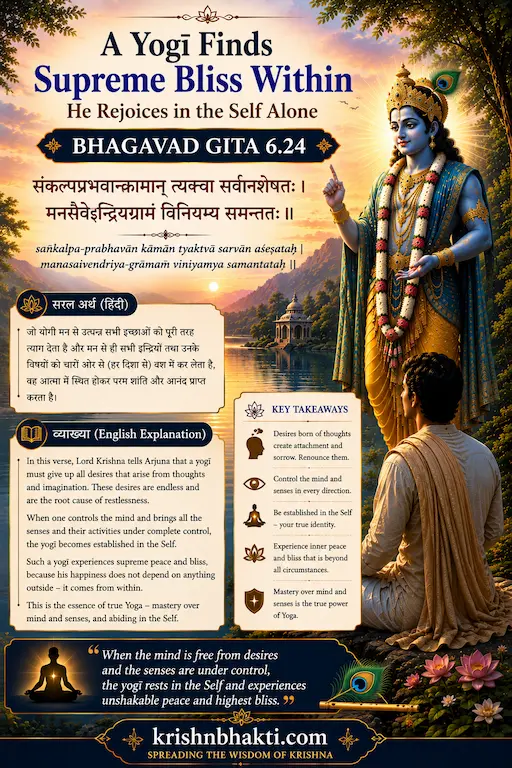
सङ्कल्पप्रभवान्कामांस्त्यक्त्वा सर्वानशेषतः ।
मनसैवेन्द्रियग्रामं विनियम्य समन्ततः ॥ ६.२४ ॥
What Is Krishna Actually Saying?
Krishna says — having completely abandoned, without exception, all desires born of mental resolve — and having restrained through the mind alone the entire group of senses from every direction.
This verse is incomplete on its own — it continues into 6.25. Here two actions are described. Sankalpa-prabhavan kaman tyaktva sarvan asheshatah — completely abandoning, without exception, all desires that arise from mental resolve. And manasa eva indriya-gramam viniyamya samantatah — restraining the entire group of senses from every direction through the mind alone.
Sadhak Sanjivani — Swami Ramsukhdas Ji
In Sadhak Sanjivani, Swami Ramsukhdas Ji explains that sankalpa-prabhavan kaman — desires born of mental resolve — is pointing to the origin of desire itself. Where do desires come from? From sankalpa — from the mind's resolution that "this should happen," "this should be mine." When that mental resolution forms and settles, desire is born. When desire is not fulfilled, anger follows. This is the chain. The only effective way to work is at the root — at sankalpa.
On asheshatah — without any remainder — he makes a pointed observation. Half-hearted abandonment does not work. If ninety-nine desires are released and one is held onto, that one will eventually pull all ninety-nine back. Like a boat with one hole — it sinks regardless of how well-sealed the other parts are. The abandonment must be complete, or the effort is ultimately undermined by what remains.
On manasa eva indriya-gramam viniyamya samantatah — restraining the senses through the mind from every direction — Swami Ji says the instrument for controlling the senses is the mind itself, not any external force. And samantatah — from every direction — means no sense is left unsupervised. Even one unguarded sense can pull the mind back into distraction and undo the work of the others.
Prabhupada — Bhagavad Gita As It Is
Srila Prabhupada, in Bhagavad Gita As It Is, says this verse begins the practical instruction section that follows from the definition of yoga given in 6.23. Krishna has defined the destination. Now He gives the first step toward it.
On sankalpa-prabhavan kaman, Prabhupada says understanding the origin of desire is essential. Desire originates in mental resolution — in the thought that settles into "I need this." Working on desire without working on sankalpa is working downstream when the source remains open. The effective work is to recognize sankalpa as it forms and not let it settle into desire.
On manasa eva — through the mind alone — Prabhupada makes a crucial point. Senses are not controlled through force. Forced restraint creates pressure that eventually breaks. The mind must be redirected — and when the mind genuinely moves toward a higher object, the senses naturally follow. This is why bhakti is the most effective approach — it gives the mind a direct, compelling, higher destination in Krishna.
Swami Mukundananda Ji's Perspective
Swami Mukundananda Ji connects this verse to modern psychology, noting that it confirms what contemporary understanding of the mind has arrived at independently. He says — desires begin as thoughts. The thoughts you entertain become desires. The desires that persist become actions. Working at the level of thought — sankalpa — is working at the most effective possible point in the chain.
On asheshatah — without remainder — he offers a practical illustration. Someone who wants to quit smoking but says "I will quit 99%, I will keep just one cigarette a day" has not actually quit. The one cigarette maintains the habit. Desire works the same way. The abandonment must be genuine and complete — not 99%, not "mostly." This is a high bar. It is meant to be.
On samantatah — from every direction — Swami Ji makes a point that many practitioners overlook. People often discipline one or two areas of sense engagement while leaving others unaddressed. Food is controlled, but hours are lost in unguarded entertainment. Meditation is practiced, but speech remains completely unrestrained. Samantatah means comprehensive. Every sense, every direction. Partial discipline produces partial results.
What Does This Look Like in Real Life?
You are scrolling through social media and a thought appears — "I wish I had a life like that." This is a sankalpa forming — the mental resolution that something is lacking. If you catch it in that exact moment, recognize it as what it is, and choose not to entertain it — you are working at the root. This is sankalpa-prabhavan kaman tyaktva in the most ordinary, daily context imaginable.
Or a colleague does something at work that would normally trigger a sharp, reactive response. But in that moment, the mind holds — "this is my sense of ego reacting, I choose not to act from it" — and the reaction is not released. This is manasa eva indriya-gramam viniyamya — restraining the senses through the mind, in real time, in the middle of ordinary life.
And samantatah — from every direction — in daily life means the discipline applies across the board. Not just during meditation. Not just in one area of life. Eating, speaking, entertainment, reactions — all of it. This is what comprehensive sense mastery looks like when it is actually practiced.
Questions That Probably Live in Your Heart
Abandoning all desires without exception — is this humanly possible?
Swami Ramsukhdas Ji says — this is the direction, not a single-moment event. It does not happen all at once. But the direction must be clear and the movement consistent. Every desire that weakens is one step forward. The word "asheshatah" sets the standard — what is worked toward, with sincerity, over time.
Restraining senses through the mind — but the mind itself is unruly, so how?
Prabhupada says — this is precisely why the mind must be given a higher object. When the mind is genuinely engaged with Krishna, it naturally moves away from lesser objects. The senses follow the mind. So the most effective approach is not to control the mind by force but to redirect it toward something genuinely compelling — and nothing is more compelling than God.
What is the difference between sankalpa and desire?
Swami Mukundananda Ji says — sankalpa is the mental resolve that gives birth to desire. "This should happen" is sankalpa. When that resolve settles and hardens, it becomes desire — which then demands action. Sankalpa is the cause, desire is the effect. Working at sankalpa means working at the cause before the effect has fully formed.
If desires are abandoned, do they not simply return?
Swami Ramsukhdas Ji says — they do, especially at first. This is why consistent practice is essential. But each time a desire is recognized and not entertained — not acted on, not reinforced — it weakens slightly. Over time, the pattern changes. Gradually, more and more, until what was once an overwhelming pull becomes much quieter.
What do 6.23 and 6.24 together teach?
6.23 defined yoga — disconnection from union with suffering — and gave the manner of practice — firm resolve, without discouragement. 6.24 gives the first concrete action step — completely abandon desires arising from sankalpa, and restrain all senses comprehensively through the mind. Definition followed by first action — the sequence makes the path genuinely walkable.
read this also:- Disconnection From Suffering Is Yoga — Practice It With Firm Resolve and Without Despair 👇👇👇
🙏 Hare Krishna — Jai Shri Krishna 🙏