Equanimity: Are You Seeing the World Through Krishna’s Eyes?
In the previous verse, we witnessed Arjuna presenting a formidable challenge to Krishna: 'This mind is as restless as the wind, impossible to tame!' We all resonate with this struggle today. From the moment we wake up and check our notifications to the relentless pressure of office deadlines and the complexities of relationships, our minds are in a perpetual state of flux. We chase happiness in external objects, but Krishna consistently reminds us that true peace lies in the stability of the mind.
A common misconception among today’s youth is that spirituality means abandoning the world or retreating to the Himalayas. However, Krishna’s Yoga is far more profound. He advocates for active living—doing your job, maintaining relationships, and aiming for success—all while maintaining your 'equanimity.' Is this truly possible? In the modern era of social media comparison and constant external validation, treating everyone as your equal seems like an insurmountable task.
Imagine a scenario: a colleague surpasses you at work, or someone insults you. In that moment, our minds immediately jump onto the scales of 'pleasure and pain.' We react instantly. But today, Krishna gives us a mantra that will create a shield between our reactions and our inner nature. He teaches us how to become 'Samadarshi' (one who sees with equal vision).
This verse isn't just about meditation; it attacks our very way of living. When we begin to treat the happiness of others as our own, and the suffering of others as our own, we enter a state of peace that remains untouched by external circumstances. Have you ever wondered why someone else's pain makes you feel distressed? The answer lies within this verse.
Today, we will dive deep into the layers of this shloka. We will examine how great saints like Swami Ramsukhdas Ji, Srila Prabhupada, and Swami Mukundananda have defined this as a 'Master Key' for modern life. This isn't a blog to just read; it’s a manual to change your life. So, let us calm our minds and immerse ourselves in this ocean of wisdom.
You might be wondering, is this 'equal vision' practical? Should we love our enemies? Should we excuse wrongdoing? No, this verse doesn't suggest that. It speaks of 'equanimity,' not 'blindness.' That is the nuance we will explore today.
Get ready, because this verse has the potential to shift your life's trajectory. When you dissolve the artificial barriers between yourself and others, you will find your stress levels naturally diminishing.
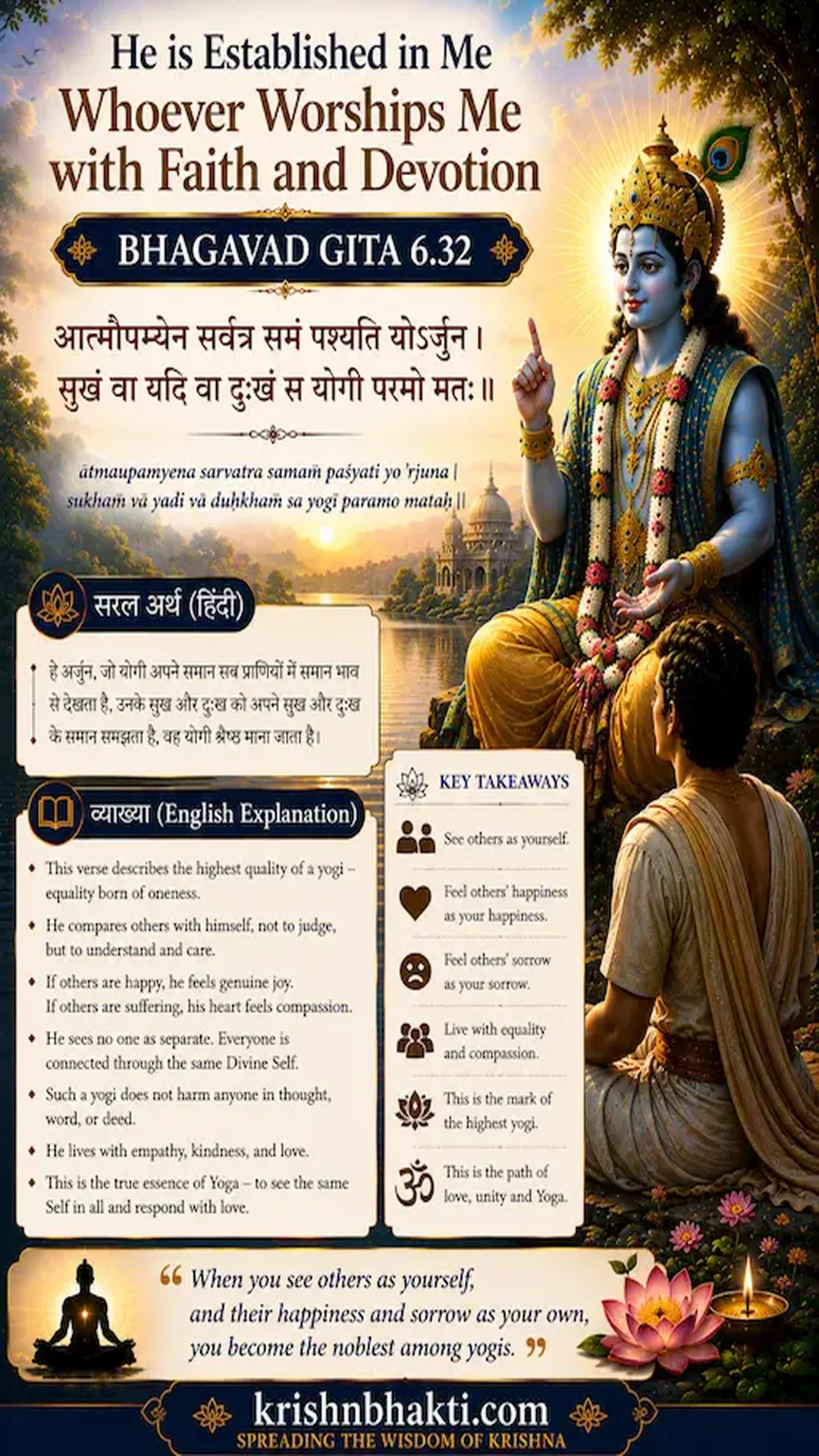
आत्मौपम्येन सर्वत्र समं पश्यति योऽर्जुन। सुखं वा यदि वा दुःखं स योगी परमो मतः ॥ ६.३२ ॥
Simple Meaning and Breakdown
In this verse, Krishna addresses Arjuna with a profound truth: 'O Arjuna! He who sees all beings as equal, in happiness or distress, by comparing them with his own self, is considered the supreme yogi.'
Let’s break this down:
Atmaupamyena — By analogy to oneself, understanding that others feel pain and joy just as I do.
Sarvatra — Everywhere, in every living being.
Samam Pashyati — Sees them as equal.
Sukham va yadi va duhkham — Whether in happiness or in distress.
Sa yogi paramo matah — That yogi is considered the highest.
The first takeaway here is that Empathy is the foundation of Yoga. The second is neutrality toward pleasure and pain. The third is the recognition of the Divine in every living being, ensuring we do not discriminate. The fourth is that this is a state of mastery, achieved through gradual, dedicated practice.
Swami Ramsukhdas Ji: The Depth of 'Atmaupamyena'
Swami Ramsukhdas Ji explains that 'Atmaupamyena' is more than just empathy; it is the realization that your soul is all-pervading. When we claim 'this is mine,' we become limited. When we start experiencing the joys and sorrows of others as our own, the circle of 'I' expands.
Swamiji emphasizes that this practice lifts us above the petty fights at work or home. If you feel like treating someone harshly, just pause and think: 'Would I like to be treated this way?' This one thought marks the beginning of true yoga.
He states that the 'Supreme Yogi' is one who maintains the stability of the mind. When happiness comes, there is no ego; when sadness comes, there is no panic. Because the yogi knows that pleasure and pain exist only at the level of the body and mind; at the soul level, we are all one.
Srila Prabhupada: The Lens of Bhakti
Srila Prabhupada views this through the lens of devotion. He says that seeing Krishna in every being means we must be compassionate toward every living entity. If we love the Lord, how can we harm His parts (the living beings)?
Prabhupada emphasizes that this equanimity is not just a mental exercise; it is an act of surrender to the Lord. When we see the Divine in everyone, the spirit of service awakens. This 'equality' is tied to service.
He calls it a 'sacred vision.' Just as a father sees all his children as equal, a devotee sees all living entities as children of God. This sentiment effectively eradicates anger and hatred from the human heart.
Prabhupada’s interpretation teaches us that Yoga isn't just about meditation; it is about remembering Krishna every moment and experiencing His presence in all beings.
Swami Mukundananda Ji: Yoga in Modern Life
Swami Mukundananda describes this as a 'mental exercise.' He notes that our minds are biased. We want everything good for ourselves and not necessarily for others. This verse is the therapy to fix that bias.
He compares it to a gym workout. When you lift weights for the first time, your hands tremble, but with practice, you become strong. Similarly, initially, seeing everyone as equal is hard, but as you repeatedly try to look through 'the other's eyes,' you develop the capacity for it.
He gives a beautiful example: 'If someone trips and falls, you might laugh. But if it happens to you, you feel embarrassed. A yogi is one who feels the pain of the person falling just as if it were his own.'
Mukundananda Ji argues that this is the only way to reduce stress in modern life. Reducing the ego and understanding the emotions of others is the essence of true 'Emotional Intelligence.'
Real-Life Examples
Imagine you are at the office. Your boss scolds you, even when it wasn't your fault. Common reaction: anger and revenge. The Yogi's reaction: 'Perhaps they are going through some stress, just as I get irritated sometimes.' This one second of reflection saves your entire day from being ruined.
Another situation: on social media, you see someone living a luxurious life and feel small. This verse reminds you: 'Sukham va yadi va duhkham.' That photo is just a moment, not their whole reality. Don't base your peace on external comparisons.
Even during meditation, it happens. The mind wanders. You get angry at yourself. Then you recall: 'Just as I forgive myself for my mind wandering, I must forgive others for their mistakes.' This is the practice of 'Atmaupamyena.'
Self Q&A
Q: Do I have to treat everyone as a friend, even if they are doing wrong?
A: Swami Ramsukhdas Ji says that equanimity is not 'blindness.' You can call a wrong, wrong, but don't harbor hatred. Maintain compassion for them like a doctor has for a patient, regardless of their condition.
Q: How hard is this practice? I get angry every second.
A: Swami Mukundananda Ji calls this a 'mental rep.' Just as you lift weights repeatedly, you have to bring your mind back repeatedly. It's not a one-day job, but a lifelong practice.
Q: Does equanimity mean I shouldn't cry or laugh?
A: Srila Prabhupada teaches that emotions are not bad, but getting lost in them is. Don't be egoistic in happiness and don't lose courage in sadness.
Q: Is this Yoga for the average person?
A: Absolutely! It is designed for those who stand in the crowd of the world. Those going to the Himalayas need it less; we need it more.
Q: How will I know if I'm making progress?
A: When small things done by others stop bothering you, then you know you are on the right path.
🙏 Hare Krishna — Jai Shri Krishna 🙏
📖 Also Read: Is Giving Up Everything the Only Way? Krishna’s Real Lesson on Karma 🧘♂️