When Your Mind Won't Stop, the Gita Says Do This
In the previous verses of the Bhagavad Gita, Arjuna expressed the deep, agonizing frustration that many of us feel today: the feeling that the mind is as impossible to control as the wind. We live in an era where 'restlessness' is the default setting. Whether it is the notification pinging on your phone, the pressure of a deadline at work, or the silent, nagging anxiety about the future, our minds are constantly being pulled in a thousand different directions.
We often fall into the trap of believing that meditation or spiritual focus means 'stopping all thought.' We think that if our mind wanders, we have failed. This is the biggest misconception about the spiritual path. When we try to force the mind to be silent, we create a pressure cooker environment within ourselves. We become anxious about being anxious, which only fuels the fire of our inner restlessness.
In this verse, Krishna doesn't tell Arjuna to suppress his mind or to magically stop it. He speaks to us like a compassionate teacher who understands the human hardware. He acknowledges the difficulty, validates the struggle, but then offers a very specific, actionable strategy. It is not about willpower; it is about 'Abhyasa' or practice.
Think about a modern young professional. You are sitting at your desk, trying to finish a report, and suddenly, you are scrolling through social media, then worrying about a relationship, then stressing about an upcoming presentation. You feel guilty, you feel like a failure. But what if you saw this 'wandering' not as a failure, but as a rep in a workout? What if you realized that every time you gently bring your mind back, you are strengthening your spiritual muscle?
The youth today are facing a mental health crisis because we haven't been taught how to manage this restless energy. We have been taught how to feed the mind with stimuli, but not how to steady it. Krishna’s message in this verse is the antidote to this modern exhaustion. It is a message of hope, persistence, and deep psychological wisdom.
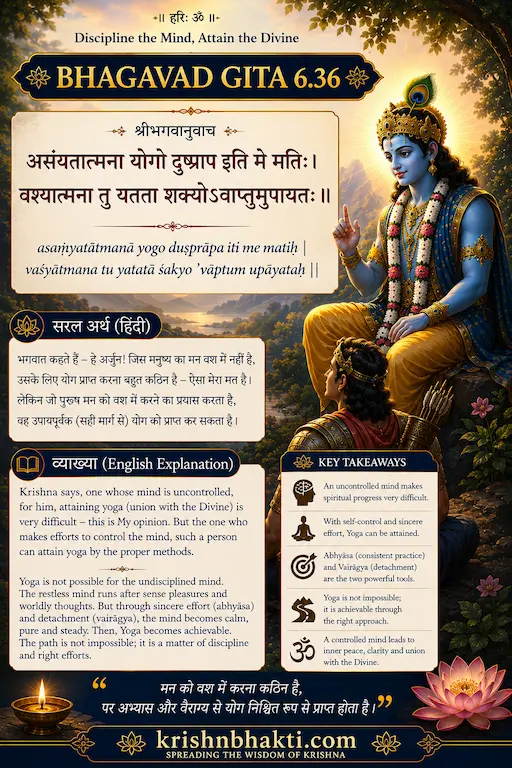
असंयतात्मना योगो दुष्प्राप इति मे मतिः ।
वश्यात्मना तु यतता शक्योऽवाप्तुमुपायतः ॥ ६.३६ ॥
Simple Meaning: In this verse, Krishna says: 'Asanyatmanā yogo duṣprāpa iti me matiḥ' — For one who has not controlled the mind, yoga is indeed difficult to achieve; this is My confirmed opinion. 'Vaśyātmanā tu yatatā śakyo’vāptumupāyataḥ' — But for one who is self-controlled and strives by proper means, it is certainly possible to achieve this perfection.
Breakdown: Asanyatmanā (one who has not restrained the mind), yogo (the path of connection/yoga), duṣprāpa (is difficult to obtain). Vaśyātmanā (one who has taken control), yatatā (striving with effort), śakyo’vāptum (can be achieved), upāyataḥ (by the right means/technique).
Swami Ramsukhdas Ji emphasizes the word 'Upāyataḥ'. He says that spiritual success is not a matter of luck or divine grace alone; it is a matter of following the correct technique. He explains that 'Vaśyātmanā' does not mean the mind is dead; it means the mind has been brought under the supervision of the Soul. He urges practitioners not to give up. He says that the effort itself is the prayer.
A.C. Bhaktivedanta Swami Prabhupada takes a devotional angle. He teaches that the mind is a servant. If we don't give it a master, it serves the senses. By placing the mind at the lotus feet of Krishna, we provide it with the highest possible engagement. He explains that this is not a dry process of repression, but a loving process of redirection. When the mind finds something more beautiful than material objects, it naturally settles.
Swami Mukundananda Ji bridges the gap perfectly for the modern reader. He uses the analogy of a 'gym workout.' He says, 'If you go to the gym and lift a weight, your muscles don't grow by the weight itself; they grow by the effort you put in against resistance.' Similarly, he explains that in meditation, when your mind wanders and you bring it back, that is a 'mental rep.' If the mind wanders 100 times, you have 100 opportunities to strengthen your focus. This shift in perspective turns 'failure' into 'training.'
Imagine you are sitting in meditation. You feel your breath, and suddenly, you are thinking about an email you forgot to send. Instead of getting angry, you smile. You acknowledge the thought, and you return to the breath. This is the 'Upāyataḥ' Krishna talks about. It is the practice of gentle, consistent return. This builds a baseline of inner peace that helps you deal with stress in the office, arguments at home, and the constant noise of social media.
Q: Is my mind uniquely restless?
No. As Swami Ramsukhdas Ji says, the mind is naturally restless. If your mind is wandering, it's functioning as it should. Your task is not to 'fix' it, but to train it. The fact that you are aware of your restlessness is actually a sign of progress, not a problem.
Q: Should I be forceful with my mind?
Swami Mukundananda Ji suggests being firm but kind. If you are too aggressive, you create more tension. Treat your mind like you would treat a small child—firmly guide it back to the task, but always with patience and compassion.
🙏 Hare Krishna — Jai Shri Krishna 🙏
📖 Also Read: When Your Mind Won't Stop, the Gita Says Do This 🧘♂️