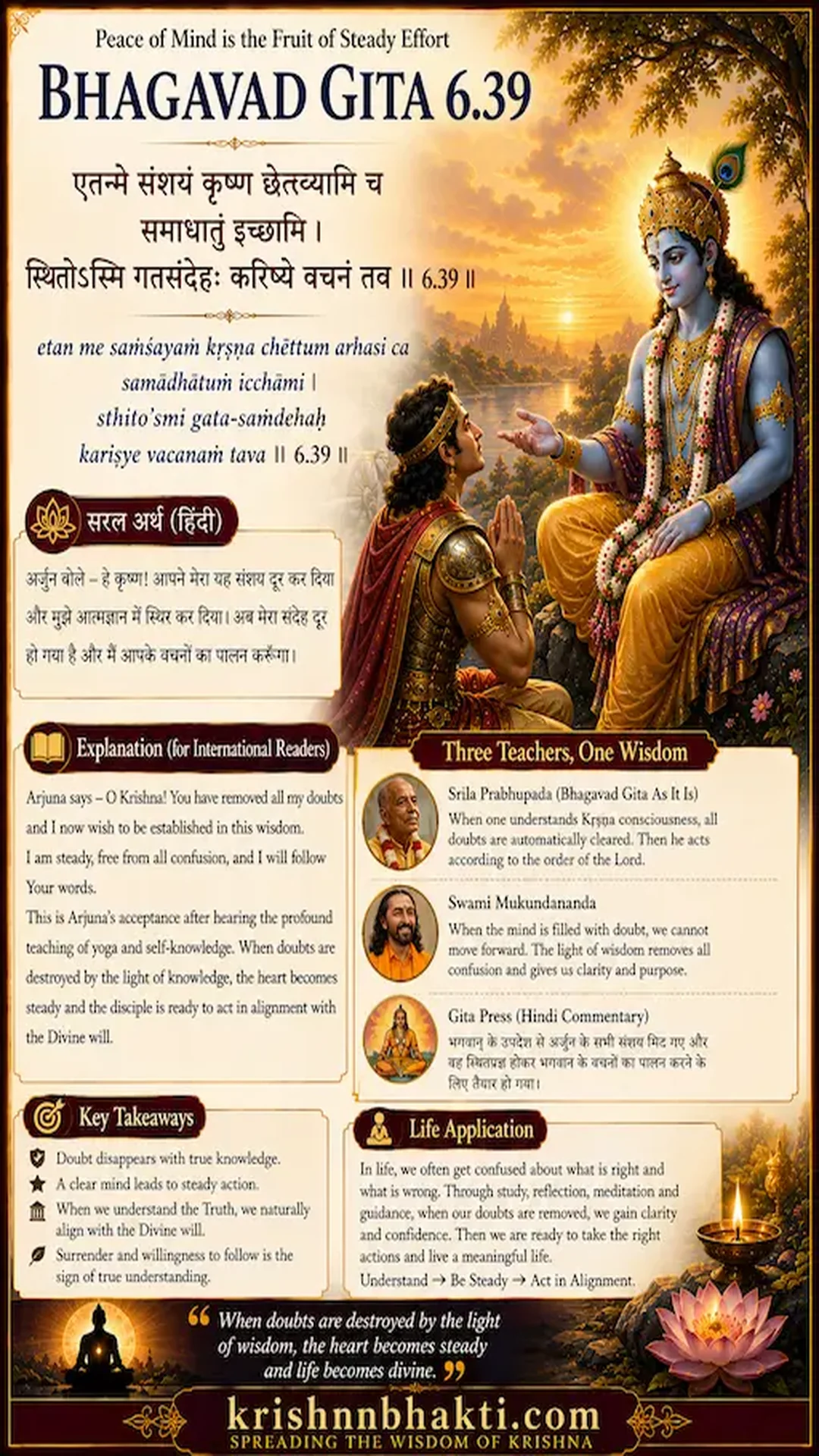
In the previous verse (6.38), Arjuna asked a heart-wrenching question. He asked, "O Krishna, what happens to the one who takes the path of yoga but falls off along the way? Does he perish like a scattered cloud?" This is not just Arjuna's question; it is the question of every young person today who tries to improve themselves but keeps failing due to the pressures of modern life.
Many of us start a new habit—meditation, reading scriptures, or focusing on our career goals—but within weeks, the demands of the office, the distractions of social media, and our own internal anxieties pull us back. We start feeling like a failure. We think, "Is my effort wasted? Am I incapable of progress?" This fear creates a block that prevents us from starting again.
Society teaches us that if you don't reach the finish line, you haven't done anything. But here, through Arjuna, Krishna introduces a revolutionary perspective. Krishna reveals that no spiritual effort is ever wasted. Your sincerity is recorded. Even the smallest step toward the divine is a gain that stays with you forever.
People often think that if their mind wanders during meditation, they have failed the session. We view our spiritual journey through the lens of a competitive corporate environment where 'results' are everything. Krishna asks us to shift this mindset. He wants us to see our lives as a long, soul-level journey where consistency matters more than perfection.
Today, we will dive into this verse to understand why your doubts are actually a sign of your sincerity and why you should never stop, even if you feel like you are failing. Let's explore how to handle the uncertainty of life with the guidance of the Gita.
Bhagavad Gita Verse 6.39
एतन्मे संशयं कृष्ण छेत्तुमर्हस्यशेषतः।
त्वदन्यः संशयस्यास्य छेत्ता न ह्युपपद्यते॥ ६.३९ ॥
Simple Meaning: Arjuna says, "O Krishna, please destroy this doubt of mine completely. Apart from You, there is no one else who can dispel this doubt." This shows Arjuna's humility. He admits that he does not have the answers and that his intellect alone is not enough to clear his confusion.
The word "Asheshatah" (completely/entirely) is crucial here. Arjuna isn't asking for a temporary bandage; he wants the root of the doubt to be removed. He acknowledges Krishna as his ultimate teacher and the only one capable of guiding his soul.
Key Takeaways: (1) Doubt is a natural phase of growth, not a failure, (2) Only the Divine can provide true clarity, (3) Honesty in admitting our confusion is the first step toward enlightenment.
Perspective of Swami Ramsukhdas Ji
Swami Ramsukhdas Ji emphasizes the word "Asheshatah" significantly. He suggests that a doubt, if left half-addressed, will sprout again like a weed. He explains that Arjuna is not just asking a intellectual question; he is seeking a permanent cure for his existential fear.
Swami Ji points out that Arjuna's exclusivity in saying "There is no one else but You" indicates that he has surrendered his ego. When we try to solve our problems using only our worldly logic, we often get trapped in deeper layers of anxiety. Swami Ji says that the moment we turn to the Divine with a surrendered heart, the solution starts appearing.
He connects this to our daily sadhana (practice). He says that our efforts are not meant to produce immediate results but to build a relationship with God. When we doubt our practice, we are essentially questioning the grace of God. Swamiji teaches us to hold onto Krishna's hand and let Him clear the fog of our minds.
Finally, he notes that asking such questions is a trait of a seeker. If you have doubts, it means you are thinking about the truth. Use those doubts to reach out to Krishna, just as Arjuna did.
Perspective of A. C. Bhaktivedanta Swami Prabhupada
Prabhupada interprets this verse through the lens of pure devotion (Bhakti). He explains that Arjuna's doubt is not a sign of weakness, but a sign of his deep dependence on Krishna. In the Vedic tradition, the guru-disciple relationship is based on the disciple's sincere inquiry and the guru's compassionate guidance.
Prabhupada highlights that academic knowledge can make us 'smart', but it cannot give us the peace of mind that comes from knowing the Absolute Truth. Only Krishna, the Supreme Personality of Godhead, can remove the illusions of the material world. He stresses that the modern youth, who are often overwhelmed by information overload, need to anchor themselves in this divine connection.
He explains that the "doubt" Arjuna feels is common to everyone who enters the spiritual path. However, by asking Krishna, Arjuna is showing the world the way. Prabhupada's teachings suggest that we should stop trying to be the 'solver' of all our life's problems and start being the 'servant' who relies on Krishna's guidance.
He often used the phrase "Krishna Consciousness" to describe the state where one is connected to the source. When we are connected to the source, our doubts don't need to be solved; they simply dissolve because we realize that our life is in the hands of the One who controls the universe.
Perspective of Swami Mukundananda Ji
Swami Mukundananda Ji uses a brilliant analogy to explain this. He compares the mind to a wild horse. When we try to tame it through meditation, it kicks and wanders. This is when the doubt creeps in: "Is this working? Am I ever going to be peaceful?"
He explains that Arjuna's question is like a student asking a coach during a difficult workout: "Is this training actually helping me, or am I just getting tired?" The coach knows that the fatigue is actually the sign that the muscles are growing. Swami Ji suggests that our struggles in meditation are actually 'spiritual reps'.
He bridges this ancient wisdom with our modern lives by saying that we live in an era of 'instant gratification'. We want results immediately. But spiritual growth is a subtle, slow process. He advises the youth to be patient with themselves. If you have a doubt, don't ignore it, and don't let it fester. Discuss it with the scriptures or a mentor.
His core message is that Krishna is always there to guide us, but we must reach out to Him with the same sincerity as Arjuna. When you place your confusion at Krishna's feet, you are actually taking a massive step towards your own evolution.
Real-life Examples
Think about a scenario where you've been working on a project for months. Suddenly, you hit a wall, and you feel like you've wasted your time. Your mind tells you that you are not good enough. This is exactly where you can apply this verse. Instead of spiraling, pause.
Acknowledge the feeling. Say to yourself, "I am feeling discouraged, just like Arjuna." Then, shift your focus to a deeper intent. You aren't just working for a project; you are performing your duties as an offering. When you change the 'why' behind your work, the 'how' becomes much easier to manage.
In meditation, when your mind wanders to your phone, your relationships, or your boss, notice that you have wandered. Don't beat yourself up. Gently, lovingly, bring your mind back. This act of 'returning' is the practice. You are not failing; you are training.
By the end of the day, when you feel exhausted, offer that exhaustion to Krishna. Tell Him, "I tried my best today, please take care of the rest." This simple mental shift takes the weight of the world off your shoulders and places it on the One who is capable of carrying it.
Self Q&A
1. Is this my special problem?
Absolutely not. Even the great Arjuna felt it. Swami Ramsukhdas Ji points out that the existence of doubt is actually a sign of an active, seeking mind.
2. How will I know when I am making progress?
Swami Mukundananda Ji says that progress is measured by how quickly you can return your focus to your goal after a distraction. It's not about not getting distracted; it's about the speed of recovery.
3. Should I force my mind or be gentle?
Prabhupada says that love is the key to all spiritual practice. Be as patient with your mind as you would be with a young child. Harshness only creates resentment.
4. Is every thought important?
Not at all. Your job is to focus on your duty and your connection with Krishna. Let the irrelevant thoughts pass by like clouds in the sky.
5. How do I actually talk to Krishna?
Start by treating Him as your best friend. Tell Him everything. Just like Arjuna, be raw, be honest, and be open. He is listening, even if you don't hear Him yet.
🙏 Hare Krishna — Jai Shri Krishna 🙏
📖 Also Read: When Your Mind Won't Stop, the Gita Says Do This 🕉️