In the previous verse, Krishna told us that the path of yoga has two stages — the stage of climbing, and the stage of having arrived. But a natural question follows — how do you actually know when you have arrived? There is no certificate, no bell that rings, no sudden announcement. So what is the sign?
This verse gives the answer. And the answer is entirely inward. It has nothing to do with how many hours you meditate, how many temples you visit, or how many scriptures you have memorized. It has everything to do with where the mind rests — and what it is no longer pulled by.
This verse is a mirror. Hold it up honestly and it will show you exactly where you are on the path.
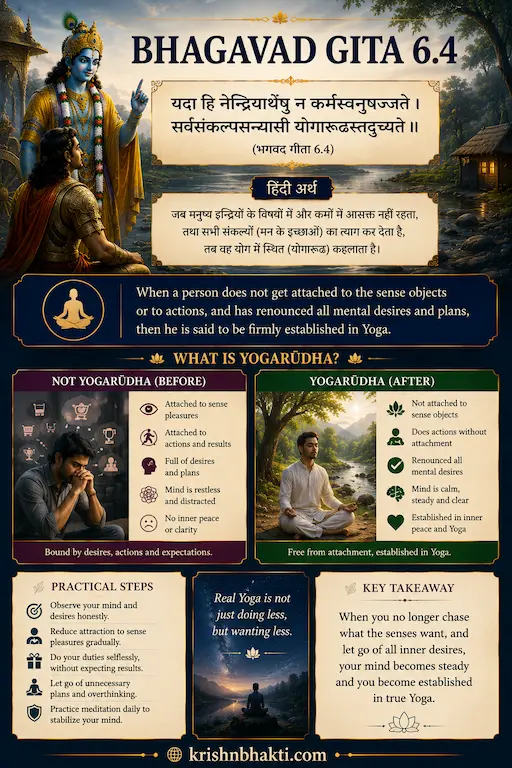
यदा हि नेन्द्रियार्थेषु न कर्मस्वनुषज्जते ।
सर्वसङ्कल्पसन्न्यासी योगारूढस्तदोच्यते ॥ ६.४ ॥
What Is Krishna Actually Saying?
Krishna says — when a person is not attached to sense objects and not attached to actions — when they have renounced all sankalpas, all selfish desires and mental resolutions — that person is then called yogarudha, one established in yoga.
Three markers. First — no attachment to sense objects. Second — no attachment to actions. Third — complete renunciation of all sankalpa. When all three are present — that is the sign of having truly arrived.
Sadhak Sanjivani — Swami Ramsukhdas Ji
In Sadhak Sanjivani, Swami Ramsukhdas Ji explains that no attachment to sense objects does not mean not using the senses. The yogarudha person still eats, sees, hears, speaks. But they do not sink into those experiences. Like a lotus that lives in water but is never wetted by it — the yogarudha lives fully in the world but is not captured by it.
On no attachment to actions, Swami Ji makes a subtle and important point. Doing work and being attached to work are two entirely different things. Attachment means — "this happened because of me, this is my achievement, I need credit for this." When that "mine" dissolves — work continues but attachment is gone. The action flows without the ego claiming it.
On sarva-sankalpa-sanyasi — the one who has renounced all sankalpas — he says this is the complete fulfillment of what was introduced in verse 6.2. There, Krishna said sankalpa must be renounced. Here, He describes what it looks like when that renunciation is complete. It is not an overnight event. It is the fruit of years of sincere practice.
Prabhupada — Bhagavad Gita As It Is
Srila Prabhupada, in Bhagavad Gita As It Is, says this verse gives the most precise definition of yogarudha in the entire Gita. He explains — freedom from attachment to sense objects and freedom from attachment to actions together create a state of complete inner liberation. Nothing pulls the mind anymore. Nothing owns it.
On sarva-sankalpa-sanyasi, Prabhupada says this is the person in whom the inner voice of "I want this" has gone quiet. Not because desires are being suppressed — but because nothing outside holds genuine power over the mind anymore. The mind rests in God, and from that resting place, everything else becomes secondary.
He connects this to bhakti — saying that for the sincere devotee of Krishna, this state arrives naturally. The devotee does not have to fight against desires one by one. The love of Krishna simply makes everything else less urgent, less compelling. That is the most direct and complete path to what this verse describes.
Swami Mukundananda Ji's Perspective
Swami Mukundananda Ji brings this verse into the texture of daily modern life with great clarity. He says — look at what consumes most of our energy every day. Two things above all others. First — the hunger of the senses: food, entertainment, comfort, the endless scroll of social media. Second — ego in our actions: "I did this", "this happened because of me", "I deserve credit for this."
He says — when both of these loosen their grip, something remarkable happens. Life continues exactly as it was — the same work, the same relationships, the same responsibilities. But the heaviness lifts. The burden is gone. That lightness is the yogarudha state — not a withdrawal from life, but a freedom within it.
Swami Ji also says — we do not have to wait for the full arrival of this state to begin tasting it. Small moments of it come in ordinary life. When you do something good and give the credit away without effort. When you pass something you want and feel no real pull toward it. These glimpses are real — and they are pointing in the direction this verse describes.
What Does This Look Like in Real Life?
Think of a doctor who gets up in the middle of the night for an emergency — without complaint, without calculating whether the extra effort will be compensated. Simply because it is the work. And when the patient recovers, there is no need for acknowledgment. The action was complete in itself. That is karma without attachment — one of the markers of yogarudha.
Or a mother who manages the household day after day — not thinking about whether anyone will notice or appreciate it, not keeping a mental account of what she has given and what she has received. And at the end of the day, no bitterness. Just a quiet completeness. That steadiness — however ordinary it looks from the outside — is the beginning of freedom from attachment to both senses and actions.
And the simplest test — when someone praises you and the mind does not rise, and when someone criticizes you and the mind does not fall. That evenness — that steady inner ground that neither compliments nor criticism can move — that is what Krishna is pointing toward.
Questions That Probably Live in Your Heart
Does the yogarudha person feel nothing — do they become like stone?
Not at all. Swami Mukundananda Ji says — the yogarudha person is among the most fully alive. They feel everything — but they do not drown in it. Like a skilled swimmer who is completely in the water — present, aware, fully engaged — but never at risk of being pulled under.
Does sarva-sankalpa-sanyasi mean giving up all dreams and goals?
Swami Ramsukhdas Ji is clear — having goals and being attached to goals are different things. Aspirations are fine. What needs to release is the grip — the "I cannot be okay without this." The goal can stay. The desperate hold on the outcome is what slowly dissolves.
Is this state reachable in this lifetime?
Prabhupada says yes — this is not a posthumous promise. The sincere seeker who practices karma yoga and bhakti with genuine dedication can reach this state in this very life. It is not reserved for a future birth or a distant future self.
Does no attachment to actions mean doing work half-heartedly?
The opposite is true. Swami Mukundananda Ji says — work done without attachment is actually better work. When there is no fear of failure and no craving for credit, all energy goes directly into the task. The yogarudha person is among the most focused and effective — precisely because nothing is pulling their attention away from what is in front of them.
What do 6.3 and 6.4 together teach?
6.3 said — karma is the means for one who is climbing toward yoga. 6.4 shows — when that karma has been performed long enough and sincerely enough, when attachment to both sense objects and actions has dissolved and all sankalpas have been renounced — the climbing ends and the arrival begins. These two verses are the journey and its destination described together.
Read this: Karma Gets You Started, Stillness Takes You Home..
https://krishnbhakti.com/english-blogs/bhagavad-gita-6-3-karma-is-the-way-up-stillness-is-the-way-in
🙏 Hare Krishna — Jai Shri Krishna 🙏