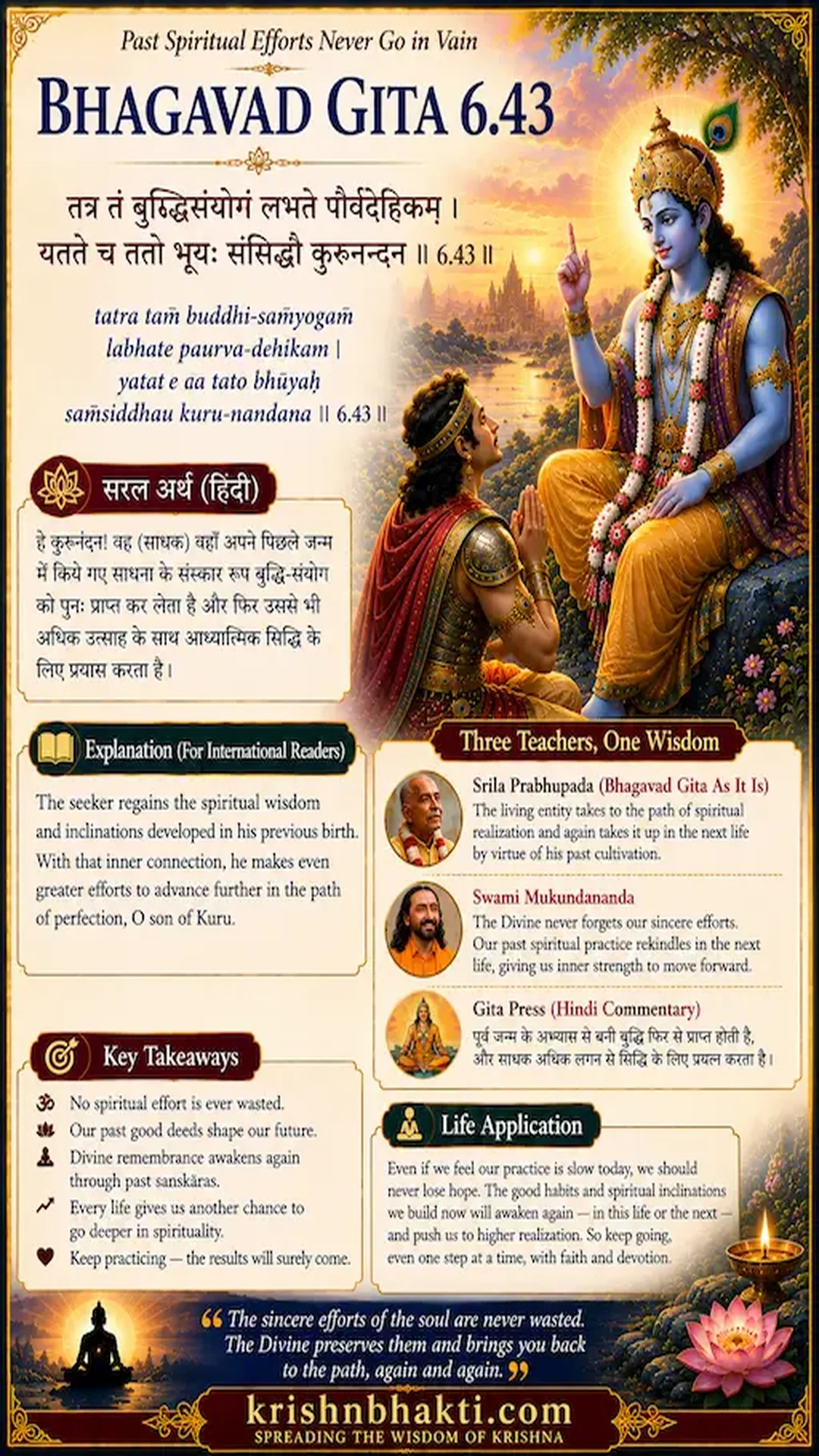
Are Your Spiritual Efforts Fading Away?
In the previous verses, we encountered Arjuna expressing a deep, relatable vulnerability. He asked Krishna, 'What happens to the seeker who begins the path of yoga but fails to reach the destination?' This is a question that haunts many of us in the 21st century. Whether we are students trying to build a career, young professionals dealing with burnout, or spiritual seekers trying to find meaning amidst the noise of social media, we are all terrified of 'failure.' We fear that if we start something and then get distracted by the pressures of life, all our efforts will have been in vain.
We often carry a misconception that spiritual progress is like a ladder—if you slip once, you fall back to the very bottom. This fear often prevents us from even starting. We think, 'If I start meditating today and tomorrow my mind wanders back to my office stress, I have failed.' We believe that unless we reach the peak of enlightenment in this very life, our struggle is useless. But Krishna, in His divine compassion, shifts this perspective entirely.
Imagine a bank account where every single deposit is locked and cannot be withdrawn by anyone. Krishna tells Arjuna—and by extension, all of us—that the spiritual capital you earn, even if it is just a moment of focused prayer or a single thought of surrender, is permanently stored in your soul. It is never lost. You are not starting from scratch; you are starting from experience.
In the modern world, where we are constantly measured by our outcomes—the salary we earn, the number of followers we have, the speed of our promotion—the idea that 'effort is its own reward' feels radical. But this is exactly what the Gita teaches. Your spiritual journey is not a race against others; it is a cumulative process of soul-awakening that spans lifetimes.
Have you ever felt that you are two different people? One who wants peace, silence, and connection with the Divine, and another who is pulled by the chaotic demands of relationships, career goals, and digital distractions? That tension is natural. It is the sign of a soul that is waking up. And Krishna, through this verse, promises that the part of you that reaches out to Him is safe, protected, and guided.
Let us dive into this profound verse to understand how we can release the burden of 'success and failure' and simply continue our journey with faith, knowing that we are always moving forward, even when we feel like we are standing still.
तत्र तं बुद्धिसंयोगं लभते पौर्वदेहिकम् । यतते च ततो भूयः संसिद्धौ कुरुनन्दन ॥ ६.४३ ॥
Simple Meaning: Krishna says, 'O son of the Kuru dynasty (Arjuna), in such a birth, the seeker regains the divine consciousness of their previous lives and begins to strive again for perfection—even more vigorously than before.' This means that your progress is cumulative. Your spiritual 'intelligence' (Buddhi-sanyogam) from previous efforts is waiting for you, and it naturally pulls you back toward the Divine when the conditions are right.
Key takeaways: 1. No spiritual effort is ever wasted. 2. You resume your journey exactly where you left off. 3. Your next attempt is backed by the momentum of your past. 4. Divine grace ensures that every soul ultimately reaches the destination.
The Wisdom of Swami Ramsukhdas Ji
Swami Ramsukhdas Ji emphasizes the word 'Buddhisanyogam.' He explains that this is the 'connection of intellect' with the Divine. It is not just knowledge; it is a 'sanskara' (impression) that has become part of your soul. He states that even if a seeker falls away due to worldly attachments, that soul's inclination toward the Truth remains intact.
He highlights the beautiful concept of 'Paurvadehikam'—that which belongs to previous bodies. Just as a child prodigy has an innate talent for music because of past life practice, a spiritual aspirant has an innate attraction to Krishna because of their past dedication. Swami Ji reminds us that God is the most loving parent; He does not let a single drop of devotion go to waste.
He says, "This is the beauty of the spiritual path. Even the mistakes you make are stepping stones. Because you have tried, you have learned what doesn't work. The soul remembers this lesson, and in the next phase, you will be wiser and more committed."
The Perspective of A.C. Bhaktivedanta Swami Prabhupada
Prabhupada explains this verse through the lens of Krishna Consciousness. He emphasizes that being in touch with Krishna is the highest form of success. He says that the Lord is so kind that He creates the perfect environment for the seeker to pick up their thread of devotion, even if they started late in life or were interrupted.
For Prabhupada, this verse is a shield against anxiety. He notes that we shouldn't worry about 'finishing' the journey in one lifetime. We should worry about being sincere in our present practice. He famously uses the analogy of a small plant—even if it is small, if it is watered, it will grow into a tree. Your devotion is that plant, and Krishna is the gardener who ensures it survives through the seasons.
He adds that the 'striving even more vigorously' (tato bhuyah) is a natural result of the internal growth. Once you get a taste of spiritual peace, your soul will never be satisfied with mundane distractions, which naturally pushes you to work harder for the ultimate goal.
Modern Wisdom from Swami Mukundananda Ji
Swami Mukundananda Ji uses the gym workout analogy to make this verse relatable to the modern youth. When you hit the gym for months, you develop muscle memory and endurance. Even if you take a week off, you don't lose that foundation. When you return, you regain your strength much faster than a beginner. Spiritual practice is exactly the same.
He explains that the 'Buddhisanyogam' is your mental muscle memory. When life throws problems at you, that spiritual intelligence kicks in. You might still get angry or stressed, but you catch yourself faster. That 'catching yourself' is the result of your previous spiritual practice.
He encourages us to stop viewing our spiritual life as a binary 'success or failure.' Instead, view it as a continuous improvement process. He points out that the modern anxiety of 'being left behind' is non-existent in the spiritual world, because the Divine is guiding you from within, ensuring you are always on the right track, even if the path seems crooked to your physical eyes.
Real-Life Application: The Loop of Growth
Consider a young professional, Rohan, who tries to meditate for 10 minutes every morning. For four days, he succeeds. On the fifth day, he oversleeps due to a late-night office project and skips his practice. He feels guilty and thinks, 'It’s useless, I keep failing.' But according to this verse, Rohan is not failing. He has built four days of 'sanskara.' His next attempt will be easier because his mind is now familiar with the practice.
Think about a student struggling with social media addiction. Every time they try to stay away and fail, they feel like a loser. Krishna is telling them, 'No, the very fact that you are trying to stay away shows your spiritual intellect is active.' They should not judge themselves by the failure but by the intention. The intention is the seed; it will sprout.
In a relationship, when you choose to listen instead of reacting in anger, that is a spiritual victory. Even if you reacted yesterday, the fact that you chose patience today is the 'Buddhisanyogam' at work. You are slowly transforming your personality, one conscious choice at a time.
Self Q&A
1. Is my struggle to focus a sign that I am not meant for this?
Swami Mukundananda Ji would say: 'Not at all! The struggle is the practice. If it were easy, it wouldn't be called yoga. The struggle proves you are actively engaging your mind, which is exactly what Krishna asks for.'
2. How can I be sure my effort is saved?
Prabhupada explains that Krishna is the Supersoul within your heart. He keeps a record of every sincere thought. Nothing in the spiritual realm is ever erased; it only accumulates.
3. Why do I feel like I'm moving backward sometimes?
Swami Ramsukhdas Ji explains that it is often a perception issue. Sometimes we need to go down to move up. The 'relapse' might be a lesson you needed to learn to understand the value of the path better.
4. What should I do when I feel like giving up?
Just show up. Even if you fail, show up the next day. As the verse says, 'regain the consciousness.' Just reconnecting is the victory.
5. How does this connect to my daily office stress?
It gives you perspective. When you know your inner growth is permanent, the temporary ups and downs of the office lose their power to define your self-worth. You become calmer, more composed, and eventually, more successful.
🙏 Hare Krishna — Jai Shri Krishna 🙏
📖 Also Read: What Happens If You Fail in Meditation? Krishna’s Answer Will Calm Your Soul 🙏