The previous verse told us that a mastered mind is your greatest friend and an unmastered mind is your greatest enemy. But a natural question follows — what does the life of someone with a mastered mind actually look like? What changes? What is different about them?
This verse is the answer. It is a portrait — a description of someone who has genuinely brought the mind under their own authority. And this portrait is remarkable. For this person, heat and cold are the same. Joy and sorrow are the same. Praise and insult are the same. Reading this, you might think — that sounds like a stone, not a person. But the truth is exactly the opposite. This is the most fully alive kind of human being.
This verse speaks directly to the person who is rattled by everything — upset when the weather changes, destabilized when someone says something cutting, anxious when things do not go as planned. Krishna is pointing to a state where none of that has the power to move you.
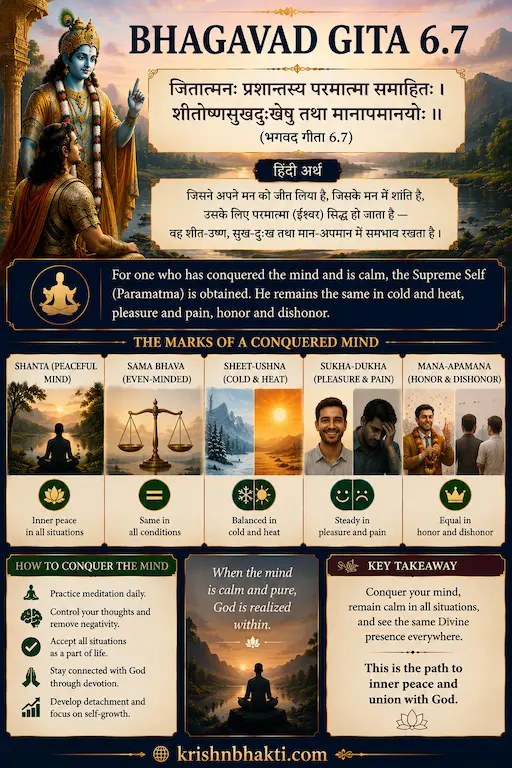
जितात्मनः प्रशान्तस्य परमात्मा समाहितः ।
शीतोष्णसुखदुःखेषु तथा मानापमानयोः ॥ ६.७ ॥
What Is Krishna Actually Saying?
Krishna says — for the one who has conquered the mind and who is completely at peace — the Supreme Self is always present, always accessible. In heat and cold, in joy and sorrow, in honor and dishonor — they remain equal.
Three pairs are given — sheeta-ushna, physical comfort and discomfort. Sukha-duhkha, mental joy and suffering. Mana-apmana, social honor and humiliation. In all three — the mastered mind remains steady. And for that steady person, God is always present.
Sadhak Sanjivani — Swami Ramsukhdas Ji
In Sadhak Sanjivani, Swami Ramsukhdas Ji explains that jitatma — one who has conquered the mind — and prashanta — one who is fully at peace — are interconnected. Conquering the mind brings peace. And that peace deepens the mastery further. Each feeds the other.
On sheeta-ushna — heat and cold — Swami Ji says this is not only about weather. It represents all physical discomfort and ease. The person with a mastered mind is not immune to physical experience — but physical experience does not destabilize them. They can remain inwardly steady even when the body is sick, tired, or in pain.
On mana-apmana — honor and dishonor — Swami Ji says this is the most common weakness of modern people. Praised — and you inflate. Criticized — and you deflate. This is the signature of an unmastered mind. The mastered mind is neither elevated by praise nor crushed by criticism. Both arrive and both pass — and the inner ground does not shift.
On paramatma samahitah — God always present — Swami Ji says this is the greatest reward. God is within everyone — but He is experienced only when the mind is still. Like the moon's reflection in water — it appears only when the water is undisturbed. The mastered mind is that undisturbed water.
Prabhupada — Bhagavad Gita As It Is
Srila Prabhupada, in Bhagavad Gita As It Is, says Krishna is making a vital point here — the experience of God requires a still and mastered mind. As long as the mind is turbulent — as long as it is pulled by attraction and repulsion, by praise and criticism — the inner space for God's presence cannot open.
On samahitah — constantly present — Prabhupada says this is a profound word. It means God is not present only during meditation for such a person. God is present while they work, while they speak, while they rest. The awareness of the divine does not leave them because nothing external pulls their attention away from it.
On the three pairs, Prabhupada says equanimity does not come from suppressing the senses — it comes from knowledge. When a person truly knows "I am not this body," physical experience loses its power to shake the soul. The body may feel heat or cold — but the one who knows they are not the body is not disturbed by it.
Swami Mukundananda Ji's Perspective
Swami Mukundananda Ji connects this verse to the social media age with striking clarity. He says — we are all caught in a strange game today. We post something, then check for responses. Someone praises — the mind lifts. Someone criticizes — the mind falls. This is the slavery of mana-apmana. And it is one of the most pervasive forms of mental imprisonment in the modern world.
He explains — the person with a mastered mind is not unmoved by praise because they are cold or indifferent. They are unmoved because they are already full. There is nothing missing inside that praise could add. And that fullness — that completeness that requires nothing from outside — is what genuine freedom feels like.
On paramatma samahitah, Swami Ji says — this is the greatest gift of a mastered mind. When the mind becomes still, something extraordinary begins to happen. A quiet presence is felt — a warmth, a fullness that is not dependent on circumstances. That is the experience of God. And it is available only to those whose minds have been brought to stillness.
What Does This Look Like in Real Life?
Think of a doctor who has not slept properly for three days — exhausted, physically drained — but still completely present with each patient. The body is tired but the mind has not collapsed. That steadiness through physical hardship is what sheeta-ushna samata looks like in an ordinary life.
Or someone who receives devastating news — a loved one seriously ill, a major loss. The grief is real. Maybe there are tears. But underneath the grief, there is a thread that does not break — a ground that holds. The sorrow is felt fully, and yet the person does not fall apart. That unbreakable thread is sukha-duhkha samata.
And for mana-apmana — think of someone who is publicly criticized in a meeting, in front of colleagues. They stay calm. They respond without defensiveness and without aggression. They make their point quietly and then let it go. By the time they get home, it is no longer carrying weight in the mind. That is what equanimity in honor and dishonor looks like when it is lived.
Questions That Probably Live in Your Heart
Does equanimity mean feeling nothing — switching off all emotions?
Not at all. Swami Mukundananda Ji says — equanimity does not mean the absence of emotion. It means emotions arise and pass without sweeping you away. Like a boat on water — the boat is on the water, but the water does not come into the boat. You feel everything, but nothing owns you.
Is it abnormal not to feel happy when praised?
Prabhupada says — actually, it is abnormal to need praise to feel okay. We are so dependent on external validation because we feel incomplete inside. When inner completeness grows through practice and devotion, the need for praise naturally reduces. That is not coldness — that is wholeness.
Does paramatma samahitah mean such a person is always in meditation?
Swami Ramsukhdas Ji says — no. It means God is present in every moment of their life — in work, in rest, in conversation. They do not need to sit with eyes closed to feel God. The awareness is continuous because nothing is pulling the mind strongly enough to break it.
Does this equanimity come suddenly or gradually?
Swami Mukundananda Ji says — gradually. First, the big things stop shaking you. Then the medium things. Then the small things. One day you notice that even things that used to bother you deeply no longer have the same grip. That is not indifference — that is the natural fruit of sustained practice.
What do 6.6 and 6.7 together teach?
6.6 said — a mastered mind is your greatest friend. 6.7 shows — what that friendship looks like in life. Heat and cold, joy and sorrow, praise and insult — none of them move you from your center. And at that center, God is always present. This is the greatest fruit of having won the mind.
The Mind You Control Becomes the Mind That Saves You 👇👇👇
🙏 Hare Krishna — Jai Shri Krishna 🙏