Are We Using God for Our Own Agenda?
In the previous verse, Lord Krishna described the four types of devotees who approach Him. Three of them—those seeking relief from distress, those seeking wealth, and those seeking knowledge—approach Him with some hidden expectation. Today, we delve into a verse that forces us to question the very nature of our relationship with the Divine. Is it a transaction, or is it pure, selfless love?
Most of us begin our day with a mental list of demands: 'O Lord, let my office meeting go well,' 'O Lord, please let my boss be happy,' 'O Lord, help me get this deal.' We see a picture of Krishna on social media, type 'Jai Shri Krishna,' and move on with our lives. But in the deep corners of our hearts, there is always a condition attached. We treat the Divine like a search engine or a problem-solving utility. We use God to get things done, and once the task is finished, He is often pushed back into the 'cupboard' of our minds.
Have you ever noticed that when life is smooth, we hardly remember God? But the moment a crisis hits, we rush to the temples. This transactional approach keeps us stagnant on the spiritual path. Krishna today is about to reveal a harsh but liberating truth: those who approach Him for material gains are devotees, yes, but they have not yet reached the pinnacle of the 'Jnani' (wise) status.
In today's fast-paced world, we are obsessed with results. Students want marks, professionals want promotions, and youngsters want perfect relationships. There is nothing wrong with wanting success, but if we define 'devotion' merely as a way to achieve these results, we are missing the point. Krishna wants us to stop asking for 'things' and start asking for 'Him.'
Many people think that devotion is all about asking. They argue, 'If I don't ask God, who will give it to me?' While God is the provider, staying at the level of a 'demanding child' prevents us from becoming the 'wise devotee' that Krishna cherishes the most. Do you know who that devotee is, and what they ask from Him?
Before we dive into this verse, take a deep breath. In this stressful world where everyone expects something from everyone, Krishna is offering you a relationship where there is no bargaining, only love. Let us explore the verse that defines the most beloved devotee.
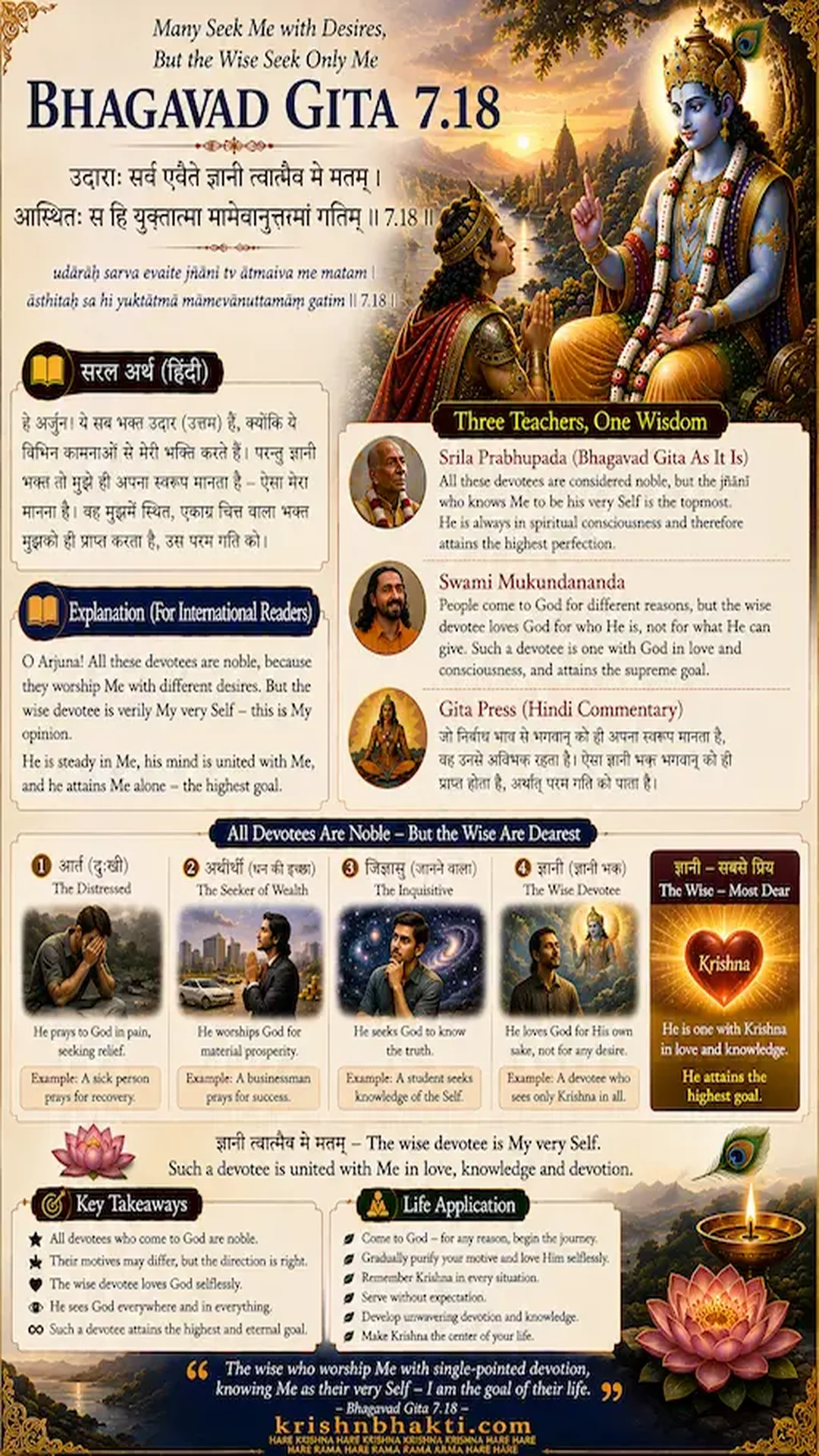
उदाराः सर्व एवैते ज्ञानी त्वात्मैव मे मतम् ।
आस्थितः स हि युक्तात्मा मामेवानुत्तमां गतिम् ॥ ७.१८ ॥
Simple Meaning:
Here, Krishna says: 'उदाराः सर्व एवैते' (Udaraḥ sarva evaite) — All these four types of devotees are undoubtedly noble because they have turned towards Me. 'ज्ञानी त्वात्मैव मे मतम्' (Jnani tvatmaiva me matam) — But the wise devotee (Jnani) is My very soul. 'आस्थितः स हि युक्तात्मा' (Asthitaḥ sa hi yuktātma) — That steadfast soul. 'माम् एव अनुत्तमां गतिम्' (Mam eva anuttaman gatim) — Having accepted Me as their only and supreme goal, they remain absorbed in My devotion.
The essence is that while God accepts everyone, the wise devotee is the closest to His heart. This 'Jnani' is the one who realizes that nothing in this world is worth asking for except Krishna Himself.
Swami Ramsukhdas Ji's Perspective
Swami Ramsukhdas Ji emphasizes that by saying 'Udaraḥ sarva evaite,' Krishna displays infinite compassion. Anyone who turns to God is not bad. However, by calling the 'Jnani' as 'Atmaiva' (My own self), Krishna reveals a deep secret. The wise person has realized that there is no difference between him and God. He is no longer seeking anything because he knows God is his very soul.
Swami Ji explains that the other three devotees approach God to fill a void. But the Jnani devotee approaches God in his fullness. If the ocean itself has come to you, would you beg for a drop of water in a spoon? No. That is the state of the Jnani. He has become one with the Divine essence.
In the words of Swami Ji, a 'Jnani' is someone whose ego of 'I' and 'mine' has dissolved. He sees that everything in this world is an expansion of God. Therefore, he does not ask for anything separately. In his vision, 'Mam eva' (only Me/Krishna) is everything.
Practically, this means we should change our prayers. Instead of saying, 'O Lord, grant me this comfort,' we should say, 'O Lord, keep me at your feet; I trust you to handle my needs.' This surrender is the hallmark of the wise.
Bhaktivedanta Swami Prabhupada's Insight
Prabhupada emphasizes the purity of 'Bhakti.' He explains that the other three devotees are motivated by material gains. However, the Jnani devotee is the one who considers Krishna the Supreme. For Prabhupada, Krishna-prema (love for Krishna) is the only destination.
He stresses that 'Jnani' does not just mean intellectual; it refers to one who has surrendered everything to Krishna. Prabhupada explains that 'Atmaiva' implies that the wise devotee sees no existence separate from Krishna. He lives in Krishna consciousness.
In the path of devotion, we often stumble because we feel we must 'conquer' the world. Prabhupada teaches that conquering the world is not the goal; conquering Krishna's heart is. When you attain Krishna, the world automatically comes to serve you.
Prabhupada's teachings boil down to practicing 'pure devotion.' Acting without demands, solely to please Krishna. When you perform your duties to please Krishna, you automatically become a 'Jnani,' because you realize who the Master is and who the servant is.
Swami Mukundananda Ji's Modern Application
Swami Mukundananda Ji explains this verse in a very practical way. He notes that today, we look for 'options.' We feel God is just one option—Plan B if Plan A fails. Swami Ji says the wise devotee is the one for whom God is the 'only' option.
He gives an analogy: a child does not go to the mother for toys; the child goes for the mother’s lap. But as the child grows, they start asking for toys. The Jnani devotee is like that innocent child who asks God only for God.
Swami Ji points out that the stress in modern life comes from our reliance on external factors like money, fame, and status. A 'Jnani' is someone who has made God the source of their happiness. Their stress vanishes because the Source never changes.
He advises the youth to perform their work (studies/office) with integrity, but keep the mind anchored in Krishna. This is what it means to be 'Yukt-atma.' Working while remaining connected to the Divine is a skill every young professional needs to cultivate.
Real-Life Scenarios
Consider Rahul, an IT professional. He works long hours and faces immense pressure. Initially, he was always anxious, blaming God for every failure. Then, he learned this verse. Now, he performs his work as service, considering Krishna the owner of the results. When his code fails, he doesn't panic. He learns and improves. His mind remains stable because he has made Krishna his 'goal,' not the boss’s review.
Take relationships: imagine you expect your partner to be the sole source of your happiness. When they fail to meet your expectations, you feel hurt. A 'Jnani' understands that no human can provide eternal happiness. You love them, but you are not dependent on them. Your happiness is rooted in your connection with the Divine.
In meditation, the same applies. If you sit to 'ask for peace,' the mind wanders. If you sit to 'attain Krishna,' the mind automatically settles down. This is the essence of Jnana-Bhakti.
On social media, we get sad comparing our lives with others. A 'Jnani' knows this is all 'Maya' (illusion). Their goal is Krishna's love, which doesn't increase or decrease based on likes or external validation. They remain joyful within.
Self Q&A
1. Is it a special problem that my mind doesn't stay on God?
No, it is a universal problem. Swami Ramsukhdas Ji says the mind’s nature is to wander. Don't label it a failure; just gently bring it back. God says the fact that you turned to Him is what matters.
2. How long does it take to become a 'Jnani'?
It is not about time; it is about the depth of feeling. Prabhupada says even one moment of total surrender can make you a Jnani. Just stop 'asking' and start 'giving' (loving).
3. Should I leave my job to become a Jnani?
Not at all. Swami Mukundananda Ji says your work is your service. Just change your attitude. Dedicating your work to Krishna is the highest form of devotion.
4. Should I stop asking God for my needs?
God knows your needs. You don't need to remind Him. Just seek Him, and He will take care of everything else.
5. I am currently distressed; can I become a Jnani?
Yes, absolutely. Krishna says 'Udaraḥ sarva evaite' (All are noble). Today you come as a distressed person, tomorrow you can be a Jnani. Just keep your devotion directed correctly.
🙏 Hare Krishna — Jai Shri Krishna 🙏
📖 Also Read: When Your Mind Won't Stop, the Gita Says Do This 🧘♂️