In life, we often find ourselves caught in a web of anxiety. Whether we are chasing a career goal, trying to save a relationship, or simply looking for peace of mind, we tend to look everywhere for support. Sometimes we pray to specific deities, sometimes we look for lucky signs, and sometimes we rely on our own ego-driven efforts. People often ask me: 'If I pray to other deities, does Krishna get upset? Am I doing something wrong?'
In the previous verse, Krishna spoke about how He steadies the faith of the devotee, no matter which form they choose to worship. But today, we are diving into verse 7.22, where Krishna addresses the 'results' of that faith. In this fast-paced modern world, we want instant gratification. We want our hard work to pay off immediately, and in that process, we often get lost in superficial rituals, forgetting the core truth of the universe.
A common misconception is that when we pray to a specific energy or deity, that entity is independent and self-sufficient in granting our desires. Many believe that these powers act on their own, separate from the Supreme Lord. Krishna shatters this illusion. He explains the cosmic hierarchy of authority, showing that while you may be approaching a departmental head, the 'budget' and the 'approval' come from the Supreme CEO.
Think of it like this: When you approach a government official, they process your request, but the power they hold is delegated by the central authority. Krishna is the source of all that power. This verse is incredibly relevant for the modern youth who feel overwhelmed by the need for quick results. Understanding this verse shifts your focus from 'Who can give me this?' to 'Where does all power originate?'
Krishna is not trying to restrict your devotion; He is trying to elevate your intelligence. He wants you to stop running from pillar to post and realize that all your aspirations are ultimately fulfilled by His arrangement. When you grasp this, your anxiety diminishes. You stop being a seeker of small favors and become a seeker of the ultimate truth.
Let us now contemplate this profound shloka, which acts as a bridge between our daily struggles and the divine order of the universe.
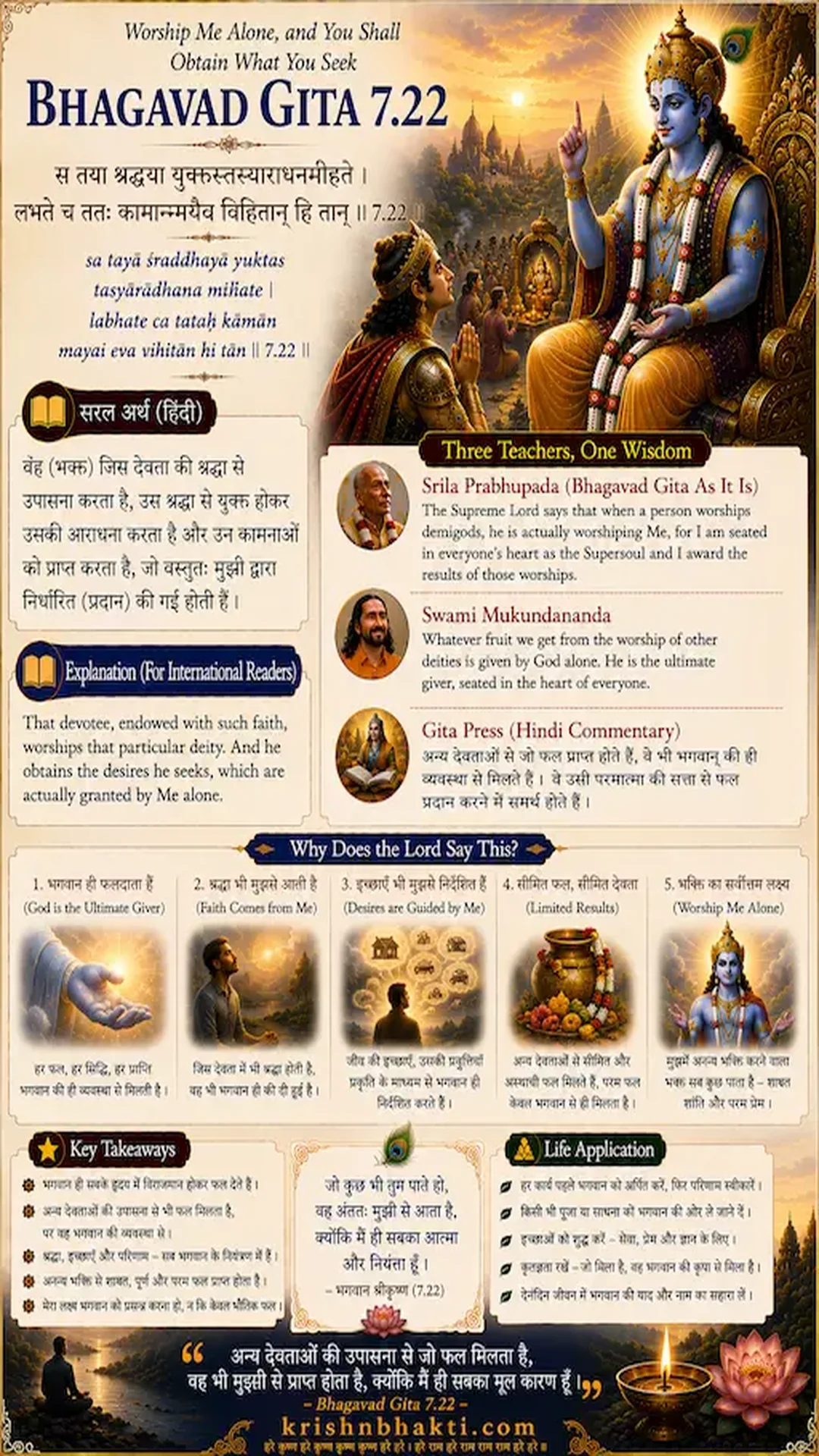
स तया श्रद्धया युक्तस्तस्याराधनमीहते ।
लभते च ततः कामान्मयैव विहितान्हि तान् ॥ ७.२२ ॥
Simple Meaning:
Krishna states: 'sa taya shraddhaya yuktah' — endowed with that faith, 'tasyaradhanamehate' — one worships that deity. 'labhate ca tatah kaman' — and from that deity, one obtains their desires. 'mayaiva vihitan hi tan' — but in reality, those benefits are ordained by Me alone.
The essence is simple: Your faith is the catalyst. The deity you worship acts as the agent. But the result—the fulfillment of your desire—is sanctioned by Krishna. He is the ultimate guarantor of all benefits, whether you approach Him directly or through intermediaries.
There are three key takeaways: First, the power of your faith is real. Second, deities play their role in the cosmic system. Third, Krishna remains the supreme benefactor behind every transaction in the universe.
Perspective from Sadhak Sanjivani by Swami Ramsukhdas Ji:
Swami Ramsukhdas Ji emphasizes the word 'mayaiva' (by Me alone). He explains that Krishna is not denying the role of the deities; He is clarifying the source of their power. He likens it to a manager who grants an employee a bonus using the company’s funds. The bonus is real, but it is provided by the owner's permission. Without the owner, the manager has no resources to distribute.
Swami Ji points out that it is the devotee's faith that prompts the Lord to release the desired result. He uses the term 'vihitan' to mean 'ordained or legislated by Me'. Krishna has created a cosmic law: if you put forth sincere effort and faith, the universe responds. That response is part of the system Krishna designed.
He stresses that there is no need to wander. If one goes directly to the source (Krishna), the benefit is not just the fulfillment of a worldly desire, but the attainment of divine grace, which is far more valuable than anything a lesser deity could offer.
Finally, Swami Ji notes that this verse matures our spiritual understanding. We stop getting trapped in external rituals and start looking at the One who controls the entire framework of our existence. The true target of all faith is Krishna.
Perspective from Bhagavad Gita As It Is by A.C. Bhaktivedanta Swami Prabhupada:
Prabhupada views this through the lens of pure bhakti. He describes those who worship other deities as 'lesser intelligent' because they desire immediate, transient fruits. Yet, he marvels at Krishna's mercy—even when a devotee approaches a deity, Krishna does not abandon them. He facilitates their desire, hoping that one day, they will realize He is the ultimate source.
He highlights Krishna as the 'Supreme Controller'. Even if someone acts out of ignorance, Krishna provides the fruit of their worship. He gives the beautiful analogy of a child asking someone else for a toy. If the father sees the child’s earnestness, he allows the other person to give the toy, but the father is the true provider. Krishna does the same for us.
His central message is that Krishna is the only enjoyer (bhokta). Whether you pray to a deity or to the Supreme, the result is granted by Krishna. Thus, a wise person skips the intermediaries and worships Krishna directly. This is the simplest and most direct path to transcendence.
Prabhupada stresses that this knowledge helps us purify our consciousness. When we know that Krishna is behind every positive turn in our life, our devotion naturally gravitates toward Him.
Perspective from Swami Mukundananda Ji:
Swami Mukundananda uses contemporary examples. He suggests viewing deities like 'departmental heads' in a large corporate firm. You might go to the Finance Department for your salary, but the funds are held by the Company. Krishna is the CEO and owner of this cosmic firm.
He explains that faith is a form of energy. When you worship with intense faith, you operate at a specific frequency. Krishna uses that faith as a filter. If your faith is unwavering, He coordinates the entire universe to ensure your work is successful. This is not magic; it is the science of divine management.
Mukundananda Ji says this verse gives us 'spiritual intelligence'. He asks, "Why go to the servant who is dependent on the Lord, when you can go directly to the King?" This logical approach is essential for today's youth, who value both logic and spirituality.
He mentions that even in meditation, this principle applies. When you focus your mind, you are activating the divine power within you, which is also a gift from Krishna. He teaches us how to purify our desires so that we can connect with Krishna effortlessly.
Real-Life Examples:
Imagine you are a student preparing for a major entrance exam. You study hard, but anxiety creeps in. You go to a shrine and pray for success. Krishna says that the peace you found or the clarity that helped you study was orchestrated by Him. Your faith served as the request, and He ensured the result was delivered.
Take the example of a corporate professional seeking a promotion. You put in your best efforts and perhaps pray to a divine power for guidance. You might think it is a result of that specific prayer. Krishna clarifies that your hard work and the resulting success are all part of His divine arrangement. He is the one allowing that promotion to manifest.
Consider meditation. You sit down to breathe, but your mind keeps wandering. You try to bring it back. Here, 'shraddha' (faith) is your anchor. If you have the faith that you can succeed, that faith is a manifestation of divine grace that Krishna provides to the seeker.
In relationships, we often feel helpless. We want things to change but don't know how. When you realize that everything is under Krishna's control, you stop being desperate. You do your part with love and surrender the result to Him.
On social media, we see others succeeding and feel left behind. This verse is a reminder that everyone’s journey, faith, and results are being managed by the same supreme source. Your comparison is futile because your life is being directed by the same divine hand.
Self-Q&A:
Question: Should I stop worshipping deities? Answer: Swami Ramsukhdas Ji says Krishna never forbids worship. He only reveals the truth. You can worship with faith, but acknowledge that the result-giver is Krishna.
Question: Why aren't my desires being fulfilled? Answer: Prabhupada explains that sometimes what we ask for is not good for us. Krishna, as the father, knows what we truly need. He gives what is 'vihitan'—what is appropriate and beneficial.
Question: Is God biased? Answer: Mukundananda Ji says God is like light. Your faith is the lens that focuses that light. The stronger your faith, the more concentrated the grace.
Question: Should I remember Krishna in everything? Answer: Yes, because He is the source of every outcome. When you make this a habit, the stress of life melts away.
Question: How to attain focus in meditation? Answer: Your faith that you are being watched and supported by Krishna will naturally stabilize your mind. View Him as your destination, and focus becomes effortless.
🙏 Hare Krishna — Jai Shri Krishna 🙏
📖 Also Read: When You Pray to Demigods, Who Actually Answers? Krishna Reveals All 🌸