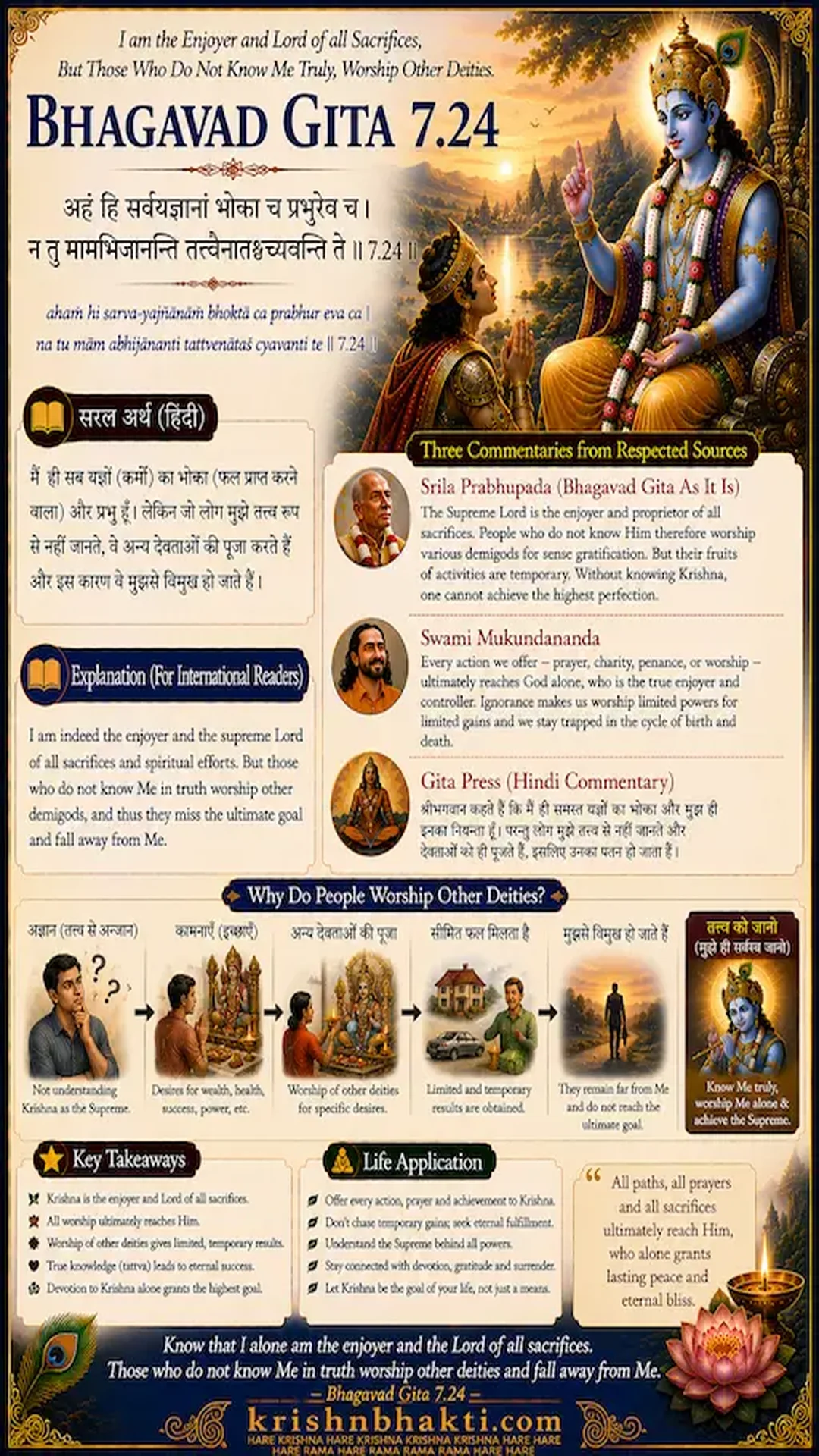
Is God Just an Energy? Putting an End to a Massive Misconception
In the previous verses, Krishna discussed those who worship celestial beings out of material desire. Today, we delve into 7.24, one of the most significant verses in the Bhagavad Gita. Here, Krishna addresses a grave subject that haunts every spiritual seeker in the modern age: the debate between the Formless (Nirakar) and the Personal (Sakar) God.
How often do we hear people say, 'God is just a formless energy; He doesn't have a specific form'? In our modern society, especially on social media, many claim that idol worship or focusing on a deity is a 'lower' form of spirituality. They believe that meditating on the formless void makes them more 'intellectual.' But is this truly the path to the Supreme?
Krishna clarifies in this verse that those who perceive Him only as an impersonal energy or a void fail to recognize His real, transcendental glory. They assume that He is an ordinary soul who has taken on a physical form, failing to realize His supreme, eternal, and divine nature. This is a failure of intelligence.
Think about it: at your office, people might judge you solely by your designation or your salary. But your family and true friends know you for your character, your love, and your unique personality. Those who see you only as a 'post' will never truly know you. Similarly, those who see God only as an abstract force miss the profound, personal connection that is available through His divine form.
This verse is crucial for the youth of today. We are constantly fed the idea that 'spiritual' means being detached from everything personal. But Krishna suggests that our attempt to limit God to a 'concept' or a 'force' is merely a result of our own limited intellect. Is God a machine, or is He a personal Friend who stands by you in your darkest hours? This is the core of today’s lesson.
अव्यक्तं व्यक्तिमापन्नं मन्यन्ते मामबुद्धयः ।
परं भावमजानन्तो ममाव्ययं अनुत्तमम् ॥ ७.२४ ॥
In this verse, Krishna states that those with poor intelligence consider Him to have been formless before, and now, having taken a human form, He has appeared in this world. He says they do not know His superior, eternal, and supreme nature.
Breakdown:
Avyaktam: That which is beyond the senses (the unmanifest).
Vyaktim Apannam: Having attained manifestation/form.
Manyante Mam Abuddhayah: The less intelligent think of Me as such.
Param Bhavam Ajanantah: Not knowing My supreme nature.
Mam Avyayam Anuttamam: My eternal and best status.
The essence here is that Krishna explains His divine form is eternally personal. He does not 'become' something else. He remains the Supreme Person, but He descends out of His own sweet will. Those who view Him as merely an impersonal light are unable to see the 'Param Bhavam'—the ocean of divine love that He possesses.
Swami Ramsukhdas Ji: Addressing the Illusion of the 'Unmanifest'
Swami Ramsukhdas Ji, in his 'Sadhak Sanjivani,' explains that the term 'Abuddhayah' (those with less intelligence) is used here specifically to address those who impose human limitations on the Divine. He explains that people tend to judge God through their own limited experiences. We grow, we change, and we transition from states of being. Humans wrongly assume God also transitions from a 'formless' state to a 'form' state.
Swamiji highlights that this is a fundamental lack of understanding. God’s nature is eternal and immutable. He does not undergo any process of change. His appearance in this world is a divine 'Lila' (pastime), not a material birth. Those who fail to grasp this mistake the Supreme Lord for an ordinary living entity.
He emphasizes that while the impersonal aspect of God exists, to deny the personal aspect is to deny the core of the relationship between the soul and the Divine. He notes that God’s 'Param Bhavam' is manifested fully in His divine personality, which is accessible to the devotee through love. Swamiji encourages seekers to transcend the debate and focus on the connection that allows one to experience the Divine fully.
A.C. Bhaktivedanta Swami Prabhupada: The Devotional Perspective
Prabhupada provides a very devotional lens, asserting that Krishna was never formless. He explains that the 'impersonal' aspect (the Brahman) is simply the effulgence radiating from Krishna’s body—much like the sunshine is the energy, but the Sun is the actual source. He warns that those who cannot accept the personal form of God remain trapped in the cycle of impersonalism.
Prabhupada often emphasized that God is a Person. He is not an abstract concept. He wants us to develop a personal relationship with Him. Those who consider His divine body to be material are failing to recognize His 'Sacchidananda' (eternal, blissful, and conscious) nature. He explains that the Lord appears by His own internal potency, known as 'Yogamaya.'
He frequently points out that this misunderstanding is rooted in pride. Without surrender, the human intellect, no matter how sharp, cannot penetrate the mystery of the Lord’s appearance. For Prabhupada, this verse is an invitation to move beyond the dry, intellectual debate and step into the vibrant, living experience of Krishna Consciousness.
Swami Mukundananda Ji: Bridging Ancient Wisdom and Modern Intellect
Swami Mukundananda Ji explains this verse through the analogy of the limited human bucket trying to measure the infinite ocean. He says that our intellect is limited. We try to categorize God into boxes—Formless vs. Form—because it makes us feel like we have 'solved' the mystery. But the Divine cannot be contained by our logic.
He points out that the modern youth often mistake 'complexity' for 'truth.' They think that because 'Formless' sounds more abstract, it must be the higher truth. Swamiji counters this by saying that love is always personal. You cannot love an 'energy.' You love a person. Our relationship with God is the same.
He suggests that we should stop trying to define God with our intellect and instead offer our intellect at His lotus feet. When we drop the ego that says, 'I know better than the scriptures,' we begin to see the Divine as He really is. He advocates for a practical approach: use your mind not to analyze God into nothingness, but to meditate on His beautiful form and pastimes, which have the power to transform the heart.
Real-Life Scenarios: Breaking the Cycle of Misconception
Imagine you are working in a multinational company. Your boss sets a policy. Some employees grumble, 'Why did he do this? He must not understand our struggle.' They only look at the policy and ignore the vision of the leader. They fail to see the person behind the decisions. If you want to succeed, you don't fight the policy; you understand the intent of the person who created it.
Similarly, when we face life's struggles, we often view God as a distant, uncaring 'energy.' We say, 'If God exists, why is this happening to me?' This view makes us feel isolated and resentful. But when we view Him as a personal Friend who is orchestrating our growth, every event becomes a 'Lila' (a divine play) that we are part of.
Even in meditation, this is key. When you sit to meditate, your mind might wander, asking, 'Am I meditating on the void? Am I doing this right?' You feel tired. But if you visualize Krishna, His smile, or His flute, your mind finds a natural resting place. This is the 'Param Bhavam'—the place where the soul truly feels at home. In relationships, too, stop focusing only on the faults of your partner and look for the inherent love. This is the same transition from 'intellectualizing' to 'loving' that Krishna is calling for.
Frequently Asked Questions (Q&A)
Q1: Is the formless aspect of God wrong?
Swami Ramsukhdas Ji clarifies that it is not 'wrong,' but it is incomplete. It is like seeing a fire from far away versus warming your hands by it. The personal form is more intimate and accessible for a devotee.
Q2: I don't see God's form in my meditation. What am I doing wrong?
Swami Mukundananda Ji says this is a process. Begin by having faith in His name and form. As your faith deepens, the curtain of the intellect will naturally lift. Do not rush the process.
Q3: Is it 'ignorant' to worship an idol?
According to Prabhupada, no. By His inconceivable potency, the Lord can manifest in a deity. For the Supreme, nothing is impossible, and He accepts the devotion offered through such forms.
Q4: Is God’s appearance a mere act/drama?
Swami Ramsukhdas Ji explains that it is not a 'drama' (acting), but a 'Lila' (divine play). Drama implies something false; Lila is the natural, joyful expression of the Divine.
Q5: How can I use my intelligence to understand God better?
Swami Mukundananda Ji suggests that true intelligence is not in analyzing God, but in recognizing Him. Use your intellect to study His wisdom and apply it to love Him, rather than to define Him within the bounds of your own ego.
🙏 Hare Krishna — Jai Shri Krishna 🙏
📖 Also Read: Worshiping Deities vs. Loving Krishna: What is the Real Difference? 🕉️