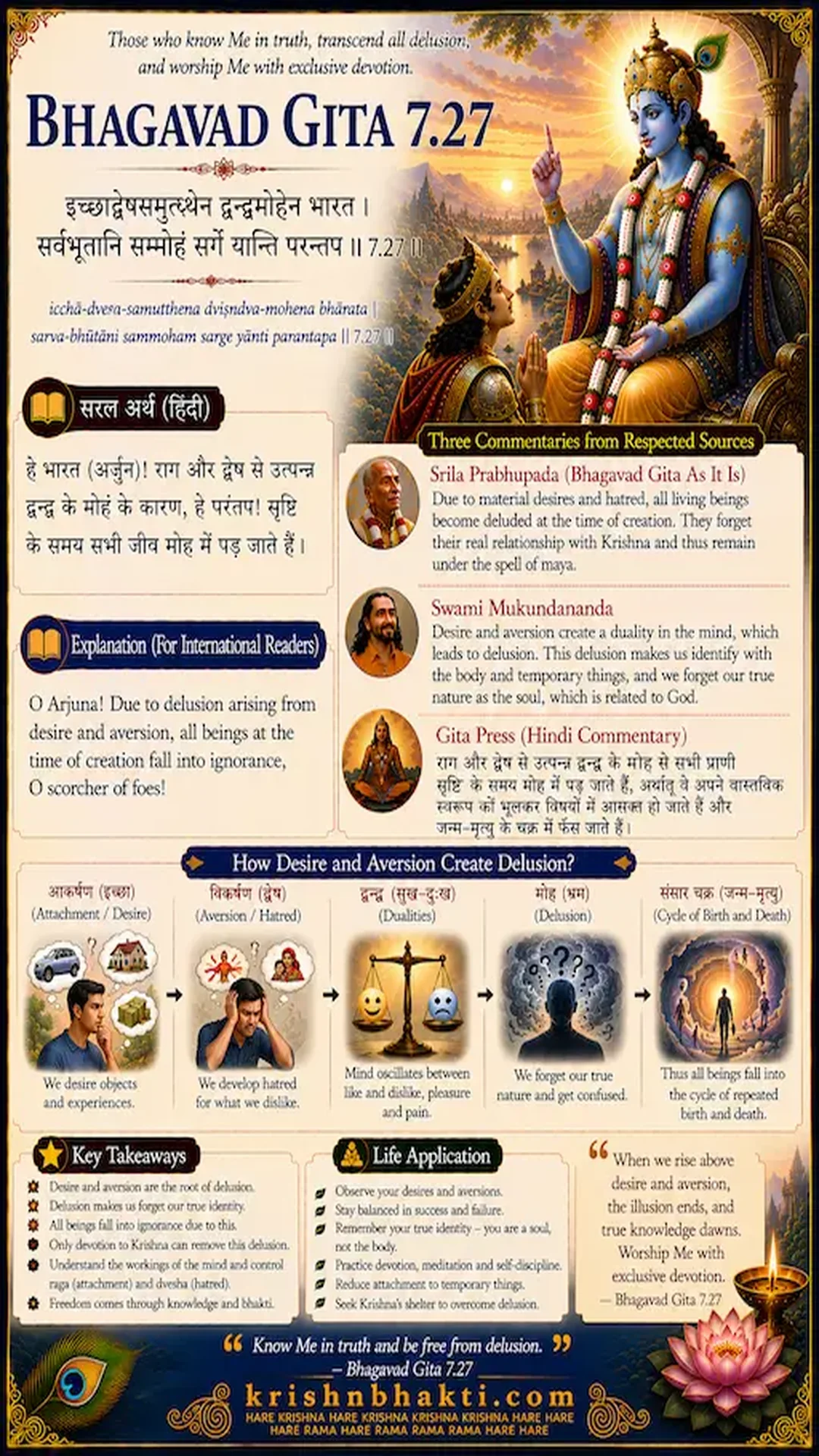
The Struggle of the Modern Mind
In the previous verse, Krishna spoke about His omniscience, noting that He knows all living beings, yet we remain in the dark, veiled by Maya. Today, in an era dominated by social media notifications, career anxiety, and complex relationship dynamics, we often feel lost. We constantly live in a state of 'if only'—if only I had that promotion, if only my partner understood me. These thoughts are the roots of our suffering.
Our mind is like a monkey fueled by the intoxicants of desire and hatred. One moment we are chasing a fleeting pleasure, and the next, we are consumed by bitterness toward someone who slighted us. You might wonder, "Is it truly possible to stop this mental chatter?" The truth is, spiritual practice isn't about forcefully shutting down the mind; it is about steering it toward a higher purpose.
When you are at work but your mind is replaying a past argument, or when you are scrolling through Instagram and feeling inferior, you are caught in the trap of 'Iccha' (desire) and 'Dvesha' (aversion). Krishna is here to teach us how to dismantle this trap. This isn't just ancient text; it is a survival manual for the modern human.
Many young professionals today struggle with burnout, not just because of workload, but because they are slaves to the results. We want validation, we want success, and we harbor resentment when things don't go our way. We are prisoners of our own expectations. Krishna’s message in this verse is a mirror—a reminder that we are not the first to struggle, but we can be the first to break free.
This verse is about understanding the dualities that shape our perception. Once we realize that these dualities are mere illusions, the weight of the world starts to lift. Let’s dive into this profound teaching and see how we can apply it to our daily lives.
॥ ७.२७ ॥
इच्छाद्वेषसमुत्थेन द्वन्द्वमोहेन भारत ।
सर्वभूतानि सम्मोहं सर्गे यान्ति परंतप ॥
Simple Meaning of the Shloka
Here, Lord Krishna says: Iccha-dvesha-samutthena — arising from desire and hatred. Dvandva-mohena — by the delusion of dualities. Bharata — O descendant of Bharata (Arjuna). Sarva-bhutani — all living beings. Sammoham — fall into illusion. Sarge yanti — become bewildered from the moment of birth.
Essentially, Krishna explains that as soon as we enter this material world, we are conditioned by the forces of attraction (desire) and repulsion (aversion). These dualities—happiness and distress, gain and loss, fame and infamy—keep us bound in an endless cycle of confusion. The key takeaway is that our distress stems not from the world itself, but from our internal reaction to it.
Krishna is warning us: as long as the mind oscillates between these two poles, peace will remain elusive. We must learn to transcend these dualities to find the truth.
Deep Insights from Three Perspectives
Swami Ramsukhdas Ji: Swami ji emphasizes that 'Desire and Aversion' are the seeds of material existence. He notes that as long as we claim something as 'mine' (desire) or label someone as 'evil' (aversion), we are living in delusion. He suggests that we must view these dualities as external to the self. He reminds us that the soul is beyond these pairs of opposites, and our task is to shift our identification from the body to the soul.
A.C. Bhaktivedanta Swami Prabhupada: Prabhupada approaches this with pure devotion. He explains that these dualities are a trap set by Maya to keep us away from Krishna. He argues that the only way to overcome these desires is to engage them in the service of the Lord. When desire is redirected toward Krishna, it becomes devotion. He teaches that surrender is the ultimate antidote to the confusion of the material world.
Swami Mukundananda Ji: Swamiji bridges the gap between modern psychology and ancient wisdom. He uses the analogy of a gym workout—you don't grow muscles by sitting still; you grow them by lifting weights repeatedly. Similarly, we develop 'detachment' by repeatedly observing our thoughts. When a feeling of hatred or intense desire arises, don't suppress it. Observe it, acknowledge it, and then gently release it. This process of returning to the present is the workout for the soul.
Real-Life Application
Imagine you are working on a project, and a colleague takes credit for your idea. Your immediate reaction is anger (Aversion). You spend the rest of the day plotting how to get back at them. Krishna says this reaction is the 'delusion.' If you pause, breathe, and realize that their behavior is a result of their own conditioning, you reclaim your peace.
Or consider the common meditation struggle: you sit down to meditate, and your mind wanders to a past regret or a future fear. You get annoyed that you aren't "perfect" at meditating (Desire). That annoyance is yet another form of delusion. The practice is to observe that the mind has wandered and calmly bring it back, over and over again.
Social media comparison is the biggest modern trap of 'Desire' and 'Aversion.' We desire the lifestyle we see online, and we feel an aversion toward our own reality. By applying the wisdom of this verse, we learn to appreciate our own path and stop measuring our lives by external, fleeting metrics.
In relationships, we often demand that our partners fit a mold we have created in our minds. When they don't, we suffer. Acceptance of the other person as they are, without the constant 'desire' for them to change, leads to harmony.
The path to freedom is realizing that you have the power to choose your reaction. When you stop reacting, you stop feeding the loop. You start to live with a sense of equanimity that is unaffected by the chaos around you.
Frequently Asked Questions
Q: Is it wrong to have any desires at all? Swami Ramsukhdas Ji explains that having desires isn't the problem; it's the *attachment* to the outcome that binds us. If you align your desires with the Divine will, they stop being a source of confusion.
Q: How do I deal with intense feelings of hatred? Swami Mukundananda Ji suggests 'witness consciousness.' Don't fight the feeling. Just watch it like a passing cloud. By not identifying with the emotion, you strip it of its power over you.
Q: Is the wandering mind a sign of failure? Prabhupada reminds us that the wandering mind is just part of our human conditioning. The success is in the *effort* to return to Krishna-consciousness, not in achieving instant perfection.
Q: Can I achieve this state while working in a corporate office? Absolutely. Equanimity is not about escaping the world; it is about maintaining a steady mind while living in it.
Q: How does this verse connect to the previous one? It explains *why* we fail to recognize the Divine in everything—because we are blinded by the dualities of our own making.
🙏 Hare Krishna — Jai Shri Krishna 🙏
📖 Also Read: Why Is God So Hard to Find? Krishna's Big Revelation 🚩