Ever Wondered How This Universe Actually Works?
In the previous chapter, we explored how Krishna guided Arjuna through the complexities of meditation. After learning how to tame the restless mind, Arjuna found a moment of stillness. But now, in the seventh chapter, Krishna introduces the 'Knowledge of the Absolute'. Often, in the chaos of modern life—juggling office deadlines, complex relationships, and the constant noise of social media—we find ourselves asking: Is all of this just a coincidence? Are we just random occurrences in a vast, indifferent universe?
There is a persistent misconception that science and spirituality are two opposing paths. We are often told that science explains the world through the Big Bang, while religion attributes it to a Creator. However, when we listen to Krishna's words in this verse, we realize that He described the fundamental building blocks of nature thousands of years before modern science caught up. It isn't a conflict; it is a profound synthesis.
Think about your daily routine. You wake up, check your notifications, worry about the upcoming meeting, deal with traffic, and struggle with societal expectations. In the middle of all this, we forget the underlying 'ground' upon which this entire reality sits. We treat the earth, water, fire, and air as mere resources to exploit, but Krishna invites us to see them as the divine expansion of His own energy.
This verse is specifically meant for those of us feeling lonely or overwhelmed in the 21st century. When you feel like nobody understands your pain, remember that the very air you breathe, the earth you walk upon, and the fire that fuels your metabolism are all manifestations of the same Divine energy. You can never be truly alone because you are intricately connected to the Source that created the cosmos.
Many young people believe that God is a distant entity living in the heavens, and spirituality means renouncing the world. Krishna clarifies here that this material world is His 'Apara Prakriti'—His lower nature. Everything you see, touch, and feel is an expression of Him. Understanding this mystery is the first step toward reducing anxiety. When you realize that the world operates within a divine blueprint, the heavy burden of trying to 'control' everything starts to fade away.
Let us dive deep into the wisdom Krishna provides. This isn't just a verse; it is the map of the universe that, when understood, changes how you perceive your own reality. It allows you to move through life with more grace, less attachment, and a deeper sense of connection to the world around you.
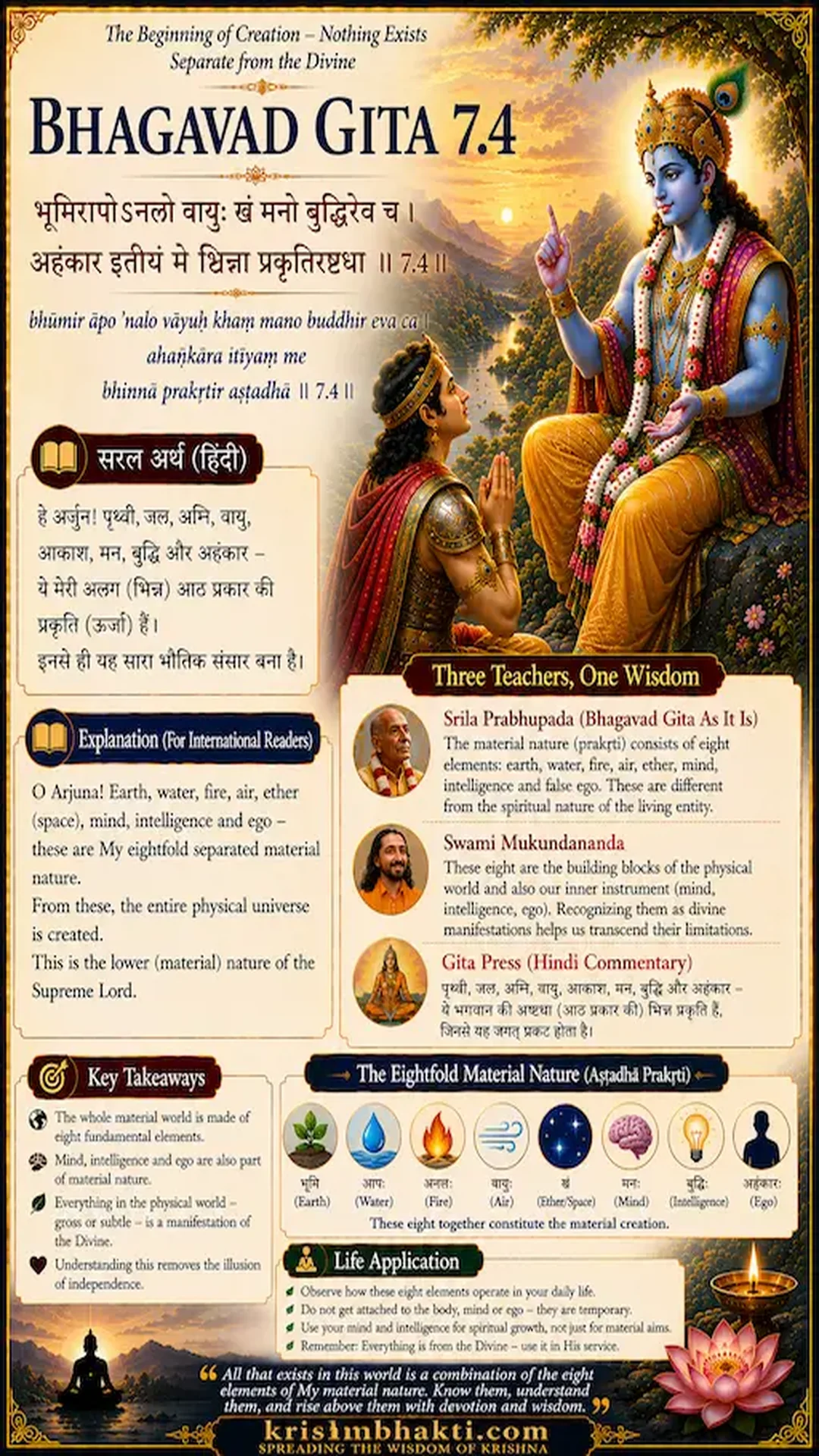
भूमिरापोऽनलो वायुः खं मनो बुद्धिरेव च।
अहङ्कार इतीयं मे भिन्ना प्रकृतिरष्टधा॥ ॥ ७.४ ॥
Simple Meaning: The Eight Elements of Nature
In this verse, Lord Krishna categorizes the material world into eight fundamental elements. He lists them as: Bhumi (Earth), Apah (Water), Anala (Fire), Vayu (Air), and Kham (Ether/Space). These are the five gross elements that constitute the physical world. Then, He lists the three subtle elements: Manah (Mind), Buddhi (Intelligence), and Ahamkarah (False Ego).
Krishna calls these eight His 'Apara Prakriti' or inferior material nature. In simple terms, everything you perceive—the world around you, your physical body, and even your thought processes—is composed of these eight elements. It is the raw material of the manifest world.
The crucial realization here is that Krishna calls these elements "My" (Me) nature. They are not separate from Him; they are His energy. We often claim things as "mine" in the world, but Krishna gently reminds us that everything essentially belongs to Him. Recognizing this shifts our perspective from possessiveness to stewardship.
Swami Ramsukhdas Ji’s Perspective
Swami Ramsukhdas Ji, in his commentary 'Sadhak Sanjivani', emphasizes the word 'Bhinna', which means 'separate'. He explains that while this nature appears separate from God, it is actually His energy. The illusion lies in our perception that we are the masters of these elements.
Swami Ji points out that we get trapped by these eight elements. We identify with our bodies, we become slaves to our emotions (the mind), and we become proud of our education (the intellect). He advises that we should use these elements to attain God, rather than using them to entangle ourselves further in the material world. He insists that this 'Ahamkara' or ego should be transformed into the realization of our servitude to the Divine.
A.C. Bhaktivedanta Swami Prabhupada’s Perspective
Swami Prabhupada interprets this verse through the lens of Krishna Consciousness. He explains that material nature is the servant of Krishna. Since we are spirit souls currently trapped within this nature, our natural position is to be a servant of Krishna as well.
Prabhupada stresses that we are eternally suffering because we try to enjoy these eight elements independently of their Owner. When we connect our mind, intelligence, and even our ego back to Krishna, we transcend the material nature. It is a gentle process of engagement—offering our thoughts and actions as service to the Lord.
Swami Mukundananda Ji’s Practical Wisdom
Swami Mukundananda uses the analogy of hardware and software to explain this verse. The five gross elements are the hardware of the body, while the mind, intelligence, and ego are the software that runs our lives. Modern problems, he argues, arise because our software is corrupt.
He says that meditation is like 'debugging' the code of our life. When the mind wanders, we bring it back. By constantly aligning our intellect with the wisdom of the Gita, we eventually reduce the influence of the 'False Ego'. He makes it relatable to the youth, comparing the practice of spiritual discipline to the discipline required in a gym or a professional career.
Real-Life Application
Imagine you are in an office meeting. A colleague criticizes your work. Your mind immediately reacts with anger, your intellect tries to formulate a sharp retort, and your ego feels attacked. If you practice the wisdom of this verse, you can pause for a second. You realize: 'This anger is just a chemical reaction in the mind, a part of the material nature. It is not me.' This detachment allows you to remain calm and professional, turning a potential conflict into an opportunity for growth.
In meditation, when you sit down and your mind wanders to social media notifications or past regrets, you are simply observing the 'Mind' element in action. Every time you bring your focus back, you are proving to yourself that you are the master of your mind, not its victim. You are the consciousness behind these elements.
Self Q&A
Q: Is it necessary to constantly think about these eight elements?
Swami Ramsukhdas Ji suggests that there is no need to memorize them. The goal is to develop the consciousness that everything is an energy of God, which naturally reduces our attachment to worldly things.
Q: How can I overcome the ego?
Swami Mukundananda suggests that we shouldn't try to 'kill' the ego but redirect it. Use your intelligence to offer your ego to Krishna. When you realize that all your talents come from Him, the false ego naturally dissolves into humility.
Q: Does this mean I should stop enjoying life?
Prabhupada clarifies that we don't need to give up things; we need to 'connect' them. Enjoyment is natural, but when you enjoy things as an offering to Krishna, that joy becomes spiritual and everlasting.
🙏 Hare Krishna — Jai Shri Krishna 🙏
📖 Also Read: Why is it so rare to truly know Krishna? The Truth Revealed 🕉️