The most devastating moments in life aren't the ones where we fail, but the ones where we simply stop moving because we are paralyzed by our own thoughts. In the previous verse, we saw Arjuna drop his bow, sink into his chariot, and lose his inner fire. He was overwhelmed by the complexity of his situation. This is not just an ancient story; this is the story of every young person today. Whether it is the pressure of a corporate career, the agony of a failing relationship, or the crushing weight of societal expectations, we all reach a point where we want to give up.
Most people assume that the Bhagavad Gita is a manual for the afterlife or a dense theological text. That is the biggest misconception. The second chapter of the Gita is a masterclass in psychological resilience. When Arjuna threw his weapons down, he wasn't just tired; he was experiencing a deep, existential crisis. Krishna didn't offer him a pat on the back; He offered him a mirror. He questioned Arjuna's very character, forcing him to look at his internal state with brutal honesty.
Have you ever been at the top of your game, only to suddenly feel like you can’t take one more step? Perhaps you have been working hard for years, but suddenly, the purpose seems to vanish. You look at your screen, your files, your life, and you think, 'What is the point of all this?' This mental fog, this sudden 'I can't do this anymore,' is exactly what the Sanskrit text refers to as 'Kashmalam'. It is the impurity of the mind, the clouding of our intelligence.
In our modern world, we are constantly bombarded with the highlight reels of others. We compare our internal struggles with their external successes, and we sink deeper into hopelessness. We think, 'If I leave this job, maybe I’ll be happy.' Or, 'If I just hide from these responsibilities, I’ll find peace.' Krishna exposes this for what it truly is—a retreat, a form of cowardice that brings neither peace nor progress. He tells Arjuna that this hesitation is 'Anarya'—not the conduct of a noble soul.
Why does this verse matter today? Because it teaches us that our emotions are not always the truth. Just because you feel like quitting, it doesn't mean quitting is the right path. Krishna challenges the validity of our 'sadness' when it becomes an excuse to abandon our Dharma. When you realize that your internal hesitation is a transient cloud, you gain the power to clear it away and move forward with renewed strength.
Think of this verse as a 'tough love' session from a mentor. Sometimes, we don't need a hug; we need a reality check. We need someone to tell us that we are better than our current weakness. This is exactly what Krishna does for Arjuna. He doesn't sugarcoat the situation. He demands excellence, focus, and adherence to duty, even when the heart is heavy.
Let us look at the verse where Krishna begins his instruction, breaking through the wall of Arjuna's sorrow with the sharp blade of truth.
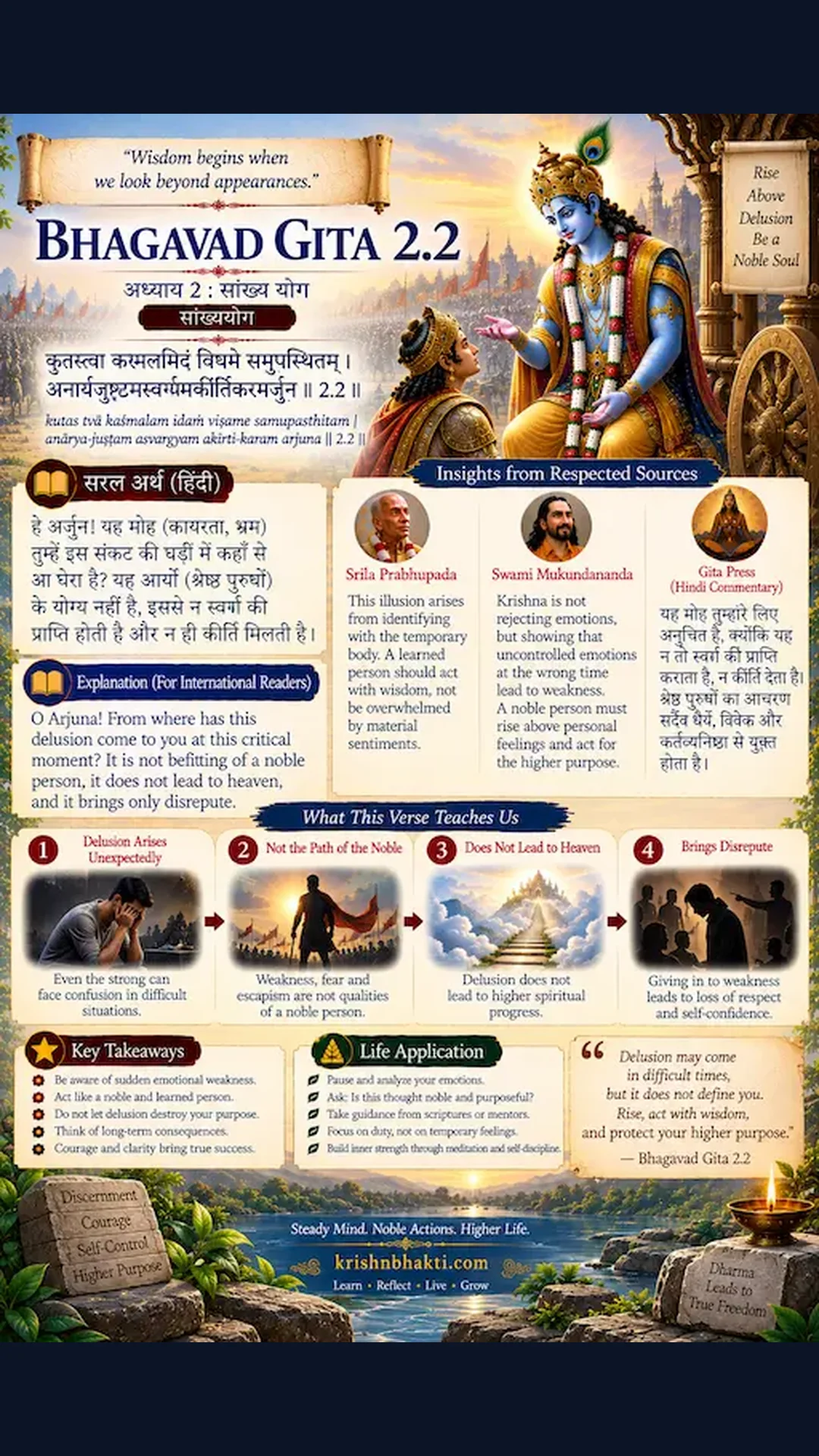
श्रीभगवानुवाच - कुतस्त्वा कश्मलमिदं विषमे समुपस्थितम् । अनार्यजुष्टमस्वर्ग्यमकीर्तिकरमर्जुन ॥ २.२ ॥
Simple Meaning: The Supreme Lord said: My dear Arjuna, how has this impurity (Kashmalam) come upon you? It is not at all befitting a person who knows the value of life. Such behavior leads not to higher planets (progress) but to infamy (disgrace).
Let’s break it down. 'Kutah' means from where? 'Kashmalam' is the mental filth, the confusion, the depression. 'Vishame' means in this time of crisis. Krishna is asking, 'Where did you get this?' He is emphasizing that this weakness is not your nature. It is an intruder. It is a foreign element that has temporarily occupied your mind. You must identify it as an outsider and evict it.
Swami Ramsukhdas Ji emphasizes the word 'Anarya'. He explains that an 'Arya' is someone who acts with character and wisdom. By calling Arjuna an 'Anarya', Krishna is wounding Arjuna's ego in the best way possible. He is reminding him of his lineage, his values, and his potential. Swami Ji teaches that this verse is a direct command to stop wallowing in self-pity and to start acting as a noble person should. It is about reclaiming one's dignity by doing what is right, regardless of how we feel inside.
A.C. Bhaktivedanta Swami Prabhupada views this through the lens of pure devotion. He explains that Arjuna’s confusion arises because he is viewing his duties through a material, bodily perspective. He is worried about his relatives as bodies, not as eternal souls. Prabhupada explains that Krishna Consciousness is the antidote to this 'Kashmalam'. When we realize we are acting in service to the Divine, the confusion of 'what will happen to me' dissolves, because we are no longer focused on our own gain, but on the pleasure of the Lord.
Swami Mukundananda Ji brings in a very practical, modern angle. He uses the analogy of a 'mental gym'. When we lift a heavy weight, our muscles tremble. That trembling isn't a sign to drop the weight; it’s a sign of growth. Similarly, when life brings a crisis ('Vishame'), our mind trembles. Mukundananda Ji explains that the 'Kashmalam' is simply the mind trying to protect us from discomfort. By understanding that this is just the mind's conditioning, we can consciously choose to push through the resistance and perform our duty.
Imagine you are a student preparing for a career-defining exam. You have been studying for months, but suddenly, the night before, you feel a panic attack coming on. You think, 'I'm not prepared, maybe I should just not go.' At that moment, you are standing in your own personal Kurukshetra. Applying this verse means recognizing that the panic is an 'impurity'—a thief of your potential—and saying, 'No, this fear is not me. I will show up, because that is my Dharma.'
Q: Is it wrong to feel sad or overwhelmed? Swami Ramsukhdas Ji clarifies that feeling emotion is natural, but letting those emotions dictate your abandonment of duty is what Krishna is criticizing. Q: How do I stop the 'Kashmalam' when it feels so real? Swami Mukundananda Ji suggests that we must catch the thought early, identify it as an external interference, and redirect our energy towards action. Q: Is this verse applicable even if I'm not a warrior? Yes, because every day you fight the battle of your own mind—against laziness, doubt, and fear.
🙏 Hare Krishna — Jai Shri Krishna 🙏
📖 Also Read: When Everything Falls Apart and You're Lost — How to Handle Life Like Arjuna? 🏹