In the rush of modern life, we often struggle with the guilt of selective spirituality. We go about our lives, chasing careers, managing relationships, and drowning in social media feeds, completely oblivious to the divine. But the moment a crisis hits—an unexpected job loss, a painful breakup, or a deep sense of existential loneliness—we suddenly look up to the sky and pray, 'Oh God, please help me.' Then, a whisper of guilt follows: 'Am I just a selfish person? Am I only using God like a service provider?'
In the previous verse, Krishna discussed those whose knowledge is stolen by illusion, those who ignore the divine altogether. Now, in verse 7.16, Krishna shifts the focus to those who are actually fortunate enough to turn toward Him. He classifies four types of people who approach Him. He doesn't judge them; instead, He calls them 'Sukritinah'—pious souls. This is a revolutionary perspective for any modern seeker feeling insecure about their spiritual maturity.
Many people believe that for your prayers to count, you must be a 'perfect' saint, someone who has renounced everything and lives in a state of eternal bliss. They think that approaching God with a laundry list of problems is immature or transactional. Krishna, however, opens the door wide for everyone. Whether you are crying in your room at 2 AM or searching for the deeper meaning of life, you are on the path of Bhakti.
The misconception here is that God is only interested in your 'enlightened' self. We think we need to dress up our prayers, be formal, and act pious. But Krishna is the Supreme Friend. A friend doesn't want you to pretend. If you are hurting, be honest about it. If you want material stability, be honest about it. This verse is an invitation to be raw, real, and authentic in your relationship with the Divine.
Imagine a young professional, stressed about a project, feeling like an impostor in their own office. They feel alone, and in a moment of vulnerability, they whisper, 'Krishna, I don't know what to do. Show me the way.' That, according to this verse, is not a sign of weakness. It is the beginning of a divine connection. It is the bridge between human anxiety and divine intelligence.
This verse matters because it removes the barrier of 'eligibility.' You don't have to be a scholar or a monk to connect with Krishna. You just have to be human. By acknowledging that even the suffering person is a 'pious soul,' Krishna is telling us that the very act of turning to Him is an act of virtue that sets us on a higher path.
Let’s dive into the Sanskrit wisdom and see why these four categories are the gateway to peace, regardless of the situation you find yourself in today.
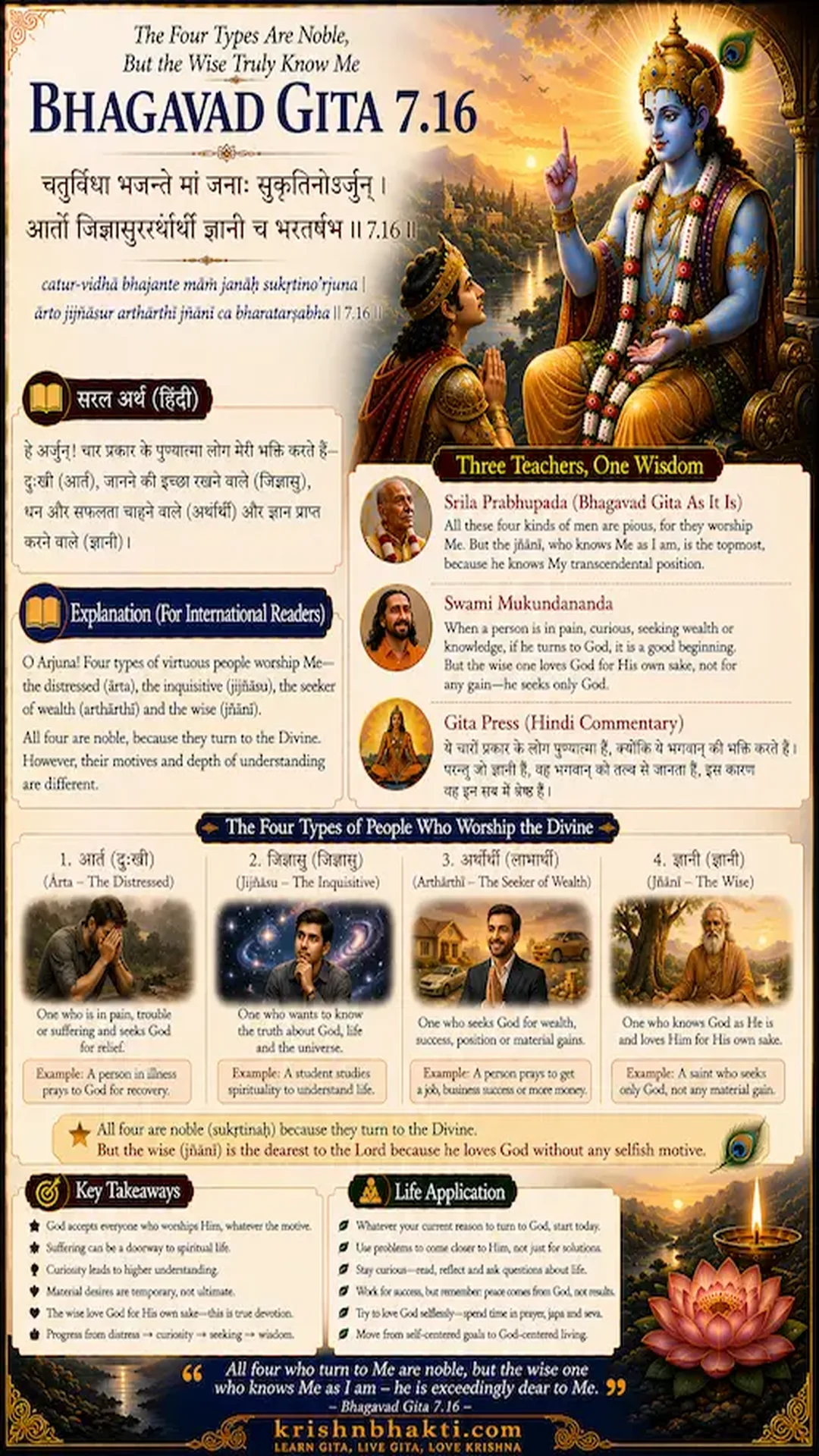
चतुर्विधा भजन्ते मां जनाः सुकृतिनोऽर्जुन । आर्तो जिज्ञासुरर्थार्थी ज्ञानी च भरतर्षभ ॥ ७.१६ ॥
Simple Meaning: O best among the Bharatas (Arjuna), four kinds of pious people render devotional service unto Me: the distressed (Arta), the one who desires knowledge (Jijnasu), the one who desires material gain (Artharthi), and the one who is wise (Jnani).
Breaking it down: 'Chatur-vidha' means four types. 'Bhajante' means to engage in devotional service or worship. 'Sukritinah' is the most beautiful word here—it means those who have performed pious activities. Even the person who approaches God out of distress is considered a 'pious soul' because they have finally turned their back on their ego and looked toward the Source. This is a massive shift in how we perceive our own struggles.
Swami Ramsukhdas Ji: Swami Ramsukhdas emphasizes the word 'Sukritinah'. He argues that the person in distress (Arta) is often the most sincere because their prayer is not intellectual; it is a desperate, heartfelt cry for help. He explains that God does not see your 'reason' for coming as much as He sees the 'act' of coming. Once you seek refuge in Him, the reason becomes secondary, and the relationship becomes primary. He suggests that whatever your situation, just keep the connection alive.
Bhagavad Gita As It Is by Srila Prabhupada: Prabhupada interprets this as the inclusivity of Krishna’s mercy. He teaches that even those who approach God for material gain are much better than those who don't approach Him at all. He explains that through the process of devotional service, even the material desire will be purified. It is not about 'giving up' your needs; it is about bringing your needs to the one who can actually fulfill them in the most sustainable way.
Swami Mukundananda Ji: Swami Mukundananda uses the analogy of a child. If a child cries for a toy, the mother doesn't reject the child; she gives the toy and gradually teaches the child to value something more meaningful. He points out that today’s youth are often 'Artharthi' (seeking success) and 'Arta' (seeking relief from stress). He encourages us to use this 'transactional' start as a stepping stone. Don't be afraid to ask, just make sure you are asking the One who can give you the ultimate peace.
Real-Life Examples: Think about your last week. When you felt overwhelmed by your workload, you might have felt a sense of panic. Turning that panic into a prayer—'Krishna, help me stay calm and do my best'—is an example of a spiritual 're-frame'. Or, perhaps you are trying to understand why things happen the way they do in your relationships; that curiosity about the 'why' of life is the 'Jijnasu' aspect. You aren't just living; you are seeking.
Q&A: 1. Is it selfish to ask for things? No, says Prabhupada; it is a start. 2. How do I move from 'Arta' to 'Jnani'? Through consistent practice. 3. Does God actually listen to my small, daily problems? Swami Ramsukhdas assures us that nothing is too small for the Divine. Keep talking to Him.
🙏 Hare Krishna — Jai Shri Krishna 🙏
📖 Also Read: Why Do People Ignore God? The Bitter Truth of the Gita 💔