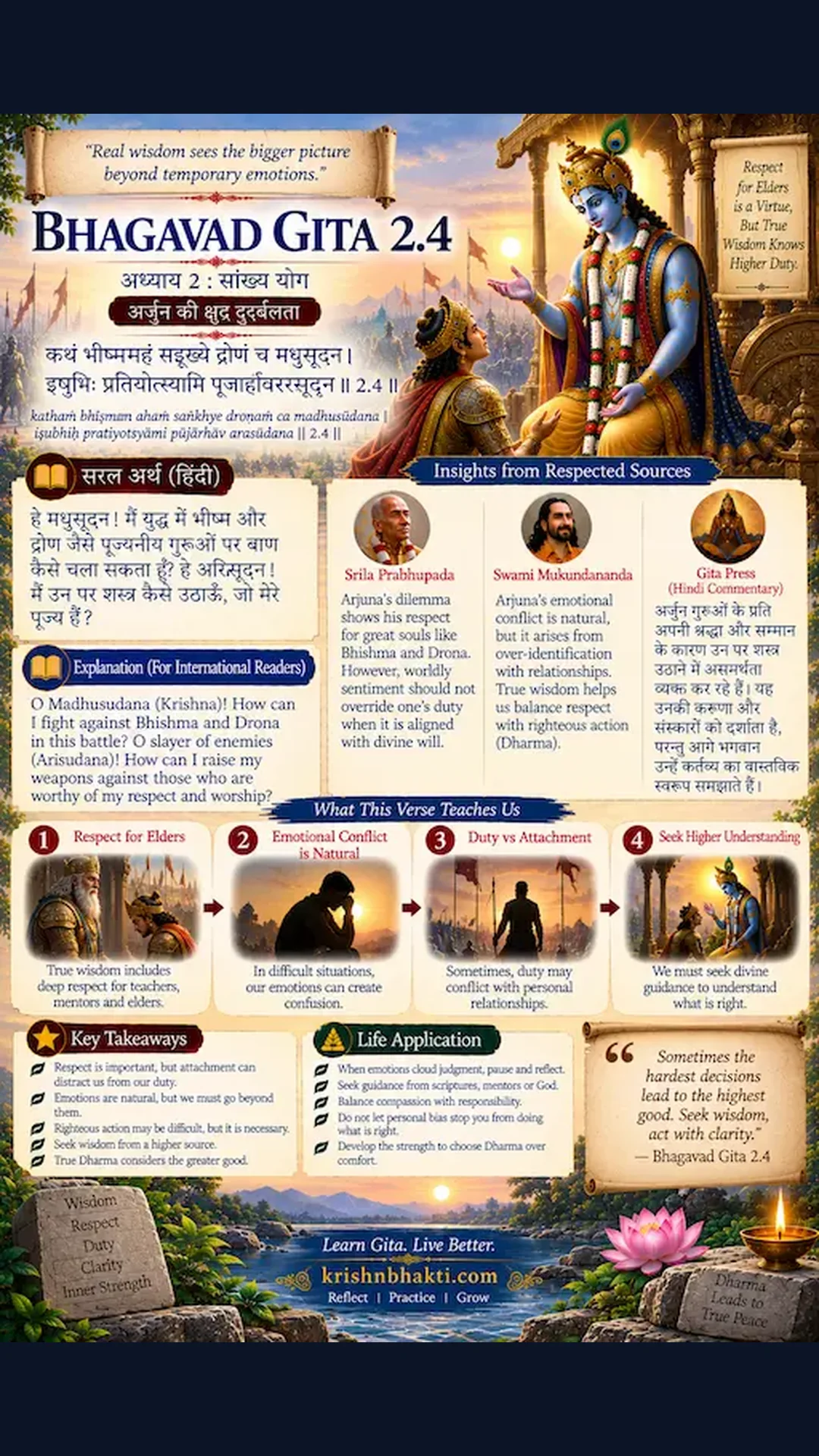
The Dilemma of Arjuna: A Mirror to Your Soul
In the preceding verses, we see Arjuna standing in the middle of the Kurukshetra battlefield. The conch shells have blown, the war has commenced, yet Arjuna has frozen. He drops his bow, Gandiva, not out of cowardice, but out of a profound existential crisis. He sees his elders, his teachers, and his beloved relatives on the opposing side. He questions, 'What is the point of a victory that is stained with the blood of those I love?' This is not merely a historical scene; it is the daily life of every young person navigating the complexities of the modern world.
We often perceive 'Dharma' as a religious ritual, but the Gita defines it as the science of making the 'right choice in a difficult situation'. Arjuna is caught in a web of emotions, societal conditioning, and moral duty. Have you ever been in a situation at your workplace where you knew your boss was wrong, yet you felt obligated to stay silent due to your respect for them? Or perhaps a situation where you had to choose between a toxic family dynamic and your own mental peace? This is your Kurukshetra.
Society often teaches us that 'emotions are weaknesses'. However, Krishna listens to Arjuna patiently. He allows Arjuna to voice his fears, his attachment, and his pain. This teaches us an important lesson: transformation starts with honesty. You cannot fix what you do not acknowledge. Arjuna is being vulnerable, and that vulnerability is the first step toward spiritual enlightenment.
Many people assume Arjuna is a superhero who should never be afraid. That is a misconception. True courage is not the absence of fear, but the ability to act despite it. Krishna smiles because he knows that Arjuna's confusion is the gateway to the highest wisdom. When you are confused, you are finally ready to learn. When your ego is shattered, your soul is ready to listen.
In this digital age, we mask our struggles behind filtered photos and status updates. But deep down, the same anxiety persists. We are terrified of being labeled 'bad' or 'selfish'. We fear losing our place in the eyes of others. Arjuna’s struggle is the voice of your suppressed conscience. It is the moment when you realize that following the crowd might be easy, but following the truth is the ultimate path.
Let us look at the verse where Arjuna pours out his heart. This is not just a dialogue between a warrior and a charioteer; it is a conversation between your trembling heart and the Divine sitting within you.
कथं भीष्ममहं संख्ये द्रोणं च मधुसूदन।
इषुभिः प्रतियोत्स्यामि पूजार्हावरिसूदन ॥ ६.२.४ ॥
Simple Meaning: Arjuna's Logical Trap
In this verse, Arjuna asks, 'How can I fight against Bhishma and Drona with arrows in this battle, O Madhusudana? They are worthy of my worship.' He uses the term 'Pujarhau' (worthy of worship) to justify his refusal to fight. He is essentially asking: 'How can I strike those to whom I owe my character and my skills?'
Breaking down the words: 'Katham' (How), 'Bhishmam' (Bhishma), 'Sankhye' (in battle), 'Dronam' (Drona), 'Pujarhau' (worthy of worship), 'Arisudana' (killer of enemies). Arjuna is stuck in a logical fallacy. He believes that respect for an individual demands the support of their actions. He fears that by fighting them, he will become a sinner, destroying his own honor.
The takeaway here is deep: 1. The clouding of judgment due to deep-seated attachments, 2. The struggle between moral duty and social conditioning, 3. The fear of being judged by society, and 4. The confusion regarding what truly constitutes 'violence' versus 'righteousness'.
Swami Ramsukhdas Ji's Perspective
Swami Ramsukhdas Ji emphasizes the term 'Pujarhau'. He explains that Arjuna is trying to trap Krishna in a moral conflict by reminding Him of the stature of his elders. Swami Ji explains that this is exactly what happens when a seeker confuses 'attachment' with 'duty'.
He points out that Arjuna's pain is real but his conclusion is flawed. Swami Ji asserts that when a person in a position of authority or a relative goes against Dharma, they lose the right to be protected by the very Dharma they are violating. It is a harsh truth, but one that requires the 'Viveka' (discriminative intelligence) to grasp.
Swami Ji suggests that we often compromise our conscience to keep others happy. He says this is not 'love'; it is 'attachment'. True love would be to help the other person realize their mistake, even if it hurts, rather than enabling them in their wrongdoings. This is the essence of true detachment.
Bhagavad Gita As It Is: A Bhakti Perspective
A.C. Bhaktivedanta Swami Prabhupada points out that Arjuna is a great devotee, which is why he constantly addresses Krishna with names like 'Madhusudana' (the destroyer of the Madhu demon). He is subtly suggesting that Krishna, who destroys demons, should not ask him to destroy his gurus.
Prabhupada explains that while Arjuna’s logic seems impeccable from a materialistic viewpoint, it is spiritually stagnant. He emphasizes that as long as we are identifying ourselves with our bodily relations, we will remain in this cycle of confusion. The moment we surrender our intelligence to Krishna, we transcend these worldly calculations.
Prabhupada teaches that Arjuna is currently operating on the platform of 'human emotion', not 'devotional surrender'. A devotee understands that when Krishna calls for action, the moral dilemmas of the material world are automatically resolved because one is acting in alignment with the Divine Will, not for personal comfort.
Swami Mukundananda Ji's Modern Application
Swami Mukundananda Ji explains this using modern psychology. He terms Arjuna’s state as 'Cognitive Dissonance'. We face this when our values clash with our emotional impulses. He uses the analogy of a workout; the pain of lifting weights is real, but it is necessary for building muscle. Similarly, the pain of standing up for the right thing is necessary for building character.
Swami Ji highlights that Arjuna is afraid of the 'label' that society will give him. He is obsessed with his self-image. Swami Mukundananda Ji teaches that spiritual progress requires the courage to detach from the need for social validation. You must be willing to be misunderstood if you are standing on the side of Dharma.
He further notes that Arjuna is failing to distinguish between the person and the action. You can hold respect for your teachers while vehemently opposing their immoral choices. This, according to Swami Ji, is the highest level of maturity—to act with love for the soul while firmly rejecting the wrong behavior.
Real-Life Application: From Meditation to Office
Imagine you are a young professional. Your mentor, whom you respect, asks you to present a report you know is falsified. Your heart races; you fear professional suicide. This is your 'Bhishma' moment. Do you prioritize the 'respect' you owe your mentor over the 'truth' you owe your profession? Arjuna felt this same terror.
In your relationships, perhaps you are in a situation where a partner is abusive, but you feel that you 'owe it to them' because of your shared history. This is not honoring the person; it is honoring your own attachment. The Gita teaches that the ultimate 'Puja' (worship) is to act in a way that preserves the integrity of the soul.
During meditation, you might struggle with recurring thoughts of people who hurt you. You feel you cannot let go because they were once 'worshipful' (important) to you. The lesson is to observe these thoughts like a witness, acknowledge their past value, but release them if they are harming your present peace.
Q&A: Addressing Your Doubts
1. Is it selfish to put my own moral integrity above others?
Swami Ramsukhdas Ji clarifies that protecting your moral integrity is actually the highest service to humanity. If you fall, you cannot help anyone else. It is not selfishness; it is the foundation of righteousness.
2. How do I cope with the guilt of letting my loved ones down?
Swami Mukundananda Ji suggests that the guilt is just a feeling, not a fact. You are not letting them down; you are upholding a higher standard that they may one day appreciate.
3. Is it possible to be 'spiritual' while being firm in the corporate world?
Prabhupada says that if you act for the satisfaction of the Divine, your firmness will not be harsh, but rooted in truth, which ultimately commands more respect.
4. How do I know if I am choosing 'Dharma' or just being stubborn?
Swami Mukundananda Ji advises checking your motives. If you are acting for ego, it is stubbornness. If you are acting for the truth despite your personal pain, it is Dharma.
5. Why does this conflict happen so often?
It happens because you are evolving. These 'Kurukshetras' are the gyms for your soul. Without them, you would never grow beyond your comfort zone.
🙏 Hare Krishna — Jai Shri Krishna 🙏
📖 Also Read: When You Feel Broken Inside, Remember Krishna's Tough Love 💔