There's a specific kind of exhaustion nobody talks about.
Not the tiredness that comes from working too hard. Not burnout in the way productivity culture defines it — too many tasks, too little rest.
This is something quieter. More disorienting.
It's the exhaustion of achieving exactly what you planned — and feeling nothing when you get there.
The promotion came. The relationship looked right on paper. The apartment was everything you said you wanted. And you stood in the middle of it all and felt — not happy, not grateful, not complete.
Just hollow.
And the worst part wasn't the hollowness. The worst part was not being able to explain it to anyone. Because from the outside, everything was fine. More than fine. So you smiled and said you were grateful and quietly wondered what was wrong with you.
Nothing is wrong with you.
But something is covered.
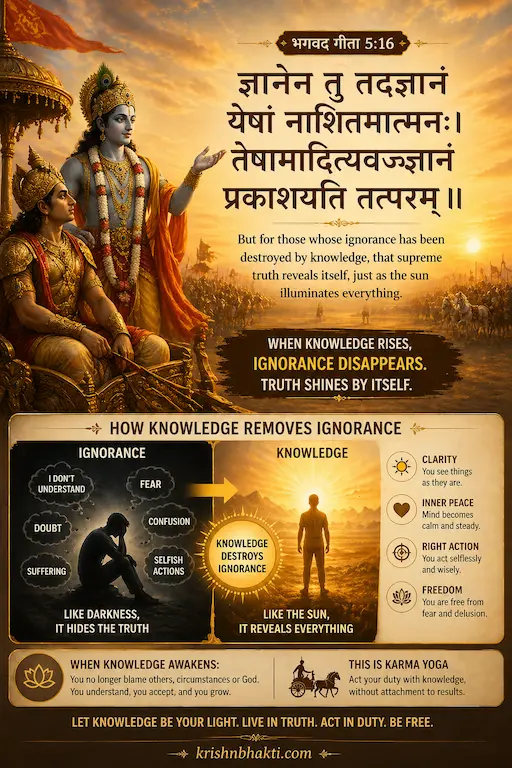
ज्ञानेन तु तदज्ञानं येषां नाशितमात्मनः।
तेषामादित्यवज्ज्ञानं प्रकाशयति तत्परम्॥
(Bhagavad Gita 5:16)
Krishna says — for those whose ignorance has been destroyed by self-knowledge, that knowledge illuminates the Supreme — like the sun.
One verse. But it contains the answer to a question most people spend their entire lives circling without ever directly asking.
Why does getting what I want not feel like enough?
The Gita's answer isn't psychological. It isn't philosophical in the abstract sense. It's precise — almost clinical.
Because what you're chasing is lit by the wrong light.
The Architecture of Darkness
Before the sun metaphor can land, you have to understand what darkness actually means here.
In 5:15, Krishna established that knowledge isn't absent in human beings — it's covered. By अज्ञान. By a layered, accumulated ignorance that isn't about lacking information but about a fundamental misidentification — mistaking the surface of yourself for the whole of yourself.
5:16 is the resolution of that problem. But to appreciate the resolution, you have to sit with the problem a little longer.
Think about how you make decisions.
Most of the time, the light you're using to navigate your life is borrowed. It comes from outside — from what your family valued, from what your culture rewards, from what your peer group defines as success. You've been using this borrowed light for so long that it feels like your own.
But borrowed light has a quality that's hard to name until you've experienced its opposite — it illuminates some things very clearly while casting everything else into shadow. It shows you the metrics. The milestones. The benchmarks. It tells you clearly when you've arrived at the destination it recognizes.
What it cannot show you is whether that destination was ever yours.
This is what Swami Mukundananda points to when he explains this verse — that अज्ञान doesn't just cloud judgment, it distorts the entire frame through which a person sees themselves and their life. You're not just making wrong choices — you're using a measuring stick that was never calibrated for your actual life.
And so you achieve. And it doesn't feel like enough. Not because you're ungrateful or broken — but because the light you used to get there couldn't illuminate what you were actually looking for.
The Great Exit — What It Actually Looks Like
We romanticize transformation.
We imagine it as a dramatic renunciation — the executive who walks away from everything, the artist who burns their old life down to build a new one. And sometimes it does look like that. But most of the time, the real exit is far quieter.
It happens in a conversation where someone challenges something you've believed for years — and instead of defending it, you pause. And in that pause, something loosens.
It happens when you're alone — genuinely alone, not just physically but mentally — and a question surfaces that you've been too busy to ask. Is this actually what I want? Or is this what I was supposed to want?
It happens when you fail at something you were certain you needed — and discover, in the wreckage, that you're still intact. That the thing you thought defined you didn't, actually. And that its absence has created a space where something more honest can breathe.
These are exits. Small ones. From borrowed identities, from inherited definitions of success, from the stories that अज्ञान uses to keep itself in place.
Prabhupada notes that the soul's return to clarity is rarely a single event — it is a gradual unmasking, each layer of ignorance dissolving as the light underneath grows stronger. The sun doesn't announce itself. It simply rises — and the darkness has no choice but to recede.
Success Without Clarity — The Specific Darkness Krishna Is Describing
There's a reason this verse comes after the previous two and not before them.
5:14 established that your nature — not God — is running your life.
5:15 established that your nature is stuck because अज्ञान has covered your knowledge.
5:16 now completes the arc — when that अज्ञान is destroyed, knowledge blazes like the sun.
The implication is precise — until that अज्ञान is destroyed, even success is a form of darkness.
Not metaphorical darkness. Experiential darkness.
Think about the highest achieving people you know — or know of. The ones who built exactly what they said they'd build. Many of them describe, at the peak of it, a profound disorientation. Not depression necessarily. Not failure. Just — a sense that the map they followed with such discipline led them somewhere, and they're standing in that somewhere, and they still don't know where they are.
This is success without clarity. This is what Krishna means.
The achievement is real. The effort was genuine. But the light that guided the whole journey was borrowed — calibrated by others, pointed at targets that were never interrogated, measuring a kind of arrival that had nothing to do with who you actually are.
And so arriving feels like continuing to be lost. Just in a better location.
What the Sun Actually Illuminates
The most important word in this verse is the last one — tat param. The Supreme. The ultimate.
Krishna isn't saying that when अज्ञान is destroyed, you get better at making decisions — though that's true. He isn't saying you'll have clearer goals — though that follows. He's saying your knowledge will illuminate tat param — the Supreme reality.
This sounds abstract. But its practical implication is concrete.
When the borrowed light is replaced by your own — when अज्ञान lifts — what you suddenly see clearly isn't just your next career move or the right relationship to be in. What you see is the nature of things. The actual shape of your life. What matters and what only seemed to matter. What you were actually built for versus what you were conditioned to pursue.
You see, as Gita Press describes it, the Supreme — the unchanging underneath the changing. The self that is prior to every role, every achievement, every failure, every opinion anyone has ever held about you.
And once you've seen that — even briefly, even partially — the borrowed light loses its grip. Not because you've rejected the world. But because you now have a reference point that the world cannot give and cannot take away.
This is what clarity actually is. Not having all the answers. Having a light that is genuinely yours — that illuminates what the borrowed light never could.
The Three Fires That Burn अज्ञान
The verse says अज्ञान is destroyed — nashitam. Not managed. Not reduced. Destroyed.
This is not a gentle process. But it also doesn't require grand gestures.
The first fire is honest self-observation. Not journaling as performance. Not self-reflection as another form of achievement. The raw, uncomfortable practice of watching yourself without immediately explaining yourself. When you react — why? When you avoid — what are you protecting? When you perform for a room that isn't watching — whose approval are you still seeking?
Most people never ask these questions at depth because the answers are genuinely uncomfortable. अज्ञान survives precisely in the space between what we do and what we're willing to examine about why we do it.
The second fire is repeated exposure to genuine knowledge. The Gita's emphasis on satsang — on the company of truth — is not religious sentiment. It's a recognition that the mind becomes what it is repeatedly exposed to. Borrowed light came from repeated exposure to borrowed ideas. Your own light develops through repeated contact with what is actually true — through scripture, through the rare honest conversation, through teachers who point inward instead of outward.
Each reading of the Gita that genuinely lands — not as information but as recognition — burns a little more अज्ञान. Not because the words are magic, but because truth, repeatedly encountered, does something to the layers covering it.
The third fire is action without the outcome as the anchor. This is what Chapter 5 has been building toward throughout. When you act and the result is not the point — when the doing is complete in itself — the ego that अज्ञान feeds begins to thin. Slowly. Unevenly. But genuinely.
Small acts of this kind — done consistently, without announcement — are the daily practice that the first two fires require to do their full work.
The Exit You're Actually Looking For
The title of this blog calls it The Great Exit.
But the exit isn't from your career, your relationships, your responsibilities. Most people who attempt that kind of exit discover they've brought everything they were trying to leave behind with them — because अज्ञान travels with the person, not with the location.
The exit is internal.
It's the moment — or the series of moments — when you stop navigating by borrowed light and start trusting your own.
It's quieter than it sounds. Less dramatic than the stories we tell about awakening. More like — one morning the anxiety you'd normalized is simply not there. One conversation where someone tries to destabilize you and you feel, not controlled calm, but genuine steadiness. One decision made without needing anyone to confirm it was right.
That's the sun rising.
Not with announcement. Not with fanfare.
Just light — where there was covering before.
And once it rises — even partially — you understand something about every achievement you pursued in the dark.
It wasn't wrong to want those things.
You just couldn't see clearly what they were — or what you were — while you were chasing them.
Now you can.
And that changes everything.
🇬🇧 ENGLISH SEO
English Slug:
the-great-exit-success-without-clarity-bhagavad-gita-5-16
Blog Title EN:
The Great Exit: Why Success Without Clarity Feels Like Darkness
Meta Title EN:
Why Success Without Clarity Feels Like Darkness | Bhagavad Gita 5:16 | Gita Blog
Short Desc EN:
You achieved everything you planned — and it still felt hollow. Bhagavad Gita 5:16 explains exactly why. When ignorance covers your inner knowledge, even success is a form of darkness. Here's what changes when the light finally rises.
Keywords EN:
Bhagavad Gita 5:16, success without clarity Gita, self-knowledge Bhagavad Gita, aatmgyan meaning, ignorance destroyed Gita, tat param Bhagavad Gita, why does success feel empty, Gita for youth, Chapter 5 Bhagavad Gita English, knowledge like the sun Gita, ajnana nashitam meaning, inner clarity Gita
Common Tags EN:
Bhagavad Gita, Gita Shloka, English Blog, Self-Knowledge, Ignorance, Karma Yoga, Youth and Gita, Chapter 5, Life Philosophy, Krishna's Teaching, Clarity, True Self
Meta Description EN:
Bhagavad Gita 5:16 reveals that when ignorance is destroyed by self-knowledge, wisdom blazes like the sun illuminating the Supreme. Discover why success without inner clarity always feels like darkness — and what the real exit looks like.
To read
Unmasking the Ego: The 3 Layers of Ignorance Blocking Your True Self | Gita 5:15 ..👇👇
https://krishnbhakti.com/english-blogs/gita-shloka-5-15-unmasking-the-ego-3-layers-of-ignorance