Ask yourself honestly —
When was the last time someone criticized your work — and your entire day collapsed?
When was the last time one failure sent you into a spiral that lasted weeks?
When was the last time someone else's success triggered something uncomfortable inside you?
These reactions feel normal. The world around us treats them as normal. But here's the question —
Is this "normal" what winning actually looks like? Or is real victory something else entirely?
Dr. APJ Abdul Kalam — the man who grew up in a modest household in Rameswaram, who faced rejection after rejection, who watched his rocket explode on a launch pad — never broke. He kept building. He kept showing up. And eventually, he didn't just succeed. He became the architect of modern India's space and missile program, and later, the President of a billion-people nation.
Why didn't he break?
Because his mind was what the Gita calls "sāmye sthitam" — established in equanimity. Success and failure moved around him. His inner ground stayed still.
This wasn't luck. This wasn't personality. This was a mindset — the exact mindset that Bhagavad Gita 5:19 describes.
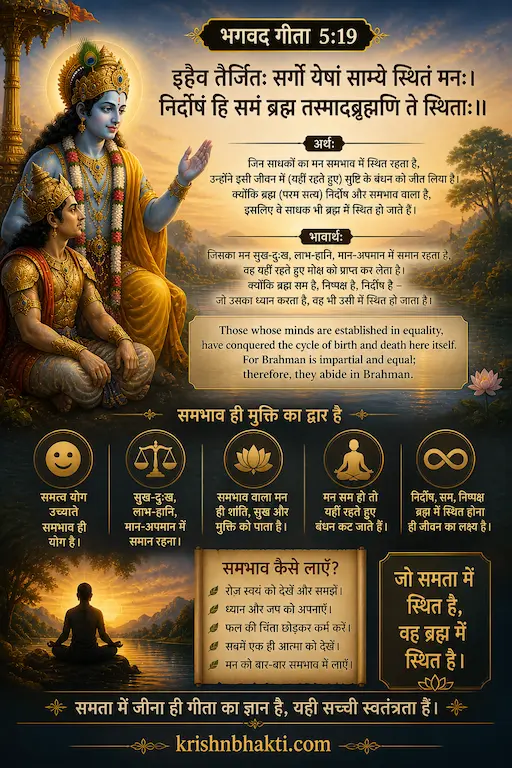
इहैव तैर्जितः सर्गो येषां साम्ये स्थितं मनः।
निर्दोषं हि समं ब्रह्म तस्माद्ब्रह्मणि ते स्थिताः॥
— Bhagavad Gita, Chapter 5, Verse 19
Breaking Down the Verse — Word by Word
"Ihaiva" — right here. In this very life. Not after death, not in some future state. Now.
"Tair-jitaḥ sargaḥ" — by them, creation is conquered. The entire world of experience — overcome. But notice: this is an inner conquest, not an external one.
"Yeṣāṁ sāmye sthitaṁ manaḥ" — those whose minds are established in equanimity. Sāmya — evenness. The same mind in pleasure and pain, victory and defeat, praise and criticism.
"Nirdoṣaṁ hi samaṁ brahma" — Brahman is flawless and equal. The nature of the Supreme itself is perfect equanimity.
"Tasmād brahmaṇi te sthitāḥ" — therefore they are established in Brahman. The equal mind is the closest thing to the divine nature there is.
Dr. Kalam — The Man Who Conquered "Sarga"
In 1979, India's first SLV rocket launch failed.
Kalam watched it happen. He felt what any scientist feels when years of work disintegrate in seconds.
Then he stood before the press and said — "This is my responsibility. The team is not at fault."
No blame. No collapse. No retreat.
One year later, in 1980, SLV-3 launched successfully. India entered the space age.
That is "sāmye sthitaṁ manaḥ" in action.
The failure didn't break him because his identity wasn't built on outcomes. The success didn't inflate him because his mind wasn't riding on results. He remained the same man — steady, curious, devoted to the work — whether the rocket fell or flew.
This is what the Gita means by "ihaiva jitaḥ" — conquered, right here, in this lifetime.
The Question That Needs Answering — Does Equanimity Mean Not Caring?
Absolutely not. And this is the most important distinction in the entire verse.
Srila Prabhupada, in Bhagavad Gita As It Is, emphasizes that "ihaiva" — in this very life — is the key phrase. This victory is not posthumous. It is available now, to anyone whose mind learns to rest in equanimity. And this equanimity is not weakness. It is the highest form of strength. The person who remains the same in joy and sorrow, gain and loss — that person cannot be broken by any circumstance the world presents.
Swami Mukundananda draws a crucial distinction: equanimity is not indifference. An indifferent person doesn't care about anything — neither winning nor losing. The person established in sāmya cares deeply. They work with full intensity. They want to succeed. But the result does not shake their foundation. They are fully engaged and completely unattached at the same time. That combination — total effort, zero dependence on outcome — is what produces extraordinary results.
Gita Press in its commentary focuses on "nirdoṣaṁ hi samaṁ brahma" — Brahman itself is equal and flawless. This is not just psychology. This is metaphysics. The person who cultivates equanimity is aligning themselves with the deepest nature of reality. They are not just becoming mentally healthier — they are becoming spiritually closer to the Supreme.
Let Me Ask Something Directly — Does This Mindset Actually Work in a Competitive World?
Not just work — it is the only thing that works at the highest level.
The greatest performers across every field share one quality that has nothing to do with talent or luck. It is the ability to stay present and steady regardless of what the scoreboard says.
A surgeon who panics when something goes wrong in the operating room is dangerous. A surgeon who stays calm, assesses clearly, and acts precisely — that surgeon saves lives.
An entrepreneur who collapses after every rejection never builds anything lasting. An entrepreneur who treats rejection as information and keeps moving — that person eventually builds something the world didn't know it needed.
Kalam was rejected for the Indian Air Force pilot selection. He did not get in. That rejection sent him in a different direction — and that different direction is why India has a space program.
The equal mind doesn't just survive setbacks. It uses them.
"Conquering Sarga" — What Does That Actually Mean?
This is the most radical promise in the verse.
"Sarga" means creation — the entire world of experience. And "jitaḥ sargaḥ" means that world is conquered.
But this is not conquest through domination. It is conquest through transcendence.
When someone praises you — and your mind stays level.
When someone criticizes you — and your mind stays level.
When success arrives — and you don't inflate.
When failure arrives — and you don't collapse.
That is conquering sarga.
Not because circumstances stopped mattering. But because circumstances stopped having the power to define your inner state.
And the Gita says this victory is available right now — in this life, in this body, starting from this moment.
Three Ways to Build the Winner's Mindset — From Gita 5:19
1. Separate the event from your response.
Prabhupada's commentary points to this: between any event and your reaction, there is a moment of choice. Training yourself to find that moment — and to choose a response rather than simply react — is where equanimity begins. Ask in that moment: "Is this reaction moving me forward or backward?"
2. Make both success and failure your teachers.
Swami Mukundananda emphasizes this consistently: when success comes, ask "What did I learn?" When failure comes, ask the same question. The same question, every time. This single habit slowly stops the mind from riding the wave of outcomes — because every outcome becomes a source of information rather than a verdict on your worth.
3. Connect daily to the source of equanimity.
Gita Press reminds us that Brahman itself is "nirdoṣaṁ samaṁ" — flawless equanimity. The daily practice of connecting to that source — through prayer, meditation, scripture, or simple stillness — gradually transfers that quality into the practitioner. You begin to take on the nature of what you regularly touch.
The Real Win Has Always Been Inside
The world defines winning one way — rank, revenue, recognition.
The Gita defines a different kind of winning — inner stability that no external event can take away.
Kalam had that stability. That is why failure couldn't stop him. That is why success didn't change him. That is why, wherever he went, people felt something different in his presence — a steadiness that had nothing to do with his title or his achievements.
Krishna is saying — this is available to you.
In this very life. In this very body. Starting right now.
When the mind is established in equanimity — creation is already conquered. Because nothing outside you can shake what is settled inside you.
That is the winner's mindset. That is what Gita 5:19 is pointing to.
To read
One Soul, Many Forms: Mastery of the Equal Eye
https://krishnbhakti.com/english-blogs/gita-shloka-5-18-one-soul-many-forms-equal-vision